

Forrest tests market’s faith



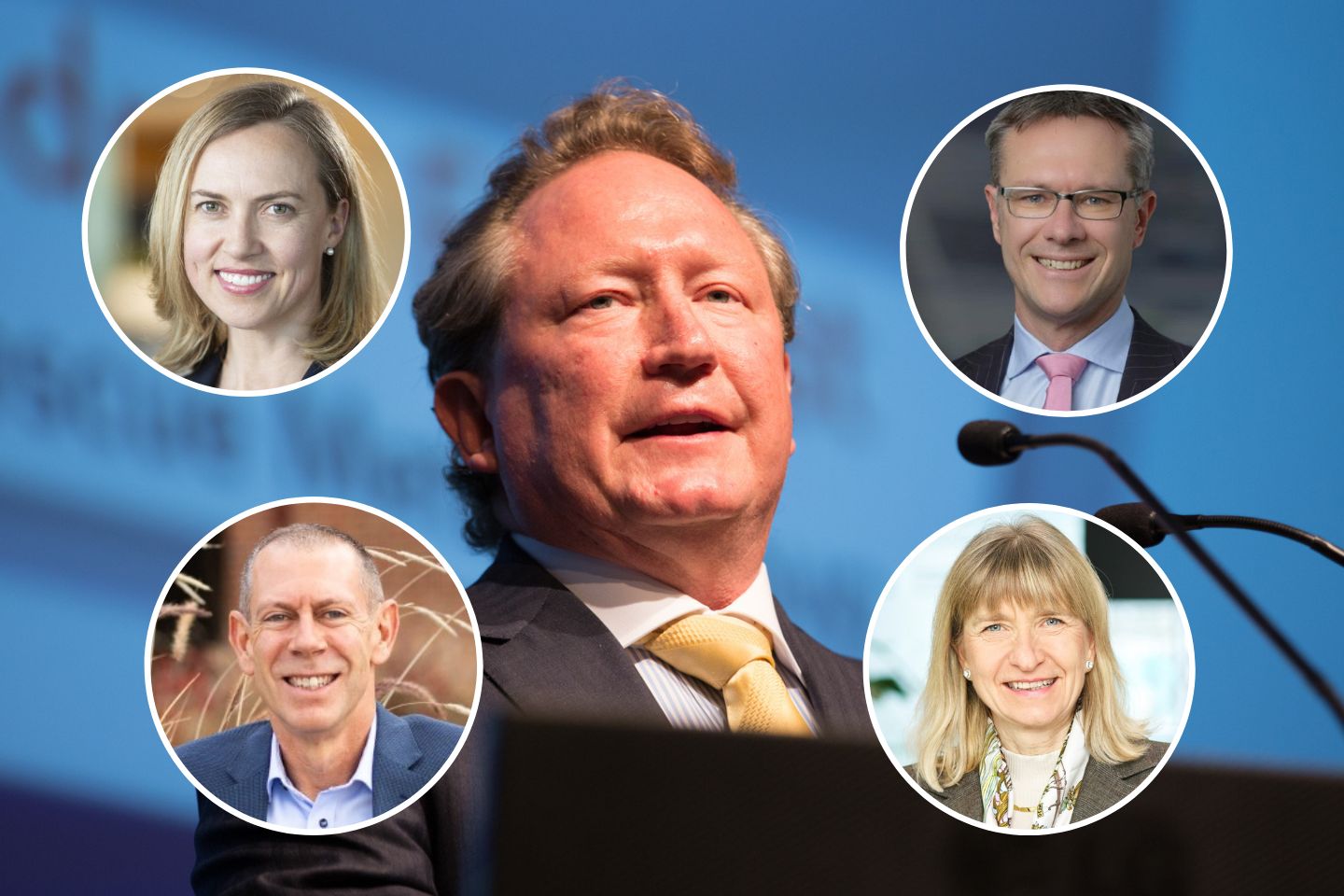
ANALYSIS: This week’s departure of three senior people from Andrew Forrest’s Fortescue Metals Group highlights just how different the Perth company is from its ASX peers.
With a market value of $66 billion, Fortescue is ranked as one of Australia’s top 10 listed companies.
That value stems from its very successful and highly profitable iron ore business yet it’s in the midst of a dramatic pivot to green energy that raises numerous questions about its future.
That pivot has been driven by Mr Forrest, who is both executive chairman and major shareholder with a 36 per cent take.
His warnings about climate change and advocacy for dramatic action have taken an increasingly evangelical tone.
It would appear not everyone, Fiona Hick included, is on the green energy bus.
Her resignation on Monday as CEO of the company’s metals business came just six months after she was lured from a senior role at Woodside Energy.
Her exit was followed on Thursday by CFO Christine Morris, who lasted just two months.
And on Friday morning we learnt that former Reserve Bank deputy governor Guy Debelle had stepped down as a non-executive director of green energy arm Fortescue Future Industries.
He originally joined FFI as chief financial officer in July last year but stepped down from that role after five months, citing the effects of a serious bicycle accident.
This flurry of exits adds a string of resignations over the past three years, including Fortescue’s long-serving CFO Ian Wells, his interim replacement Felicity Gooding and long-serving non-executive director Jenn Morris.
(Some observers include Elizabeth Gaines in their list of exits but that is misleading – the former chief executive stayed on the company’s board and has since resumed an executive role.)
It’s not just Fortescue suffering high turnover in its senior ranks.
It’s a similar story at Mr Forrest’s private company Tattarang.
The latest departure is Paul Slaughter, who had been CEO of agribusiness arm Harvest Road Group.
Other notable Tattarang exits over the past year include CEO Andrew Hagger, CFO Bree Fraser and chief operating officer Stephen Daly.
Spot the pattern?
Its not just the number of exits that is worrying.
The lack of explanation is also a concern.
Monday’s CEO announcement, for instance, was all about Fortescue’s board of directors expediting the promotion of chief operating officer Dino Otranto.
Adding to the intrigue, Ms Hick took the unusual step of issuing her own media statement, though that didn’t shed much light either.
Thursday’s CFO announcement comprised all of two sentences, with the company simply advising the departure of Ms Morris.
Media and analysts were left frustrated when they were unable to get meaningful answers during Monday’s conference call to discuss the company’s annual results.
The absence of the company’s executive chairman from that call was in itself extraordinary.
Mr Forrest, whose private life has been equally tumultuous of late, left it to the freshly promoted Mr Otranto and Fortescue Energy CEO Mark Hutchinson to try and explain the company’s executive upheaval and future strategy.
If Mr Forrest continues as the company’s executive chairman, there is surely an onus on him to front the media and analysts when there is big news.
That is especially so when Fortescue announces a major shift in its financial strategy.
The company has previously stated that spending on its green energy projects would be capped at 10 per cent of its mining profits.
It said on Monday it was removing that cap, leaving uncertainty as to how much money will go into green energy.
Rather than attend the conference call to explain this, Mr Forrest told the Financial Review he would accept the first generation of clean energy projects having lower rates of return than alternative growth options in the mining business.
With Fortescue aiming to make final investment decision on five green energy projects by the end of this year, that leaves a lot of uncertainty.
The market has had a relatively muted response to the news flow this week.
Fortescue’s share price dipped on Monday morning, more than recovered those losses over the next three days, before falling about 5 per cent on Friday morning.
The share price has ended the week about where it started.
There are two likely reasons for that.
First, the company continues to deliver strong operational and financial results.
It posted a net profit of $4.8 billion for the year to June 2023, despite a weaker iron ore price and a $720 million write-down of its Iron Bridge magnetite project.
Its annual dividend of $1.75 per share was down a modest 15 per cent.
Second, the company has always been dominated by Mr Forrest and his mercurial approach.
Fortescue has got to where it is only because of Mr Forrest’s entrepreneurial drive, his refusal to accept the status quo and willingness to take on enormous challenges.
Climate change is the latest of those.
In his Boao Forum speech this week, he did not hold back, laying the blame for global warming squarely at the feet of businesses like his own.
“It is business which is causing global warming, it’s business which will kill your children, it is business which is responsible for lethal humidity, but it’s policies which drive business,” he said.
His chairman’s address in Fortescue’s 2023 annual report had a similar flavour.
“We sit at the tipping point of global warming,” he said, adding that decarbonisation was shifting “from a ‘nice to have’ to being essential to our existence”.
He confirmed that renewable energy and green hydrogen are set to play a very big role in Fortescue’s earnings.
“But change takes a huge amount of courage.”
In a pointer to Ms Hick’s departure, he said Fortescue would stick to its plans.
“Individual ambitions come second because what I’m talking about is the course of humanity.”
That’s not the kind of language you are likely to hear from the chair of any other major ASX company.

