

 13 Mar 2024
Junior miners weigh policy pitfalls abroad




OPERATING a resources project in Australia is a known entity, albeit with the ongoing challenges of labour and production costs, and the at-times-onerous approvals process.
But these issues are offset by a stable, supportive political and business landscape, access to a highly skilled workforce, and strong international trading ties.
Australia is, for all its perceived shortcomings, a good place to do business.
Most of the time you get what it says on the tin.
A 2023 survey of about 2,000 companies by Canadian research house Fraser Institute ranked Western Australia as the second-best mining jurisdiction in the world, behind only Nevada in the US.
Nine of the top 10 spots and 17 of the top 20 on that list were taken by Australian, Canadian and US provinces.
Botswana, Morocco and San Juan were the other three regions at the pointy end of the investment attractiveness index.
In the same survey’s policy perception index, WA ranked 10th.
A high ranking certainly, but somewhat of a hit for the home state.
Perception, previously recorded in the mid-90 per cent range in WA, fell to 87 per cent in the most recent survey.
Again, the entire top 10 and most of the top 20 were occupied by Australia, the US and Canada.
That stability attracts a lot of overseas interest.
Rio Tinto, for example, is so closely tied to WA most people these days would be unaware Australia isn’t its traditional home.
Rio Tinto is named after a river in southern Spain where the British company’s first mine was acquired in 1873, about 100 years before the Pilbara’s red rocks filled its coffers.
While WA attracts plenty of foreign interest, there are numerous Perth-based companies looking abroad to make their fortunes.
There are myriad good reasons to do so, but the practice can come with risks.
Resource Capital Funds has about 220 companies in 50 countries on its investment register.
“Our typical due diligence process takes into consideration political stability and the overall ability to successfully advance a mining project through to production,” RCF opportunities principal Joe Bishop said.
“A favourable mining jurisdiction, from my perspective, will have good geology, a robust and well-understood regulatory framework, and the in-country resources to support mining.
“Additionally, how we think about jurisdictional risk will also depend on things like the stage of the project, the people and management teams involved, how big is the investment for us, and our planned exit strategy.”
The Americas
Alongside Australia, North America is generally considered the best place in the world to mine.
Political stability, strong international trade, and a helpful business climate in the US and Canada attract miners to both countries.
Australian majors Northern Star, Woodside, and BHP have interests in North America, as does Rio Tinto.
At the other end of the scale, small firms are poking around for all manner of metals, rocks and brines.
Some of them, such as PolarX, which is pushing copper and gold plays in Nevada and Alaska, have even managed to attract backing from the big fish.
In late 2022, the Perth-based minnow attracted investment from Northern Star, which also operates a goldmine in Alaska.
While remote, the isolated US state is well serviced by the ports, roads and energy infrastructure needed to support the region’s mining industry.
The way Alaska’s mining lobby groups talk about mining sounds much the same as what one would expect to hear in WA.
A focus on local jobs, social reinvestment, education support, green energy, and environmental and First Nations benefits is littered through many reports published by the Alaska Miners Association.
The AMA says 11,400 jobs flow from the state’s mining industry, about 300 non-profit groups benefit from charitable contributions, and $1 billion was spent on 450 local businesses in 2022.
There are also parallels with Australia in the relationship between northern American mining and other land stakeholders, such as traditional owners and environmentalists.
Environmental concerns came to a head in January 2023 when the Pebble copper-goldmine was torpedoed by the US Environmental Protection Agency over concern about its impact on the world’s largest sockeye salmon fishery.
That move was lauded by Alaskan First Nations tribes, but as recently as November, Pebble Limited and Alaskan governor Mike Dunleavy were still fighting to progress the project.
Other issues facing miners in Alaska include what the AMA describes as “overreach” of the EPA in clean-water policy, inequitable federal taxation, and duplication of state and federal land access laws.
It all sounds very Australian.
South America can be a different proposition.
Argentina is part of the continent’s lithium triangle, which also spans Chile and Bolivia.
But it is on the verge of economic ruin, has a heavy reliance on China for credit, and its new government holds minority rule in congress.
Several Perth-based firms are developing lithium projects in Argentina: Galan Lithium, Lake Resources, Argosy Minerals, and Allkem among them.
And, of course, Rio Tinto is in town.
Investment has headed into Argentina due to the country’s willingness to ease foreign exchange controls, provide long-term tax guarantees, and fix royalty rates, according to US research firm Wilson Center.
By contrast, state ownership hangs over the sector in Chile and a sliding royalty rate can slug companies as much as 40 per cent of the export price.
Argentina made headlines ahead of its presidential election last October when the former government proposed a new lithium profits tax.
With Argentina tipped to become the third-largest lithium producer by 2030, it was a move designed to funnel money from the sector into nation-building infrastructure projects.
About 20 per cent of lithium output would also have been retained for domestic battery production under the plan.
As it happened, the hardline libertarian agenda espoused by Javier Milei won the day.
Now president, Mr Milei appears eager to realign his nation with the US and break any shackles holding its mining sector back.
“Despite exhibiting a more market-friendly approach than neighboring Chile and Bolivia, in the past, the mining sector has not met its full potential due to government intervention, price controls, and trade restrictions,” Americas Program representatives Ryan Berg and Laura Delgado Lopez wrote for the US Centre for Strategic and International Studies in December.
“Yet, Argentina has resources to expand production and achieve exports worth over eighteen billion dollars per year by 2030.
“Currently, there are thirty billion dollars’ worth of projects in the country’s mining portfolio, half of which are copper-related.”
Mr Milei’s rise might not be all good news for mining, however.
He is a climate change denier who has shunned policies to protect Indigenous people and prevent deforestation, which could put his nation at odds with the world’s move toward sustainable practices.
“We have to carry out the transition to reduce energy costs, not so that a family in Europe can have three electric cars,” Argentina’s Environment and Natural Resources Foundation environmental policy director Pia Marchegiani said following Mr Milei’s win.
Europe
There is a handful of Perth firms eyeing off mines in Europe, including Vulcan Energy’s German lithium fields, Critical Metals’ urban mining of vanadium from Finnish industrial by-product, and Aura Energy’s interest in Swedish uranium.
But most of Australia’s involvement with European nations leans toward offtake deals for the likes of battery metals.
Hastings Technology Metals is an interesting example.
The Gascoyne-focused rare earths miner is building the 20.93-milliontonne Yangibana mine near Carnarvon and hopes to be feeding 1.1mpta into a processing plant by mid-2025.
“We have spent a bit over $140 million on our non-process infrastructure up there, which has really been aimed at de-risking our project as far as some of the cost challenges and blowouts that we’ve seen in the industry,” Hastings chief executive Paul Brown said.
“We have got a $210 million beneficiation plant to build with GR Engineering.
“Part of our strategy has been pretty deliberate … to get a WA ASX-listed organisation that has built twenty or thirty of these plants globally and it is a fixed price (engineering, procurement and construction) contract.
“Coupled with our early infrastructure strategy, partnering with GR engineering we are very, very confident we’ve got our costs right and we plan on absolutely shooting the lights out in project execution, commissioning and operational readiness.”
In January, Hastings signed a deal with the Estonian government to probe the feasibility of sending its rare earths concentrate to a hydrometallurgical plant in Estonia.
The move would also be helped by Hastings’ stake in Canadian firm Neo Performance Materials, which already has a separation plant in the Estonian port town of Sillamae and is building a magnet plant in nearby Narva.
“They are in the magnet manufacturing business, which falls into our strategy of mine to magnet,” Mr Brown said.
“[Estonia is] like most governments globally that want to get an opportunity to have an organisation like Hastings come and produce a carbonate product.
“There are the same challenges that exist here: approvals, costs, evaluation, a number of things that obviously we will do to ensure when we get to a final investment decision it makes sense for us.
“But they are very hungry to attract work and certainly this would be a big capex spend for us and a decent employer for that region, so they are happy to have us talking to them.”
Estonia is one of the most advanced digital governments in the world and is recognised for its information and communications technology, and skilled workforce.
The former Soviet nation also appears eager to strengthen ties with the West.
“In Estonian politicians, civil servants and all local business partners, Neo found the most entrepreneurial and problem-solving attitude, which seems to be driven by a collective Estonian pursuit for growth and becoming a most strategic jurisdiction for critical supply chains of the Western world,” Neo corporate development director Vasileios Tsianos said in November.
It all sounds good, but there is a catch.
The towns Neo operates in straddle the Russian border, and the world knows all too well what kind of neighbour Russia is.
Estonian Foreign Intelligence Service director general Kaupo Rosin sounded the warning bell this year after Prime Minister Kaja Kallas was added to the Kremlin’s wanted listed for removing Soviet-era war memorials.
Mr Rosin signalled Russia’s intention to double troop numbers along its Baltic and Scandinavian borders ahead of possible military conflict with NATO in the next decade.
“We will highly likely see an increase of manpower, about doubling perhaps,” he said.
“We will see an increase in armed personnel carriers, tanks, artillery systems over the coming years.”
Mr Rosin said that attack was unlikely in the short term due to Russia’s engagement with Ukraine.
Vladimir Putin, for his part, recently told US political commentator Tucker Carlson he had no interest in invading other nations.
Mr Brown is not too concerned about the unruly neighbours at this stage.
“Anywhere we look, we will assess all of those opportunities and risks … that is what we do in the commodities business,” he said.
“[Estonia] is part of the European Union, part of NATO, and … they have been neighbours with Russia for a very long time, so they know their neighbour very well.
“It will form part of our overall investment strategy to consider what’s happening in and around Europe in general.”
Africa
Mining in Africa has historically been tainted by concerns around corruption, instability, poor environmental, social and corporate governance practices, and foreign influence.
Today, many commentators point to the continent’s immature industry base, substandard infrastructure, and lack of exploration investment among reasons for ongoing hesitancy.
African miners have not been held in high regard, as University of Bath international development lecturer Ben Radley wrote in a piece for The Conversation late last year.
“Despite the sector’s importance to rural employment, African miners have typically been cast by the World Bank, African governments, and parts of the scholarly literature as primitive, basic, inefficient, rudimentary and unproductive,” he wrote.
“In 2017, 70,000 miners were displaced by Ugandan military and police to make way for a Canadian-listed mining corporation.”
The continued hesitance to invest in the resources-rich continent is spelled out in Fraser Institute’s surveys, which put Australia, the US and Canada at the top of the list.
At the other end of the scale is Africa.
Eight of the bottom 10 countries on the investment attractiveness scale are African, as well as seven of the bottom 10 on policy perception.
Not all regions are perceived equally, though.
Botswana is among the tier-one jurisdictions on Fraser Institute’s scorecard and Namibia is rising up the ranks.
The Kalahari copper belt district stretching through Namibia and Botswana has been hot land for years and may go some way to explaining the rise of the two nations.
Rio Tinto has previously been active in the area and a host of smaller players have been busy pegging ground, including ASX-listed Sandfire Resources, Noronex, and Cobre, and Chinese-backed Khoemacau Copper Mining.
A recent conference presentation by Cobre gives some insight into why the Kalahari copper belt has become so attractive.
In it, the explorer touts the district’s “excellent infrastructure”, road networks and large investments into energy.
That, coupled with what the US Geological Survey describes as one of the world’s most prospective copper areas, has attracted explorers looking for deposits to plant their flags on.
And it helps to have a headliner, in this case the mammoth 502mt Khoemacau copper-silver mine in Botswana, which began production in 2021.
While the reputation in parts of Africa has improved substantially, other areas are still throwing curveballs.
The experience of Base Resources is a case in point.
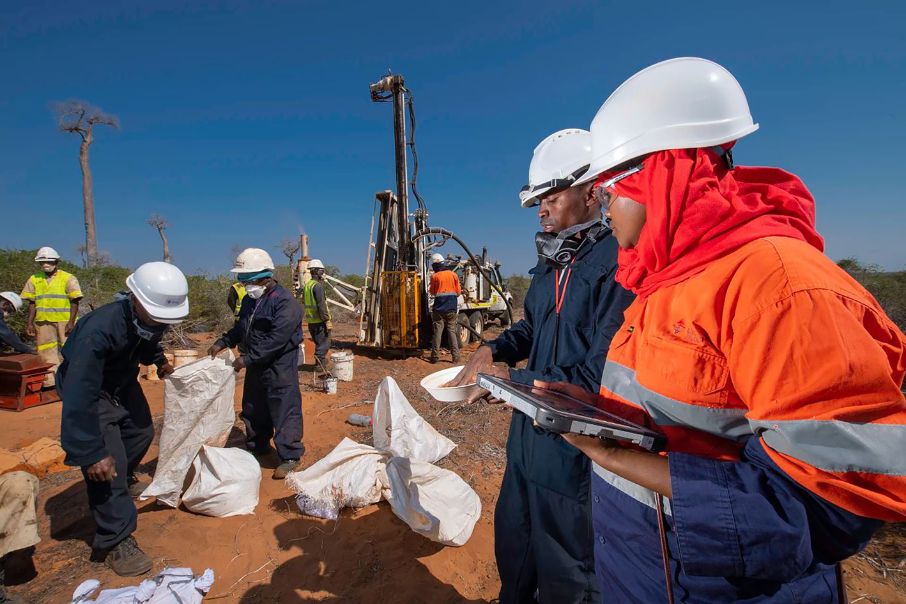
The West Perth-based mineral sands explorer has been trying to get an operation up in the island nation of Madagascar for seven years.
It has proved a tricky place at times to do business.
The Toliara project had been sweating on the Madagascan election, a new mining code (which implemented a 5 per cent royalty, 1 per cent higher than Base had assumed), and a mandate to contribute to a social investment fund.
For Toliara, that outlay would be $US15.6 million, about $5 million above what Base expected.
The project was suspended by the Madagascan government in 2018 and negotiations around fiscal terms to lift this ban have been repeatedly interrupted.
Things appear to be looking up for Base, though, with the Madagascan government re-engaging with the company since the election in November last year.
“Pleasingly, the incumbent president was re-elected with 59 per cent of the vote with a strong mandate to get on with business and a real thirst to start making some decisions in the country, we hope,” Base Resources chief financial officer Kevin Balloch told Proactive Investors in January.
“The new government was formed early in January, including the reappointment of the minister of mines who we have been dealing with and is a supporter of the project.
“He has re-engaged with us already over the last few weeks and has indicated progressing and concluding discussions on Toliara is a priority for the government.”
It is worthing noting opposition parties boycotted the vote over claims of unfair conditions, leading to President Andry Rajoelina’s election’s credibility being questioned, but ultimately confirmed, by Madagascar’s constitutional court.
How that will play out socially on the African island is yet to materialise.
Base’s other mine, in Kenya, is due to close in December due to low grades.
The closure of what has been a lucrative pit is in line with its life-of-mine plan.
Share Price
Revenue
| 102 | - | Hastings Technology Metals | $2,108,849.00 |
| 203 | - | Noronex | $368,164.00 |
| 204 | - | Lion Energy | $358,528.00 |
| 205 | - | Xpedra Resources | $350,423.00 |
| 211 | - | Viridis Mining & Minerals | $324,598.00 |

