SAMUEL McSkimming brought a clear sense of purpose to discussions with Business News of his plan to drastically reduce emissions from the region’s shipping industry.
This effort by the head of Pilbara Ports to decarbonise shipping even landed him a seat at the table with King Charles III in January this year.
Pilbara Ports is one voice in a group of local and foreign stakeholders setting a course for the global leader in bulk shipping to become a global leader in clean marine fuels.
“If you are going to buy a Capesize bulk carrier today, brand new, the market you are going to put that into is the Pilbara,” Mr McSkimming told Business News.
“If you are buying a ship that is going to potter along the coast moving containers somewhere in the world, you really don’t have much choice today but to go with a heavy fuel oil, because there are lots of operational complexities associated with a hydrogen-based fuel if you are going to go into 100 different ports.
“If you are buying a bulk carrier that’s going to spend the first 10 years of its life, at least, going from Port Hedland to China and back, it is a very different equation.
“What that means is the decisions getting taken today around the Pilbara fleet essentially cascade into the rest of the world.”
The quasi-consortium comprises the state-owned port agency, an ASX-listed company with a $1 billion-plus project in the works, large industrial plant owners, a Japanese investment house, iron ore giants, and the world’s largest ship builders.
Also in the mix is an unheralded local startup that wants to be the key cog in the wheel.
What the group is progressing is known as the Pilbara clean fuel bunkering hub.
The hub would serve the dual purposes of enabling the Pilbara resources industry’s decarbonisation and furthering the state and federal governments’ ambitions for Western Australia to become a green energy superpower, as Premier Roger Cook has put it on several occasions.
The hub’s progression comes amid a policy crossroads in the global maritime shipping industry.
The shift towards clean maritime fuels had built a head of steam prior to the US’s about-face on green energy policy when Donald Trump was elected in 2025.
In 2025, the International Maritime Organisation deferred adoption of a fossil fuel phase-out plan for one year. Supporters of the policy pointed the finger at pressure from the US.
“Delay is not cancellation, it is still being worked on, and it is still very broadly supported internationally,” Mr McSkimming said.
“It would be naive to think that in no time in the next 25 years will there be any decision made in relation to the carbon pricing of marine fuels, so the longer the IMO framework is delayed the more uncertainty there is.”
Marine fuel would represent a new industry for the Pilbara. Ammonia fuel bunkering would not replace any existing business because the Pilbara currently offers no refuelling service at all, with bulk carriers currently bunkering with diesel elsewhere on the voyage.
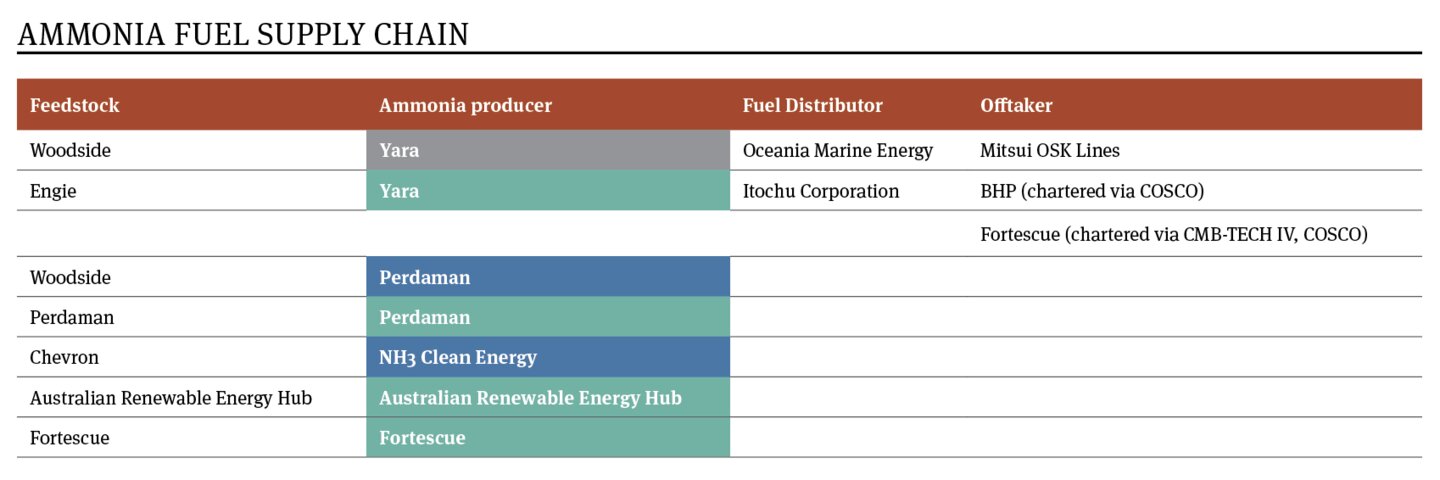
Pursuing the new industry is no flight of fancy. Dual-fuel-powered vessels are already on their way to the Pilbara.
Mitsui OSK Lines expects the first of three ammonia-capable Capesize carriers ordered from Belgian shipbuilder CMB.TECH IV to head to the Pilbara this year.
BHP has chartered two ammonia-capable Newcastlemax ships from China’s COSCO Shipping Bulk.
They are expected to arrive in 2028.
Fortescue’s first chartered dual-fuel vessel from CMB.TECH IV is expected to arrive this year.
In 2024, Fortescue signed a preliminary deal with COSCO to “explore construction” of a fleet of green ammonia-powered vessels.
Research by Business News has found at least 20 ammonia-capable bulk carriers either under construction or ordered for potential use on the Pilbara-to-Asia corridor.
Supplying demand
Oceania Marine Energy is the linchpin in the bunkering hub dream, in which shipping companies buy ammonia from suppliers and load it onto OME’s proposed bunkering vessel in Dampier for transfer to anchorage for refuelling.
Oceania Marine Energy managing director Nick Bentley said the company would need a fraction of the 1,200 or so ships servicing the Pilbara-to-Asia corridor to convert to ammonia to make its business model viable.
“We can actually start with about four [ammonia-powered vessels] … but really we are looking for a dozen vessels to opt-in for a reasonable-term contract to initiate the operation of the ship,” he said.
“We are already seeing the ships being built, currently coming out of China, so there are basically a couple of dozen of these vessels coming out of the yards at the moment, and on the order books.
“The Pilbara has the market, it has the supply of clean energy, so why don’t we just connect it all together?
“The actual contractual agreements will be between the suppliers and offtakers, and we’ll just be a bunker delivery contract.
“We are almost the Amazon delivery service of the fuel.”
Japan’s Itochu Corporation is also trialling a bunkering vessel in the Asia-Pacific region but is yet to confirm where it would be based.
Singapore and China are other options.
Two potential ammonia suppliers already exist within eyesight of Dampier Port: Yara’s Burrup plant and Perdaman’s Project Ceres, which is under construction.
Both are fed gas by Woodside’s Burrup hub and have competing interests to maritime fuel supply as fertiliser and explosives producers.
Energy infrastructure company Engie is close to completing a small green hydrogen project to feed Yara.
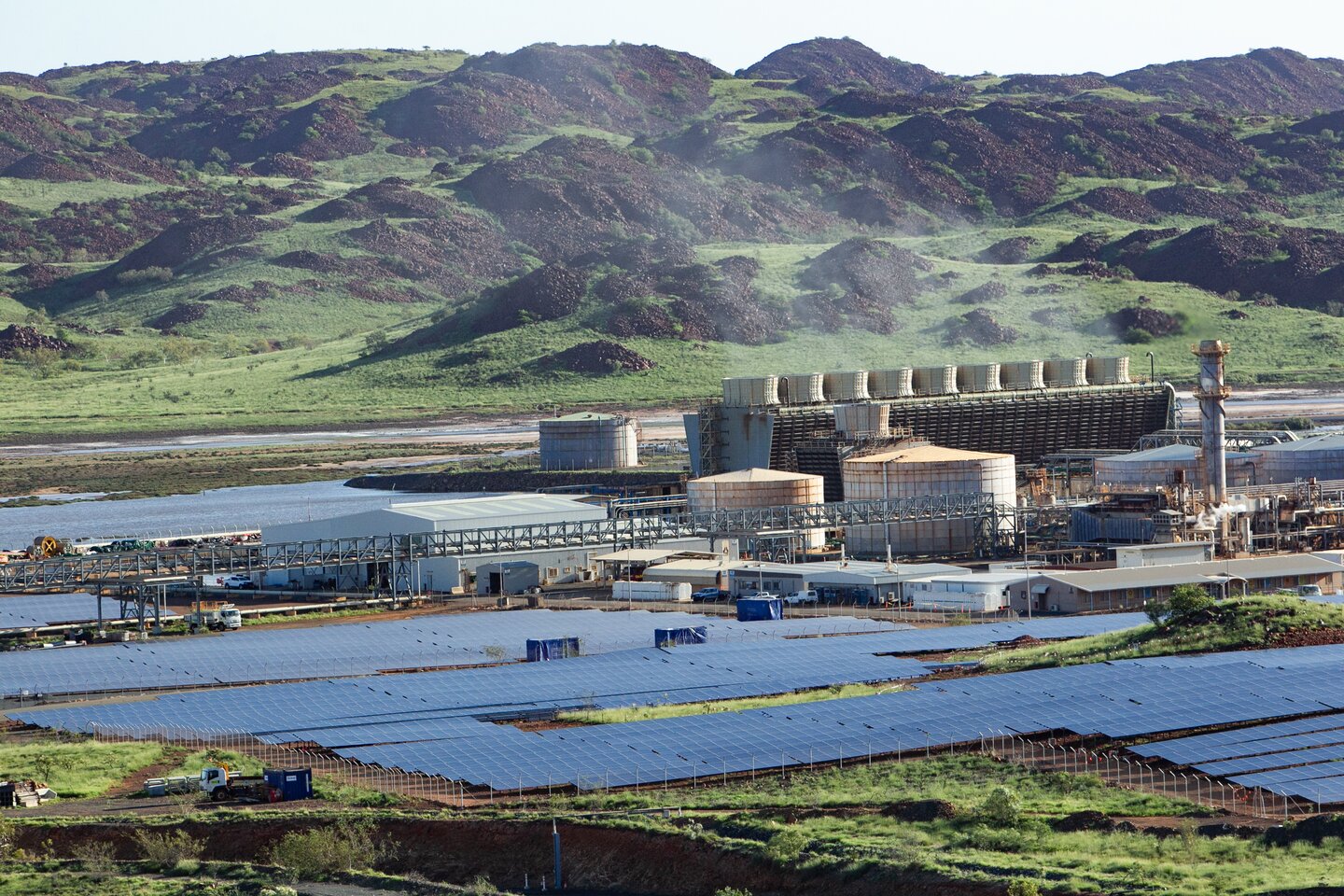
Engie and Yara are collaborating on Project Yuri in the Burrup Peninsula. Photo: Tom Zaunmayr
Perdaman has a large renewable energy project named Helios planned, which would turn Ceres ammonia progressively from blue to green.
A third major project – the WAH2 facility proposed by ASX-listed NH3 Clean Energy – has been closely involved in development of the clean-fuel bunkering hub concept.
A final investment decision on the first stage of the $1.6 billion project is due this year.
Front-end engineering design is under way and preliminary deals for feedstock from Chevron and carbon capture with Woodside have been signed.
NH3 chairman Charles Whitfield said the Pilbara had established infrastructure and strong potential shipping demand to underpin a bunkering operation.
“If you are producing blue ammonia you need to have gas, you need to have CO2 sequestration, and we wanted to be able to piggyback off as much existing ammonia infrastructure as possible,” Mr Whitfield told Business News.
“Dampier has been an ammonia export hub with a deepwater bulk liquids pier for 20 years.
“The value proposition to the mining companies and the shipping companies is compelling.
“All the hard work has been done for them, they just need to sign up to convert a portion of their fleet over and it is very easy for the ship owners … who have a growing fleet of ammonia vessels to operate them on that route
Product and place
NH3’s ammonia will be blue, meaning it is produced by gas and emissions are captured and stored.
Both Fortescue and the Australian Renewable Energy Hub have plans for green ammonia production at the Boodarie Strategic Industrial Area.
Yindjibarndi Energy and SP Energy are potential third-party energy providers for a green ammonia product, should their large renewable projects get up.
Green ammonia producers would also require a vast amount of water, sustainable quantities of which do not exist in the Pilbara.
Desalination plants such as those proposed by the state government and the Ngarluma Water consortium could be a solution.
NH3 has green ambitions, too, but currently the economics do not stack up.
“It is not a philosophical debate, it is a practical commercial one,” Mr Whitfield said.
“Green ammonia has really struggled from the point of view of both cost and volumes in order to really meet the commercial needs of the operators, whereas ... blue ammonia is a relatively straightforward transition.
“It is a meaningful change. Every ship you are converting to [blue] ammonia, you are basically reducing emissions by 80 to 90 per cent.”
Mr Whitfield pointed out that blue and green ammonia plants shared much of the same infrastructure.
Making the transition would be simple, he said.
As for ammonia supply directly into Port Hedland, that is a long-term prospect given there are currently no producers or required ship-loading infrastructure.
The intention, therefore, is to initially have bunkering vessels collect ammonia from Dampier and service the ports of Dampier/Cape Lambert and Port Hedland.
Oceania Marine Energy’s Mr Bentley said operating out of Dampier would suffice for the initial bunkering demand.
“Port Hedland, as a market, is probably two thirds larger than Dampier,” he said.
“If we are looking to scale to 40 per cent of the Pilbara shipping fleet … we are going to need multiple bunker vessels, and we are going to need a source of supply from Port Hedland.
“There are development plans to look at future port facilities within Port Hedland, so either at South West Creek or Lumsden Point, or wherever the port authority decides to place the infrastructure.
“There are multiple players looking at low-carbon ammonia operations in Port Hedland over the next five years, we just need to be able to tap into that.”
Another first
It appears Fortescue will be the guinea pig for ammonia bunkering in Port Hedland.
Fortescue’s chartered vessel from CMB.TECH IV is the frontrunner for the first ship-to-ship iron ore bulk carrier bunkering trial due to take place this year.
Fortescue metals and operations chief executive Dino Otranto said the miner was preparing its fleet for the inevitability that green ammonia would reach cost parity with traditional fuel.
“We have invested and partnered with a large shipping manufacturer, which will offer us an ammonia-powered ship as well as the conventional power, so it gives us the choice,” he said.
“The reason that’s important is, first, we want to prove the technology that the engines can work on ammonia, just as we have proved on our prototype vessel with the green pioneer.
“The next step ... is to make sure that fuel is economic.”
Fortescue’s scope three emissions (which include shipping) target is not as assertive as its ‘real zero by 2030’ aspirations for terrestrial emissions, seeking only net zero by 2040.
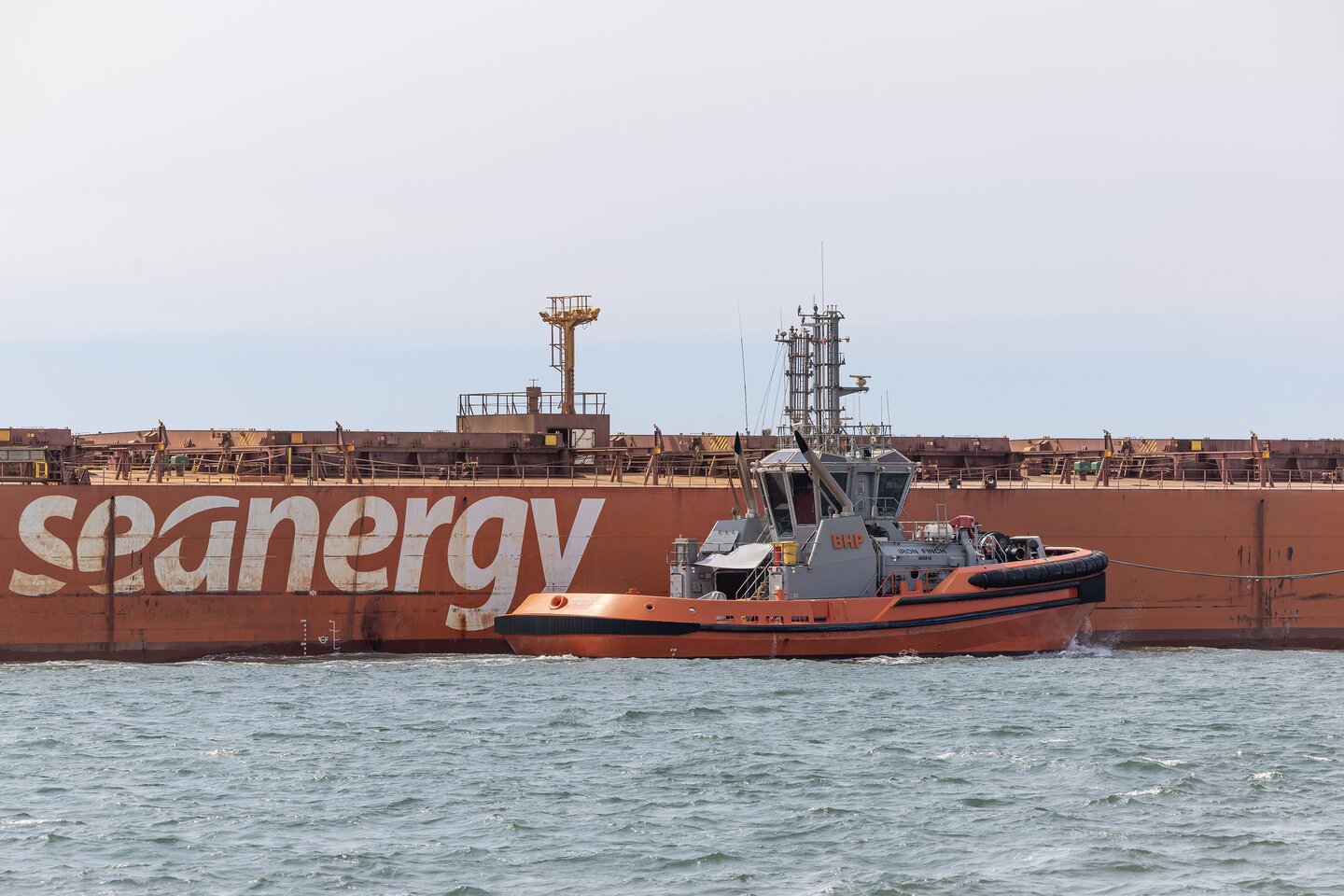
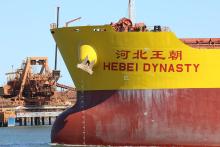
Fuel bunkering in Port Hedland is currently not an option for bulk carriers. Photo: Tom Zaunmayr
Stakeholders in the Pilbara’s bunkering hub are aware that policy could be beefed up, given Fortescue founder Andrew Forrest’s public crusade against gas.
Mr Otranto said progress in Asia to make green hydrogen was particularly encouraging.
“There are many, many players now, including ourselves, working on this to get the cost of the electron down to a point to make hydrogen economic,” he said.
“Then it’s a quick step to create the ammonia as a fuel, particularly in China and around Asia.
“There are many, many opportunities already arising to buy that ammonia.
“Right now it is not yet at a cost parity, which is why we haven’t pulled the trigger on the entire fleet.
“But as we’ve demonstrated [with battery-electric locomotives], it’s not too far away.”
The refuelling in the Pilbara would be done out at anchorage, for two reasons. One is safety.
Mr McSkimming said hazards associated with having a small ship next to a big ship were more easily managed at anchorage than in the port.
Time is the other major factor.
Bulk carriers can spend days at anchorage doing nothing. Once berthed to load up on iron ore, however, there is a short and stressful turnaround.
“There is a huge amount of work that goes into bringing a conventionally fuelled vessel in and out of Port Hedland,” Mr McSkimming said.
“You can imagine how much extra work’s involved with a brand new ship design.
“We are going to work all that out, and we will get that first vessel in, and it will be, I think, a tremendous moment.”
Once the service is established, Mr McSkimming said he would rather it be run as a port service by the private sector in a similar fashion to that utilised by tugboat operators.
Value proposition
For Oceania Marine Energy, the potential the clean fuel bunkering hub holds is clear.
It would facilitate establishment of a company with a clear trajectory for growth as demand for ammonia fuel increases, driven by government and industry policy.
Mr Bentley said Oceania was ready to fill a void in bunkering the large companies had been hesitant to move into.
“We have got the expertise to get into the bunkering game, to design the ship, to make a proprietary design specifically for the Pilbara, and to initiate the operation,” he said.
“The Pilbara has had this incredible opportunity to decarbonise shipping for many years. Over the last 10 years, it’s been explored and it’s been studied.
“We can showcase that the economics work, it is just the will of all the combined stakeholders to come together and to realise this clean fuel shipping hub is a worthy target.
“We have got that opportunity, which is incredible, really, and I can’t wait to see 2030 and actually be operating this thing.”
Oceania Marine Energy is aiming to make a final investment decision on its bunkering ship this year, and to have it commissioned when the NH3 plant comes online.
For NH3 the hub is a nice to have, but not an essential.
Its WAH2 plant could also feed ammonia bunkering operations in China and South-East Asia, and energy supply in Japan.
Still, Mr Whitfield sees clear benefits in the establishment of ammonia fuel bunkering up the road from his company’s proposed facility.
“If you are transporting fuel to other parts of the world, you have to include any emissions involved in transporting that fuel to those other places, as well as the cost,” Mr Whitfield said.
“Of the ways that [Pilbara Ports] can create growth, one is the amount of iron ore that goes out through the ports, and the second is the number of services you offer to your shipping customers.
“Bunkering would be a massive lost opportunity if the Pilbara didn’t manage to build that business; it would be a massive loss for WA as a whole.”
Phase one of WAH2 does not require a mass uptake of ammonia fuel. Mr Whitfield said NH3’s phase-one supply could be consumed by 20 ammonia dual-fuelled vessels.
As the man trying to lasso the hub’s potential beneficiaries together, Mr McSkimming is bullish in his belief that the Pilbara is the “magic circle” for ammonia bunkering.
“You have a source of gas as the transition, you have carbon capture and storage as the further transition, you have all of the renewable energy you could want … you have an existing ammonia berth that is already built … with heaps of spare capacity available for proponents, and you have a state government that has made land available and is pro development,” he said.
“I look at this list of things and go, ‘Well, what’s a good reason why it wouldn’t be in the Pilbara?’
“You can get very competitively priced bunkering services in China [and] Singapore, but what a tragedy it would be that we make ammonia in WA, put it on a ship and send it to China.
“WA has a tremendous opportunity to lead it, and I want to make sure the port is at the front of that.”