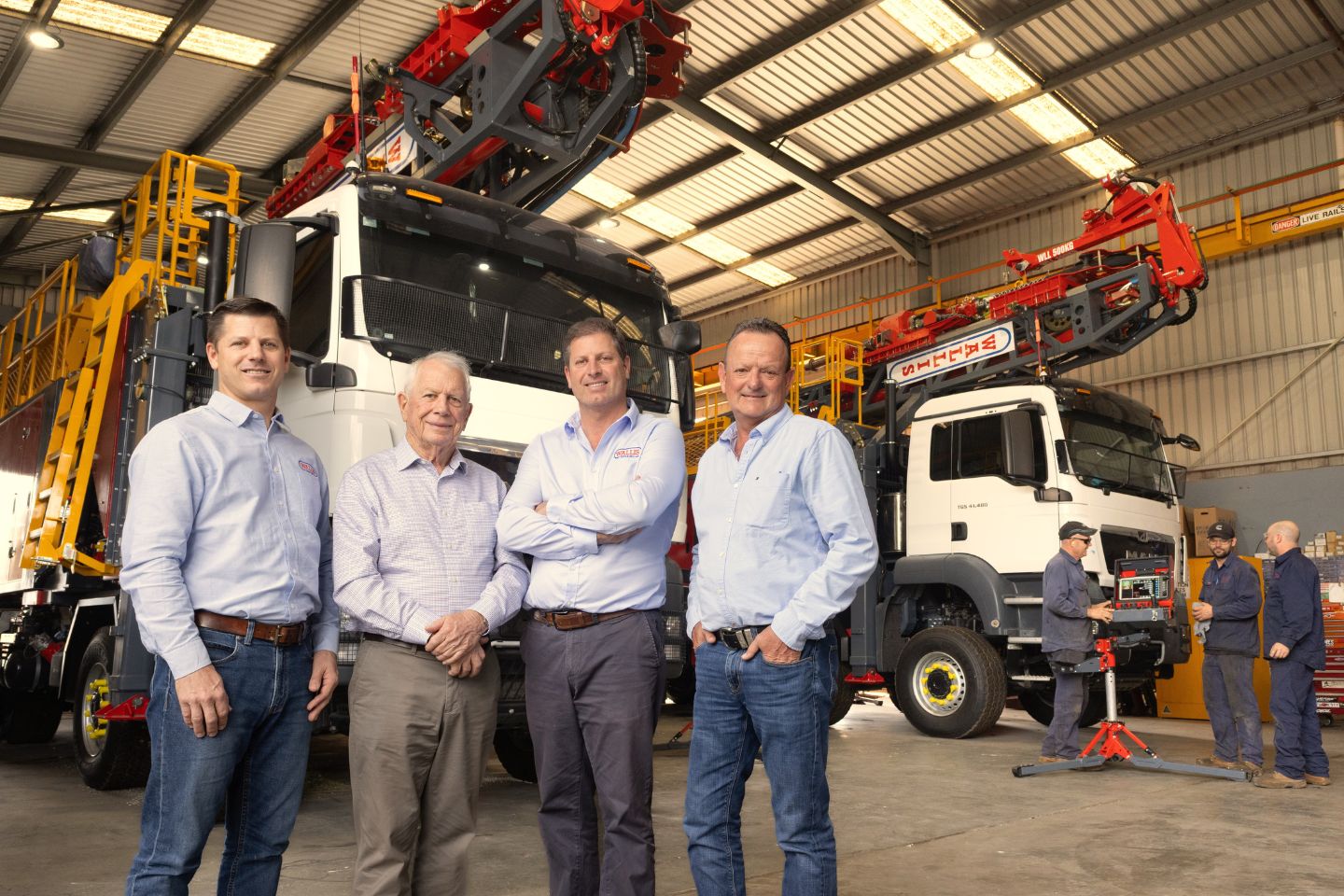
GRANT Wallis clearly recalls the first time a group of BHP managers visited his company’s headquarters at Midvale.
It was 2017 and they had come to check out the company’s latest drilling rig, the 300RC.
The Wallis Drilling managing director recalls the BHP staffers were sceptical when they arrived.
“You could tell they didn’t believe us, but by the end of that day, it was: ‘how have you done this, how can we get our hands on it’,” Mr Wallis said.
It was a pivotal moment for Wallis Drilling, which had been trying for years to win BHP as a client.
Executive chairman Mark Crumby said the breakthrough came after he approached BHP executive Mike Henry.
“To his credit he responded to my email and sent a team out here, and within six months we had a contract,” Mr Crumby said.
Mr Wallis attributes that success, and many others, to his company’s investment in product research and development.
“Without that product, which came through our R&D process, we would not have been able to get into BHP,” he said.
“We have been with them for seven years and they are in our top three clients every year.
“Without that R&D, we would probably be half the company we are today.”
Today, Wallis Drilling is the largest family-owned drilling contractor in Australia, with more than 350 staff and about 60 drills operating across the country.
Mr Crumby admits the business was financially stretched when it brought the 300RC rig to market, around 2015.
“The development of that drill Grant referred to, the 300RC, was at the deepest depths of the downturn,” he said.
Mr Crumby said the commitment to R&D was only possible because of the company’s family ownership.
“We were managing a P&L for shareholders who knew the long-term story,” he said.
“If we were managing a P&L for (public) shareholders and analysts it would not have happened that way.”
The continued investment in new technology is clear to see at Midvale, where the company is putting the finishing touches on four new drill rigs boasting the latest technical advances.
The 400RC rigs have put Wallis in a rare position.
Rather than chasing mining companies for a contract, the big iron ore miners are keen to get their hands on the new rig.
It’s an enviable position for a mining services company in Perth and reflects Wallis’ focus on developing and building its own equipment.
Early days
That focus has been with the company since the beginning, when Marty Wallis and his son, Jamie, won their first contract in the Northern Territory in 1965.
Marty’s second son, Graeme, who has been with the business since 1976, traces the culture to the family’s background as orchardists.
“In those days if you wanted something, you just made it, they were always tinkering with the equipment,” Graeme said.
While Jamie, who passed away this year, focused on the technical side, Graeme built up the company’s commercial capabilities.
“It was a really good partnership that allowed the business to flourish,” said Grant Wallis, who is a third-generation family member.
He sees two key factors in the company’s evolution.
“It’s the will to innovate from Jamie in the early days, and clients pushing us, saying if you just give us the same as everyone else, you are not going to get any more work,” Grant said.
Mr Crumby said the group was already working on the next opportunity.
“We are making a big investment in machine learning, AI and remote operations,” he said.
“It sounds very futuristic, but we have a team working on that as we speak.
“The more we can get the machines doing, and the more we can work remotely in time, will give us a competitive advantage.”

Graeme Wallis with the first drilling rig used by his father, Marty, and brother, Jamie, in the 1960s. Photo: Michael O’Brien
Another focus area is building electric drills, initially by retrofitting electric engines to some drills.
“The big miners all want to move away from diesel-powered drills by 2030,” Mr Crumby said.
“We are not going to wait for an OEM (original equipment manufacturer) to produce an EV drill for us to buy.
“We have got a clear competitive advantage in that space, and we want to continue to leverage that.
“Ideally through this process we will widen that advantage.”
Wallis’ main competitors are global companies such as Epiroc and Sandvik, but Grant Wallis is unfazed.
“I’m not convinced that being bigger is always best in our market in Australia,” he said
“Our competitive advantage is being big enough to have the resources we need and small enough to make decisions quickly and develop products and push it out there.”
Mr Crumby said that, from a global perspective, Wallis operates in a smaller segment, with its core product being a customised reverse circulation drill rig for the iron ore sector.
“The space we operate in, that grade control work for the three iron ore players, is somewhat niche,” he said.
He believes that makes it harder for global manufacturers to focus on that segment.
Takeover interest
Over the company’s 60-year history, the family has been approached several times by potential bidders, but the conversations have never progressed far.
Graeme Wallis said the closest he came was about two decades ago when US company Boart Longyear “put a serious offer on the table”.
Boart was subsequently forced into a major restructure after being caught with heavy debts during a market downturn.
Having seen many contractors get taken over, Graeme Wallis is relieved he walked away.
“The first thing they do is get rid of what they think are surplus people,” he said.
“We’ve all seen when that happens, companies lose a lot of their momentum.
“My conscience wouldn’t allow me to put our people in that situation.”
Family ties
While Wallis remains a family company, Graeme said the recruitment of an outsider in Mr Crumby was an important step in its evolution.
“I was looking for someone who could make us a modern company that could be looked upon by our larger clients as a sophisticated contractor,” he said.
Mr Crumby got to know the business when he worked for ANZ Bank.
“Mark was the first (bank) manager who was genuinely interested in what we were doing and how we were running the company,” Graeme said.
Mr Crumby joined the business in 2008 as chief operating officer, then became chief executive and is now executive chairman.
“Graeme said to me he has plenty of technicians and drillers but wanted someone with broader management experience,” Mr Crumby said.
“He said he wanted to run the business as if it was a public company, in terms of forming the board, the governance, the reporting, the engagement with stakeholders.
“That’s the philosophy we adopted back in 2008.”
Mr Crumby said the business also became a lot more transparent with its bankers, sharing both historical information and budgets.
“We were able to use debt a lot more effectively and aggressively,” he said.
“We used debt for longer-term asset funding rather than using cash.”
That has helped the business to expand its annual turnover to about $100 million and its assets to about $200 million.
Mr Crumby said the family’s interaction with the board had been formalised.
“The shareholders direct questions regarding the business through me as chairman,” he said.
At an executive level, Grant and his brother, Kim, lead the business but there were no guarantees, and they had to gain experience elsewhere first.
Nor was there an expectation placed on the next generation.
“Graeme said to us, if you want to join, that’s great, if you don’t, that’s also great,” Grant said.
“Same for our kids, they can join but we’re not going to create roles for them, it has to be a meaningful job.”
Diversification
The company’s current operations build on a long history of innovation.
The first big break came in 1974, when it developed the aircore drilling technique, designed to get uncontaminated drilling samples.
Graeme said it was much more efficient than the traditional auger drills.
“It was such a huge leap forward,” he said.
“That was the first time there was an air reverse circulation system in the world that was commercially successful.
“We drilled with that for years before any other drilling contractors really understood what we were doing.”
The aircore drills proved to be very successful in the mineral sands sector.
“Most of them found it was spectacularly good,” he said.
Graeme admits it took much longer to break into other sectors like goldmining, but the contractor eventually made it.
“That was a story of continual improvement to keep our clients happy and keep a step in front of other people,” he said.
The company has worked across most commodities, riding the uranium boom of the 1980s and doing two years of foundational drilling on Woodside’s North Rankin platform.
It has been a contractor at the Collie coal mines for 33 years.
Other long-standing clients include Glencore’s Murrin Murrin nickel mine (27 years) and Newmont’s Boddington goldmine (18 years).
Its international operations have taken it far and wide, from Mozambique to Romania and even North Korea.
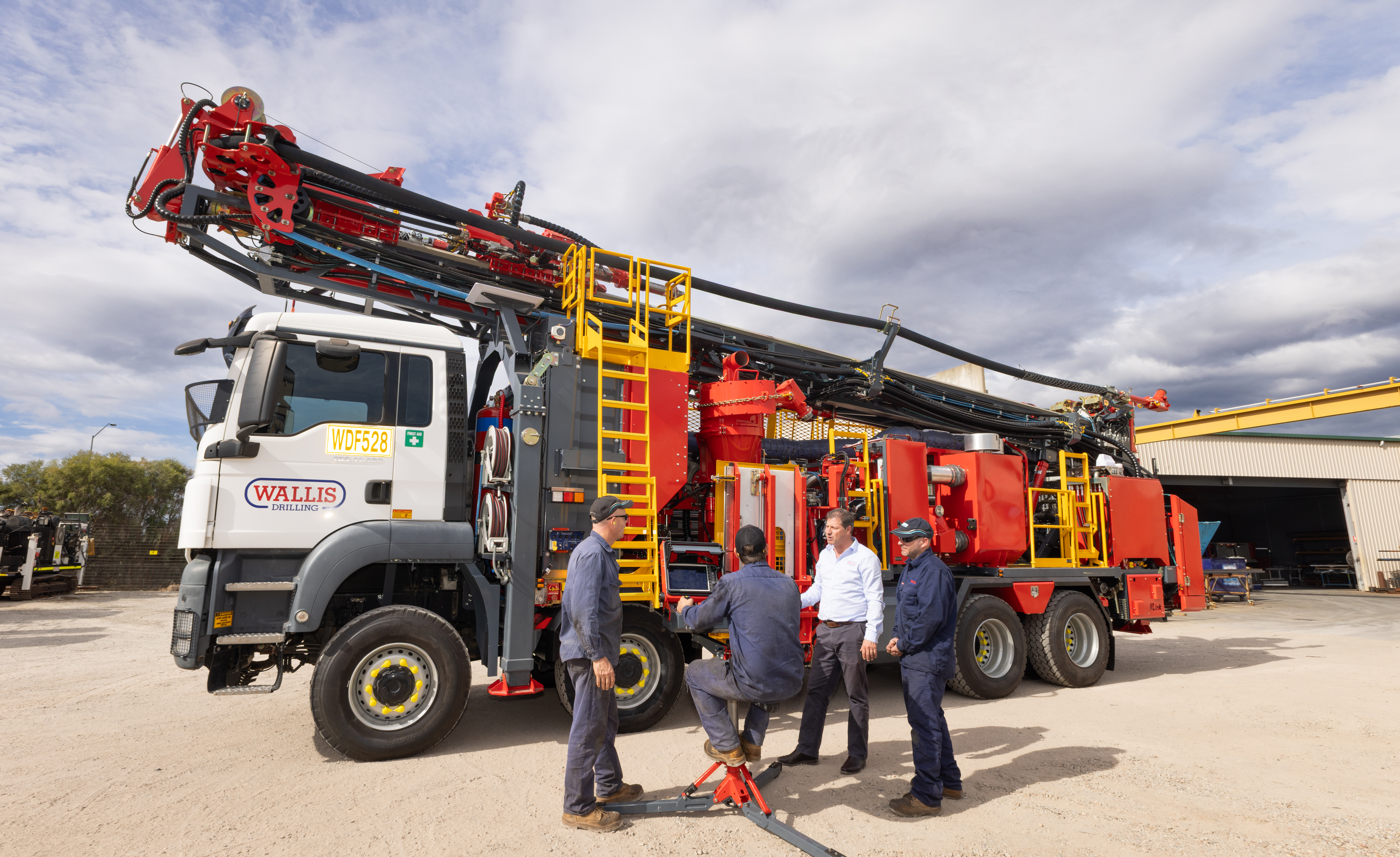
Grant Wallis with team members testing the company’s newest product, the 400RC drilling rig. Photo: Michael O’Brien
The company won its first contract in the iron ore sector with Rio Tinto 23 years ago and has subsequently secured work with BHP and Fortescue.
In the exploration sector, the company’s lead product is the Mantis 200AC drill, which came into service in 2022.
“They have changed the outlook on safety and productivity in the exploration space in that size drill rig,” Grant said.
“We took what we’d learnt in parts of the business and took it to a field where nothing was available, developed a product, and the 200AC is among the most in-demand drills in our fleet.”
Expansion
Of the 60 rigs in Wallis’ fleet, about three quarters have been built in-house and that proportion is set to grow.
“That number will grow as we push out the old fleet and replace them with new drills,” Grant said.
The company’s fleet of aircore rigs has been designed and built in-house.
Its reverse circulation rigs include several bought from other manufacturers, but they will be phased out.
“Right now, the market in iron ore is demanding automation and safety improvements,” Grant said.
“That rig is not available, so we are having to continue building our own.”
The company has no plans to manufacture diamond drill rigs, which are a small part of its fleet, nor does it plan to build blasthole drill rigs, which are mass produced and readily available in the market.
Mr Wallis said that in the company’s core markets, it had no plans to buy rigs from original equipment manufacturers.
“From a Wallis perspective, we see that we have purchased our last OEM drill,” he said.
“We will be manufacturing drills for our core business moving forward.”
Kim Wallis said the company would use local engineers and local staff to service the mining industry.
“Graeme and Jamie have always been firm believers in manufacturing in Australia,” Kim said.
“We are very proud of our company and our product and our people, that’s the secret sauce.
“The big clients also like to see local manufacturing.”
Mr Crumby said the company’s priority was a rig replacement program, which was expected to take between three and five years, depending on market conditions.
Once the company has updated its own fleet, it will evaluate the possibility of building rigs for other contractors.
The construction of a new purpose-built headquarters and workshops at Hazelmere has for the first time made that a possibility.
“We are confident in our ability to design and build, we’ve been doing that for a long time,” Graeme said.
“We couldn’t supply the outside market from our current facilities whereas our new facilities have a far better ability to do that.”
Grant said the company was still evaluating that opportunity.
“We haven’t settled on a position on that yet,” he said.
Manufacturing
If the company does become an OEM, it will be one of just a few manufacturers in the WA market.
The local manufacturers of RC rigs are led by Welshpool-based Schramm, which was bought three years ago by Swedish multinational Epiroc.
That was one of several acquisitions Epiroc has made in WA in recent years, along with mining technology firms Kinetic Logging Services and RCT.
Epiroc has stated it plans to double rig production volumes at Welshpool this year but has not provided further details.
Another smaller player in the market is Forrestfield-based Australian Exploration Engineering.
Canning Vale-based Ausdrill had a big focus on local manufacturing when it was led by founder Ron Sayers.
It is now part of ASX company Perenti, which has acquired multiple drilling contractors in recent years.
Through its subsidiary Best Tractor Parts, Perenti refurbishes drilling equipment for the group’s drilling services business but is not a manufacturer.
The capability of global OEMs was highlighted by a contract Epiroc signed with Fortescue in April.
It has been contracted to supply 50 electric blasthole drill rigs worth $350 million, which the Swedish company said was its largest ever contract.
The cable-electric and battery-electric machines will be manufactured in the United States and Sweden respectively.
The contract was also a pointer to the drilling sector’s electric and autonomous future.
Epiroc said the driverless machines would eventually be operated fully autonomously, overseen from Fortescue’s Integrated Operations Centre in Perth.
The machines will eliminate about 35 million litres of diesel consumption annually, according to Fortescue.
Grant Wallis is very aware of these trends.
“It’s coming whether you want it or not and you either jump on or retire,” he said.
“We need to innovate in design, decarbonise, electrify, it’s the only way forward.
“Without it, we will just be another contractor.”