Scratching your head over Trump’s recent Greenland fanfare? You’re not the only one.
The politically autonomous Danish territory has an interesting past, and its future appears just as complex as global superpowers vie for a slice of its natural resources.
A treasure trove of critical minerals amid a sea of melting ice caps, Greenland is a paradoxical symbol of the climate crisis and the race to curb global carbon emissions.
But this duality is far from new - in fact, some even say it’s part of how Greenland got its name.
Legend has it that Greenland and Iceland earned their monikers thanks to a quick-witted bait-and-switch orchestrated by Nordic Vikings.
Eager to keep roaming pirates away from their newfound home, the Vikings started a rumour that the place they had discovered (Iceland) was frigid and uninhabitable.
Instead, they encouraged their enemies to set off for the "green" land to the west, which turned out to be the icy, inhospitable island we now know as Greenland.
Centuries passed, the myth faded into obscurity, and Greenland’s true utility - as a hotbed of rare and valuable minerals - has since been revealed as the real story.
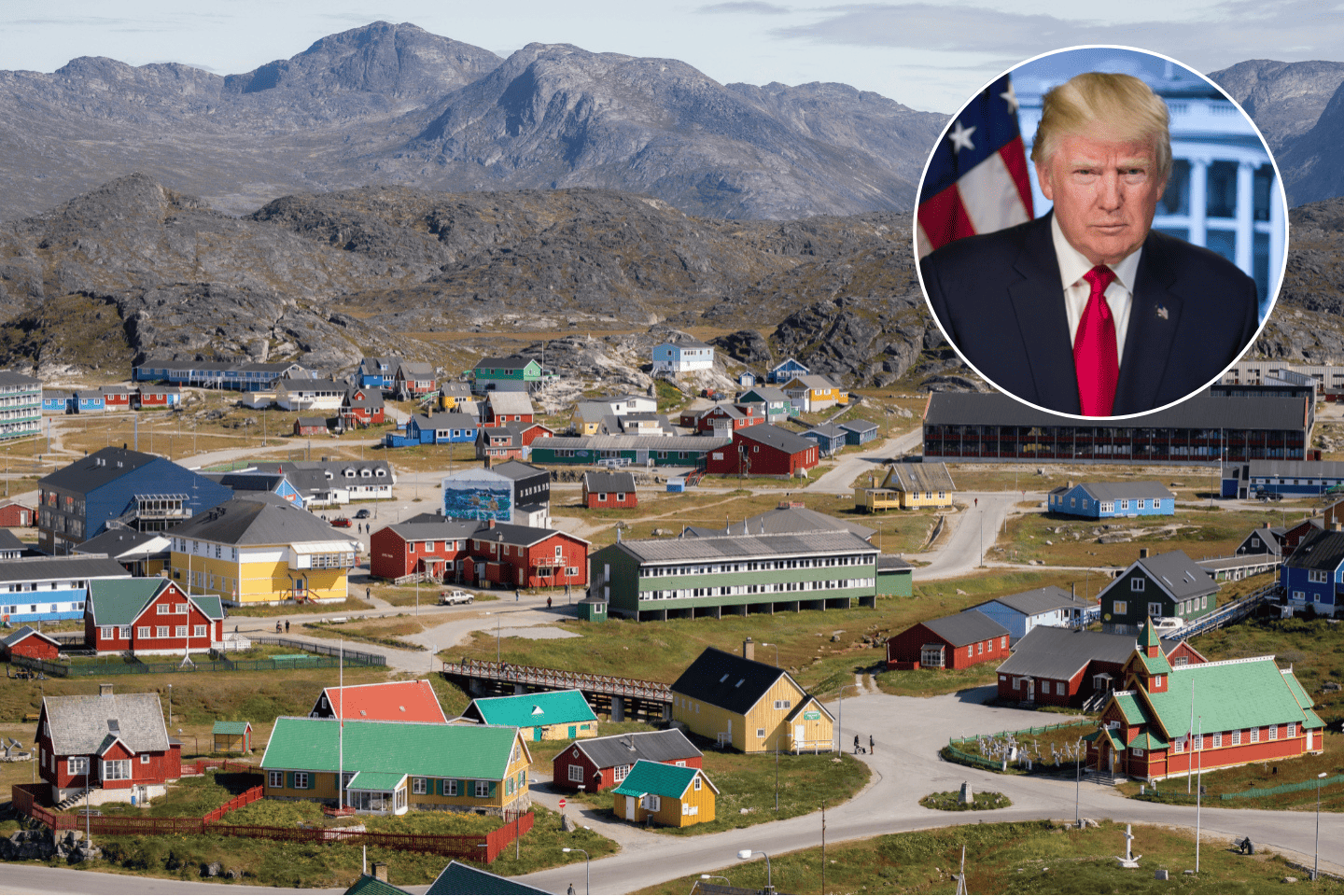
Of course, that reality hasn’t escaped the attention of global politicians, including the former (and soon-to-be) President of the United States, who sees Greenland's resources as key to the nation’s economic and geopolitical ambitions.
The latest chapter in this saga involves a bold proposition from Trump - that the U.S. should simply take Greenland over from Denmark.
The idea was first lobbed during the President-Elect’s first term in office, when, in 2019, The Wall Street Journal reported that Trump had repeatedly expressed interest in "buying" Greenland.
But now, the stakes are higher: in a Tuesday (Wednesday morning local time) press conference this week, Trump refused to rule out using force to secure the Danish territory, claiming the Arctic island was essential to “national security”.

A post from Donald Trump on social media platform Truth Social
That claim drew the ire of political leaders the world over, including Danish Prime Minister Mette Frederiksen, who responded to Trump's overture by saying “Greenland is not for sale”.
But beyond whether Trump is successful in his dreams of U.S. sovereignty over Greenland, the standoff has enormous implications - not just for the U.S. and Denmark, but for the superpowers vying for control of the Arctic and the resource pundits aiming to upend China’s monopoly on the critical minerals market.
Big-picture, the President-Elect is far from the first to highlight' Greenland’s raw potential. In fact, several WA companies have been exploring the island’s mineral wealth for years - long before Trump’s power plays made international headlines.
Close to home, Tanbreez founder and Perth geologist Greg Barnes is no stranger to the island’s rare earth prospects, having explored one of the world’s largest REE deposits in southern Greenland for nearly two decades.
He advised White House aides on the island’s commodity makeup back in 2019, bringing them up to speed on Greenland’s rare earth potential and territory politics when Trump first toyed with buying the island.
Fast forward to today, and Mr Barnes says Tanbreez has been a focus for his company since the early 2000s - and the potential of the project’s 4.7-billion-tonne multi-element resource just keeps growing.
“We’ve only looked at about 10% of the ore, so there’s a lot more to go yet,” he told Business News.
Numbers aside, Mr Barnes believes the real conversation centres not just on the volume of Tanbreez’s resource, but in its concentration of valuable rare earth elements.
“China has about 36 million tonnes of rare earths, most of which are light. But around a third of Tanbreez is expected to be heavy [rare earths],” he said.
Heavy rare earths, which have a higher atomic weight compared to their light counterparts, are set to be the flavour of the decade. They are essential components in everything from electric vehicles to military hardware, and their utility in magnets makes them a key ingredient in the renewable energy revolution.

Elements in the light and heavy rare earths mix. Photo: Tanbreez
There’s a problem though. The market for many of these rare earths - the most important of which include neodymium, dysprosium and terbium - is currently dominated by China, which controls more than 90 per cent of global supply.
Therein lies the opportunity for Greenland, and for WA explorers and miners eager to temper the Asian superpower’s stranglehold on the sector.
Barnes’ Tanbreez project sits atop the second-largest REE hub globally. Consequently, this earmarks the project as a lucrative development opportunity for countries that want to increase their critical minerals exposure.
Nations within the European Union, in particular, are keen to lessen their reliance on Chinese-dominated rare earth supplies, and Greenland’s ties to Denmark (an EU member nation) make it an appealing candidate.
In November 2023, the bloc inked a memorandum of understanding with the Arctic island, indicating their commitment to investing in critical mineral value chains and growing Greenland’s mining capabilities.
According to the EU, the agreement will help advance “sustainable and responsible mining” in the region, while strengthening Greenland’s resource security and easing Europe’s mineral reliance.
“Given the geostrategic interests and the battery mineral endowments in Greenland, it makes sense for the EU to deepen the raw material and geopolitical relationship with Greenland,” Benchmark principal policy analyst Bryan Billie said at the time.

The EU is hungry to secure these critical minerals. Photo: Benchmark
But it’s not just Europe that has sights set on Greenland’s mineral riches. In recent years, China has also emerged as a prominent suitor, with the Asian superpower moving to cement economic and political influence across the Arctic region.
Greg Barnes has seen offers of Chinese investment in the Tanbreez project, but he says while Greenland may welcome funding from international players, his company aims to strike a careful balance - one that benefits the island’s economy and environment.
“The problem is, from an economic point of view, most of the rare earths end up in the U.S. or Europe,” he told Business News.
“But China wants to do the maximum amount of production in their own country - they wouldn’t want to employ locals.”
Mr Barnes is far from the only Perth influence in Greenland. Last year, WA entrepreneur and Tanbreez director Tony Sage struck a deal to take a controlling stake in the Tanbreez project through Nasdaq-listed Critical Metals Corp, the same entity backed by Perth-based, Austria-focused ASX-lister European Lithium.
“Tanbreez is a game-changing rare earth mine for the west, and is a key step towards positioning Critical Metals Corp as the preeminent critical minerals supplier,” Mr Sage said when the acquisition was announced in June.
Since the deal was announced, Critical Metals has moved to a 42 per cent holding in Tanbreez. The company has the option to up that stake to 92.5 per cent down the line for a cool $116 million in shares, subject to a range of conditions (including key greenlights from Greenland’s mining authorities).
And in September, the Nasdaq-lister moved into a 14-hole diamond drilling program, aimed at improving confidence in Tanbreez’s rare earth bounty and shoring up options for the project’s development roadmap.
With an exploitation license in the can, Mr Barnes believes the project offers Mr Sage a tangible rare earth prospect that has the potential to become much more than a mineral endowment.
“It’s got a real opportunity to take Sage into another orbit”, he said.
“When you’ve got a project of this size and quality, it can make a person very important.”
Of course, the scramble for Greenland’s critical minerals doesn’t end at Kvanefjeld.
Perth-headquartered Eclispse Metals is chipping away at the Ivigtût project in southwest Greenland, home to the world’s largest and only known source of naturally-occurring cryolite - a lesser-known mineral known that has implications in the aluminum industry.
Ivigtût’s cryolite mining history spans more than a century, but Eclipse says there’s also near-term potential to turn waste material from the mine into concentrates jam-packed with critical minerals like zinc, gallium, copper, lead and rare earths.
Eclipse has also turned its attention to Ivigtût’s north, setting its sights on a rare earth enrichment known as the Grønnedal project that remains open at depth and in all directions.

Map of Eclipse's Grønnedal project. Photo: Eclipse Metals
This rare earth-rich complex has been recognized by the Geological Survey of Denmark and Greenland (GEUS) as a prime REE target, sitting just a stone’s throw from an eponymous port and the Kangilinnguit settlement.
Eclipse managing director Carl Popal told investors in March that the company was working towards an exploitation permit for the tenement covering Ivigtût and Grønnedal, with a pre-feasibility study for the camp expected early this year.
“The combination of gallium in the Ivigtût waste dumps and the substantial rare earth mineralisation at Grønnedal positions Eclipse as a potential leader in the supply of critical minerals essential for global clean energy and technology transition,” Mr Popal told the market in December.
Of course, bringing these minerals to market isn’t without its challenges.
ASX-listed Energy Transition Minerals, which was previously headquartered in Perth when it traded as Greenland Minerals, is also looking to mine rare earths at the Kvanefjeld project.
However, the company has faced ongoing opposition from local Greenland communities over the environmental impact of the historical uranium mine and the legacy of nuclear waste on the island.
Consequently, ETM has been embroiled in a long legal battle with mining authorities in Greenland, which banned uranium mining in 2021 in a move that threatens to block Kvanefjeld’s development.
ETM’s subsidiary has since applied for arbitration, seeking to have an exploitation license at Kvanefjeld confirmed after Greenland’s government rejected its applications in 2023.
Even so, these potholes haven’t deterred traders from buying into the market minnow. Following Trump’s comments on Greenland this week, ETM’s share price quadrupled to 8 cents on Wednesday.
The pile-on brought the company’s market cap up as high as $108 million recently, with the sudden price hike triggering an ASX speeding ticket in early January.
“The company notes that there has been significant global media coverage this week stemming from recent statements by incoming US President Donald Trump that owning and controlling Greenland is an ‘absolute necessity’ for the United States,” ETM said in response to the ASX’s price and volume query.
Regardless of what’s next for these Aussie resource hopefuls, one thing is clear: Greenland will remain at the forefront of the critical minerals conversation in the years to come.
And whatever the outcome of Trump’s bid for the Danish territory (although ‘bid’ may be too soft a word given the events of recent weeks), the world's largest and least populated island has all the makings of a global hotspot for developers seeking to shore up new sources of rare earths outside of China.