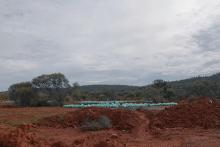
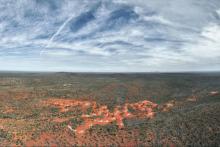
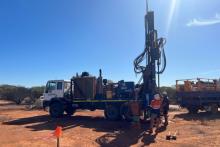
Following interpretation of results from a recent geophysical survey at its wholly owned Smokebush project near Paynes' Find, 350 kilometres north of Perth in WA's Mid West region, Terrain Minerals has identified seven new high-priority gold targets for drilling within its granted mining lease in the northern part of the company's tenure. Five more second-priority targets were defined across the greater survey area, with two at Lightning, one at Paradise City, one at Hurley and one at Wildflower.
The targets were generated from a dipole-dipole induced polarisation (IP) geophysical survey and include the most compelling anomaly, immediately north of the company’s recently defined 54,000-ounce Lightning gold resource within the company's granted mining lease.
The promising survey results come against a strong backdrop for WA gold explorers, with the Australian dollar gold price continuing to hover around the A$6300 per ounce mark, adding a solid commercial imperative to the hunt for new ounces.
The IP survey was designed to sniff out repetitions of Terrain's recent Lightning discovery, which itself emerged from a previous similar survey. The best results came from the northern extension of the Lightning and Monza structures and include the strongest chargeable anomaly, identified just north of the Monza structure, which forms part of the maiden Lightning mineral resource estimate announced last month.
The new IP anomaly returned amplitudes more than four times above local background level and has been modelled by independent geophysical consultancy Newexco Exploration as a discrete source with a steep easterly dip coinciding with a resistivity low. The consultants assessed it as the best-constrained chargeable anomaly in the entire program, with an amplitude comparable to responses observed in the best gold results at Monza. Terrain has already designed two high-priority reverse circulation (RC) holes to probe the response.
The survey also lit up a previously untested north-south structure 1500m west of Lightning, which the company says is a new target area. It has already designed two high-priority and two moderate-to-high-priority drill holes to test the anomaly. Adding further weight to the new targets, one of the survey lines sits close to the Lightning-Monza structures and within 50 metres of three historic drill holes which intercepted grades better than 5 grams per tonne (g/t) gold.
Terrain Minerals executive director Justin Virgin said: “These results are really exciting and exactly what the exploration team was expecting. We now have continuous IP coverage across our granted Mining Lease and an exciting list of priority targets ready for drilling. What really stands out is the anomaly north of the Monza structure. It's the strongest response we identified in the program and sits on the same structure that delivered our maiden Mineral Resource at Lightning. We've also identified a genuinely new structure to the west that has never been drilled.”
The company says that IP anomalies at Smokebush are generated by disseminated sulphides often associated with gold and sometimes, magnetite. As the IP technology cannot discriminate between the two types of response, Terrain's target ranking was driven by the coincidence of the geophysical responses with interpreted structures, surface geochemistry and known mineralisation, rather than by anomaly strength alone.
At the Hurley prospect, 1600m southeast of Monza, the 5-line IP survey included one line that ran across a historic drill hole that intersected 5m at 6.14 g/t gold, yet it was not associated with any IP anomaly. Terrain regards this as a material result as it suggests that IP alone may not always be a suitable means of identifying gold prospectivity, reinforcing the company's multi-faceted targeting approach.
At Paradise City, 1100m south of Hurley, a chargeable anomaly coincided with an interpreted major structure and historic drilling, and is considered the strongest candidate in the southern part of the IP survey. One previous drill hole near an equivalent hotspot on a line 200m north of the new Hurley anomaly returned 251 parts per billion gold and 4300 parts per million sulphur over one metre from a depth of 72m.
Terrain's new target inventory will now form the principal exploration component of the company's next round of RC drilling, which will also include infill and extensional drilling at the Lightning deposit. Terrain says it is currently finalising arrangements with its drilling contractor.
While the Smokebush gold project is its main game, the company also holds other interests, including its Lort River rare earths and Carlindie lithium-and-gold projects in WA.
Although Terrain only delivered its maiden 54,000-ounce gold resource at Lightning last month, the latest geophysical results have already served up a fresh batch of look-alike targets within the same mining lease.
In keeping with the project's Smokebush moniker, the combination of a modest gold resource at Lightning, promising drill hits, abundant IP anomalism, meaningful gold geochemistry, favourable geology and plenty of linear structures shows there is indeed plenty of smoke and it may even be enough to suggest a raging inferno exists somewhere nearby.
With a clear plan to get the drill bit probing the new anomalies soon, the company looks set to find out if lightning really can strike twice in the same place - and it might even be happy if it simply strikes again nearby with similar or better results.
Is your ASX-listed company doing something interesting? Contact: matt.birney@businessnews.com.au


 By Doug Bright