SOUTH WEST: Mining in the region often plays second or third fiddle.
A spotlight on the resources industry down south has reignited the discussion on mining activity in an area that is known for its lush greenery and coastal landmarks.
The mining sector was a talking point at the first Innovative Industries of the Future Conference in Bunbury in November.
At the conference, Association of Mining and Exploration Companies chief executive Warren Pearce called for more support for mining in the South West.
It was followed by the first release of seismic data collected through the Western Australian Array project, which received $30 million in state government funding.
The first phase of the waveform data, covering the South West, was released in November.
The state government hoped the array data would help exploration companies target areas of high prospectivity, evaluate competing land uses, mitigate seismic hazards and maximise WA’s opportunities.
Mr Pearce said a significant range of critical minerals lay under agricultural land, as shown by the prospectivity mapping.
“However, if we’re going to get to it, we’re going to need the support of the farming communities to actually go on that ground and explore in an area where it’s already being used for intensive use,” he said.
“Equally, we understand that Western Australia’s renewable energy is likely to be produced mostly in the South West and central Wheatbelt.
“If two thirds of our energy is going to be coming from it, that means there’s going to be some major new industries setting up here, outside of agriculture and mining.
“It means you [will] be seeing large solar farms and large wind farms. We need to find ways ... to coexist and to work together.”
Chamber of Minerals and Energy or Western Australia chief executive Rebecca Tomkinson acknowledged that the region’s resources sector was often overlooked.
Ms Tomkinson said the South West contributed $2 billion towards the WA economy from mining, according to CME’s economic contribution survey 2022-23.
“When people think of resources in Western Australia, their minds turn to the conventional and more visible mining heartlands of the Pilbara and the Goldfields,” she said.
“While the North West is underpinned by vast iron ore operations that rely on economies of scale, the South West has a more diversified portfolio of higher-value commodities extracted from much smaller footprints.
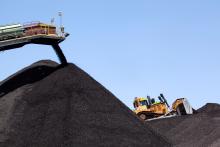
“If you include [the] neighbouring Peel, the region boasts the world’s biggest hard rock lithium mine in Greenbushes, Australia’s only commercial silicon producer in Simcoa, Australia’s largest gold-producing mine in Boddington, and two coal mines in Collie that have played an important role powering WA’s main electricity grid for decades.
“The region also houses a lithium hydroxide plant in Kemerton and is a major supplier of alumina and mineral sands.”
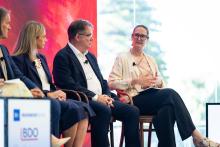
Warren Pearce called for more mining down south. Photo: Nadia Budihardjo
Opposition mines and petroleum spokesperson Mia Davies agreed with the assessment, telling Business News the South West was poised to play an important role in the global energy transition but required investment from federal and state governments.
“The North West dominates in bulk commodities and large-scale mining, serving as the economic powerhouse of WA’s resources sector,” she said.
“In contrast, the South West offers more diversity, with an emerging industry focused on critical minerals and downstream processing.
“There is a healthy mix of long-standing commodities and operators, newer companies and minerals that reflect the mining ecosystem of the future, particularly with regards to the battery supply chain.
“Minerals and products coming out of the region include synthetic rutile, titanium dioxide pigment, glues and binding agents, alumina, coal, gold, spodumene (lithium) and silicon.”
On top of the WA Array project, the state government has invested in some initiatives to boost mining in the South West, including creating a dedicated and localised Department of Energy, Mines, Industry Regulation and Safety liaison officer role in early 2023.
“The role directly engages with stakeholders such as local government agencies, community organisations, environmental groups and private landowners,” Mines and Petroleum Minister David Michael said.
“This interaction helps educate stakeholders on how the department regulates mining in the region.
“In May 2022, DEMIRS created the Aboriginal Empowerment Initiative, which drives genuine engagement and mutual partnerships with Aboriginal stakeholders across the state, including the South West.
“The AEI openly communicates the department’s intentions, listening and seeking Aboriginal stakeholder guidance on matters that affect their country.”
Major players
The biggest resources operation in the region remains Talison Lithium’s Greenbushes mine, one of the longest continuously operated mining areas in WA.
Mining in Greenbushes can be traced back to 1888, with lithium being produced by Talison and predecessor companies from their operations in the area since 1983.
Talison Lithium chief executive Rob Telford said the mine, located between Balingup and Bridgetown, was a true global player.
“It is the biggest producer of lithium concentrate in the world. It is the purest grade [of spodumene],” he said.
“While some folks are hurting– and we feel for them because it’s never easy when you have to cut back – we are steadily moving forward.
“We operate in a part of the world that is just absolutely stunningly beautiful and unique.”
Another player in the region is International Graphite, which operates a mine near Hopetoun and a downstream processing plant in Collie.
The company is planning a battery production facility in Collie, International Graphite chair Phil Hearse said at the IIF conference.
“There is about seven times more graphite than lithium in a lithium-ion battery, but there is virtually no production of graphite in Australia,” he said.
“There is no downstream processing. There is no production of graphite to speak of in the US, Canada, anywhere in Europe.
“It is completely controlled by China, and really, just about every kilogram of battery that comes out has got Chinese production.
“So, you can understand really, the apprehension that countries have [on] that supply chain dependence.”
Little big towns
So where are the investments headed, and where in the South West are the hotspots for mining projects?
Bunbury, the biggest city outside of the Perth metropolitan area, is no doubt on the list.
“The Port of Bunbury has a large landholding and can be expanded considerably to allow the more efficient turnaround of imports and exports, including through the addition of storage facilities and laydown areas capable of accommodating both regular trade products and bulk renewable infrastructural imports,” Ms Tomkinson said.
“This could be complemented by investment in an open access intermodal terminal in or near Bunbury that links to both the port and the Kemerton Strategic Industrial Area, as well as better rail links between Perth and the South West.
“Reactivating the Greenbushes to Picton railway line is another opportunity to better service spodumene and other rail movements between Bunbury and the Greenbushes area.”
Mr Pearce similarly referenced Bunbury as an appropriate spot for infrastructure.
“We’ve got a lot of reasons that Bunbury in the South West is very viable infrastructure: access to ports with a large resident population and a skilled workforce here, so we’ve got someone to work with, but none of that happened,” he said.
“We’re going to have to find internal mines somewhere in the South West if that’s to take place.”
Despite pitching Bunbury as the viable spot for infrastructure, a lot of conversation around the city has been about the transition to net zero emissions.
The federal government has declared the country’s sixth offshore wind zone in the Indian Ocean off Bunbury, between Cape Naturaliste and Dawesville.
Bunbury mayor Jaysen de San Miguel said whatever green industries the state would be developing in the future would be in the South West.
“We have some infrastructure here,” he said.
“We have an incredible port where it’s going to be so heavily accessed,” he said.
“We’ve now got a road infrastructure to be able to grow to cater to some of this stuff. All of those things are coming.
“We need to make sure, as a city, we’re poised to get ready for them, and we’re going to continue our lifestyle and that’s where the significant investment in some of our regional facilities has happened internally.”

A town that can’t be missed in the green energy discussion is Collie.
The state government plans to close coal stations by 2030, transitioning the coal-powered economy in Collie to a renewable one.
Mr Hearse said International Graphite had dealt with about 70 individual companies in Collie.
“We have been just amazed by the level of professionalism that we’ve received in Collie,” he said.
“Our current status is that our feasibility study is progressing on the mine, we have established the first graphite downstream processing facility in Collie.
“That’s the first one in Australia, and we’ve built a much bigger qualification plant now in Collie, again, the first in Australia, and we expect to be fully funded for our first commercial downstream processing plant and have that up and running by the end of next year.
“That’ll initially be with imported feedstock, until we get our mine running.”
Green Steel of WA is developing a green steel recycling mill using renewable energy in Collie, and a hydrogen-powered facility to produce steel from iron ore in the Mid West.
The company aims to have the recycling mill operational by 2026.
The project is set to be the country’s first steel mill in more than 30 years, the company claims.
Green Steel of WA co-founder Don Johnston said there was an opportunity to capitalise on scrap steel in Collie, a resource that had been a topic of discussion by the European Union.
“Far more importantly, there is a huge transition occurring across the world, and the epicentre for that in WA is Collie, as far as the energy transition,” he said.
“It’s not a huge town, but it’s held together currently, and it has been for generations, by coal … the whole state benefited from that industry as a result, and they’re now facing a pretty significant change for a very short period.
“There’s a whole load of scrap steel in Western Australia that gets exported. It all goes offshore.
“But ultimately, we’ve got a great opportunity with this scrap.”
The Kemerton strategic industrial area, 17 kilometres north-east of Bunbury, is one that has been troubled of late.
US-based Albemarle has shut down parts of its Kemerton lithium plant, stopped construction activities at the third lithium hydroxide processing plant and adopted idle production at train two.
But Ms Davies said there was hope for the area yet.
“Downstream processing presents an opportunity for the region, but only if the right investment is made into Strategic Industrial Areas to facilitate this investment in the supply chain,” she told Business News.
“Activating the Kemerton SIA should be a high priority for [the] government given the capacity limitations that exist at the Kwinana Industrial Area.”
Mr Pearce said downstream processing was the region’s next big step.
“There is a big opportunity to develop those processing hubs here in the South West, whether that be here, inside or outside Bunbury or in Collie, there are active efforts by exploration mining companies to look to do processing on minerals in these communities,” he said.
“However, you can’t process what you can’t buy. If we’re not able to turn on mines in the South West, they won’t be processed here.
“We’re not going to be sending minerals down from the Pilbara to process them in Bunbury or Collie only.
“It’s going to have to be somewhere more local, where it makes sense to transport locally, process here and then export through some of the ports.”
Challenges
Despite all the hopes pinned on the region, there are hurdles to overcome.
Mr Pearce said one of the issues faced by mining project developers was competitive land use.
“Unlike in the goldfields, there’s not a lot of unused land. There’s a lot of intensive use,” he said.
“For a start, there’s a quite substantial state forest that runs through the South West that is heavily, heavily fought for by environmental activists and indeed, communities here in the South West.
“You’ve seen that mining companies that have taken the efforts to explore or operate here face a range of challenges.
“The question we need to ask, is the South West off limits for these developments, or is there a path to take these projects forward and realise that opportunity that may exist under the forest or into the agricultural areas?”
Rob Telford, Phil Hearse, and Don Johnston at the IIF panel. Photo: Nadia Budihardjo
Ms Tomkinson said the region had a deserved reputation for its nature and biodiversity, acknowledging the community’s desire to protect it.
But Ms Tomkinson said competing land uses was an issue for many resources projects across the state.
“WA has rigorous environmental protections in place for all resources projects,” she said.
“Our members have a focus on accessing these commodities in a way that seeks to minimise adverse impacts.
“Expansion of the South West resources sector is also limited by bottlenecks in key transport infrastructure including ports, road, rail and aviation.
“The South West experiences many of the same challenges that apply to the sector as a whole, including lack of access to turnkey industrial land, access to low emissions electricity that is also reliable and low cost, and an undersupply of housing.”
Mr Michael said there was a balance to developing resources projects with conservation in mind.
“Despite the resource prospectivity of the state’s South West, there is high sensitivity with respect to environmental and social values in the region,” he said.
“We will continue to work closely with local communities to ensure any new projects benefit both the environment and the economy, while protecting the region’s iconic landscapes, water resources, or agricultural activities, which are critical to maintaining the local lifestyle.”
Ms Davies similarly said there was always a balance to be struck in maintaining a sustainable mining industry and preserving the region’s assets.
Ms Davies said companies operating in the region had a high awareness of sustainability because they were operating in a biodiversity hotspot.
“While the mining sector underpins significant economic opportunities in the South West, the region’s natural landscapes are integral to its agricultural productivity and tourism industry,” she said.
Business News' South West publication is out now