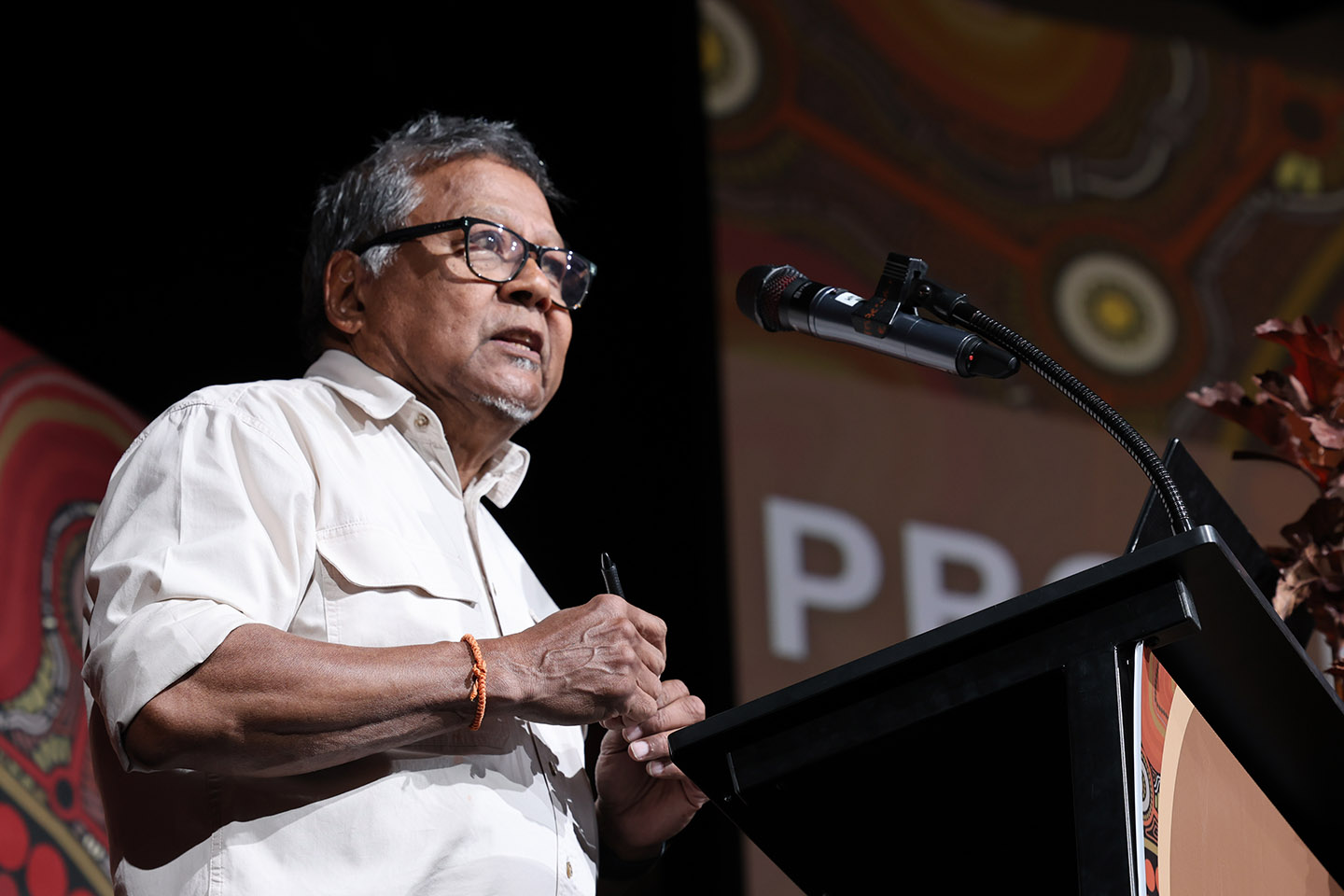
Yawuru professor Peter Yu has urged native title groups to buy stakes in infrastructure, while warning of the risk far-right politics posed to Indigenous advancement.
Speaking at Broome Chamber of Commerce and Industry’s Indigenous Business Forum on Tuesday, Mr Yu said Kimberley Aboriginal groups were well positioned to take advantage of trade with South East Asia, as they had done pre-settlement.
To do so, Mr Yu said native title bodies needed to start consolidating and taking equity positions in infrastructure and services.
“We have direct and indirect ownership of 96 per cent of the land assets, so the issue for us now is how do we start building and how we might consolidate and develop some kind of resilience capability,” he said.
“None of the prescribed body corporates – unless they are very lucky – are ever going to substantially generate their own revenues by themselves.”
Logistics and export infrastructure were singled out as key opportunities for equity positions given the Kimberley’s proximity to Asia.
Mr Yu said geopolitical instability and the rise of far-right politics would leave Indigenous groups vulnerable if they did not get creative about building wealth.
“We can’t rely on governments down south, we can’t rely on politics,” he said.
“We see the nature of growth of the far right and we know its views toward Indigenous business.
“We have got to continue to build our strength and resilience because these matters are not guaranteed for life.”
Mr Yu’s views were shared by most speakers throughout the day in Broome.
Fellow former KLC leader Wayne Bergmann said business relationships, not native title, were where real difference could be made.
“Native title, I don’t know if they are worth the paper they are printed on,” he told the forum.
“The reality is it is the individual managers in these companies who have that attitude who can walk side-by-side with you and make a difference.
“I have no faith in the government system.”
Djarindjin Aboriginal Corporation chief executive Nathan McIvor was similarly critical of government systems and full of praise for the power of commerce.
“Don’t settle for small stuff – don’t be looking at 5 per cent equity, look at more than 50 per cent,” he said.
“Go for 100 per cent and then you can bargain from there.
“We been around 65,000 years and did a bloody good job before whitefellas came along.”
Mr Yu, an Australian National University professor and former Kimberley Land Council boss, delved into several practical options on the table for Kimberley Indigenous groups.
Chief among those was an idea for the corporations and PBCs of the Dampier Peninsula to pool resources into a development and investment vehicle and take control of the peninsula’s destiny.
“Negotiate with the state and shire to delegate approvals and development application to be controlled by those eight entities,” Mr Yu said.
“The question is the possibility of looking at the peninsula becoming a development zone in its own right where we delegate rights of a local government to those communities.
“You are not going to get legal authority the way the state is established because of racist laws, so the only way to take it is economically.”
Mr Yu said pay-for-access models imposed at African safari parks could be implemented on the peninsula, where tourism has boomed since the access road was sealed.
On another economic development opportunity, Mr Yu said running a spur line from the subsea fibre optic cable to Broome could turn the Kimberley town into a hotspot for data centres, communications and universities.