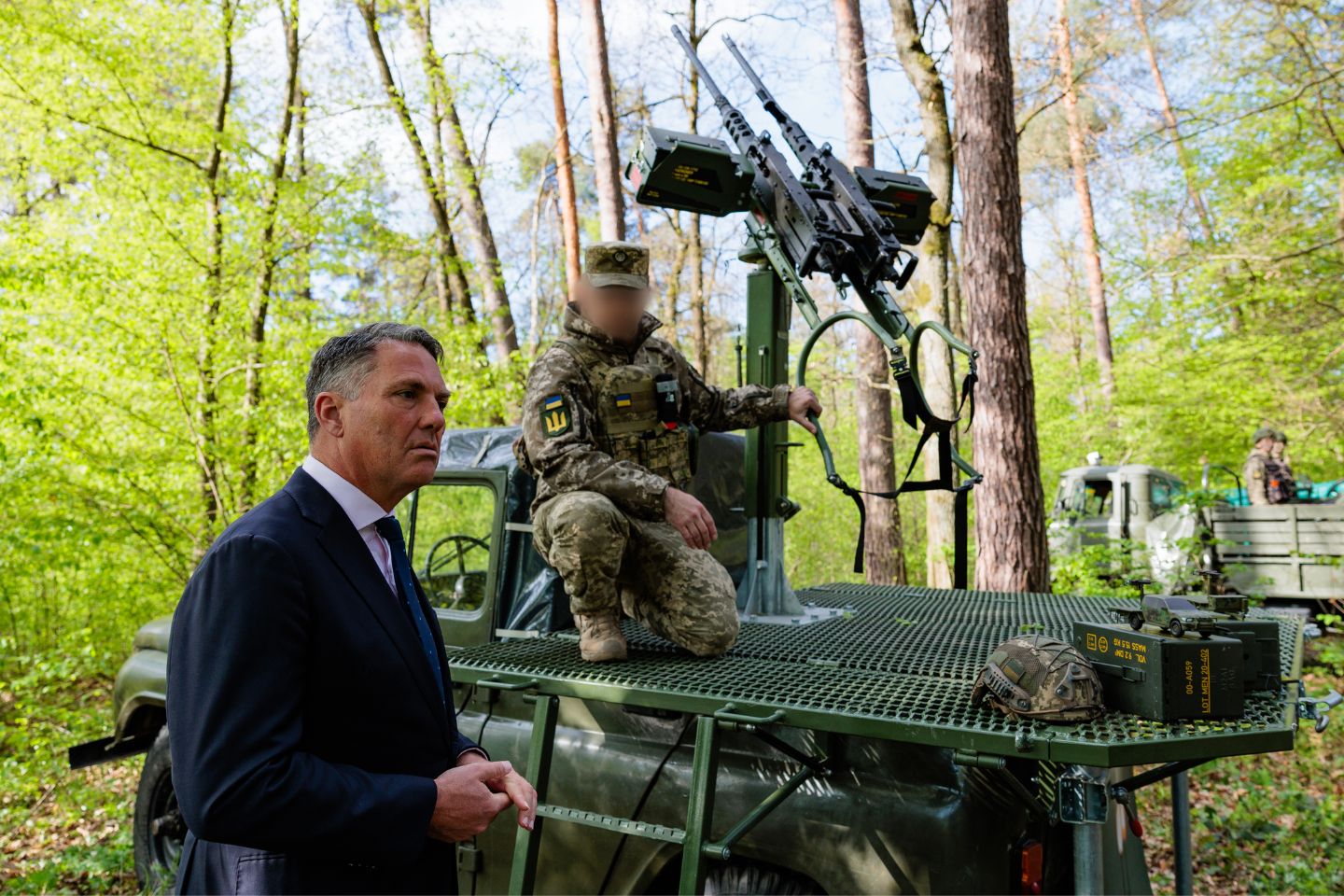
Australia's new 10-year security agreement with Ukraine deserves attention for something beyond being another aid package.
The agreement was announced following a meeting between Prime Minister Anthony Albanese and Ukraine’s president Volodymyr Zelenskyy on the sidelines of the recent UN meeting in New York.
It could mark a turning point in the relationship between the two countries, leading to a shift towards joint capability-building, rather than simply Australia providing Ukraine with military equipment.
Australia has now committed almost $1.9 billion in support to Ukraine, including $100 million announced by Defence Minister Richard Marles in 2024. That has included 120 Bushmasters, 56 M113 armoured vehicles, 49 M1A1 Abrams tanks, M777 howitzers, missiles, ammunition, drones, counter-drone systems and other equipment.
The latest announcement adds a further $60 million.
Military assistance is often discussed as though donor nations simply ask what a partner needs and provide it. Reality is more complicated. Aid packages also reflect what donors manufacture, what they can spare, what their governments will authorise and, sometimes, what they are already replacing.
Australia has examples of both. Bushmasters have become a visible Australian contribution, while the Abrams tanks were leaving Australian service but also met a direct request from Kyiv. The best support can satisfy an urgent Ukrainian requirement while strengthening industry at home.
Of more interest is what comes next.
Australia and Ukraine have agreed to explore joint production of air defence systems, missiles, drones and other technologies, including through joint ventures. The agreement also identifies uncrewed systems, the maritime domain, repair, maintenance, technology exchange and supply chains as areas for industrial cooperation.
President Zelenskyy said the agreement would increase co-production and trade. That matters, because Ukraine is no longer simply a recipient of Western military technology.
Four years of fighting a technologically sophisticated war has forced its defence industry to innovate at extraordinary speed, particularly in uncrewed aerial and maritime systems, electronic warfare, counter-drone technology and the integration of these capabilities.
There is an obvious opportunity here: Australia can provide capital, advanced manufacturing, materials and access to trusted markets while Ukraine contributes technology refined through battlefield experience.
Canada has already embraced this logic. Its new partnership with Ukraine combines Ukrainian battlefield experience with Canadian manufacturing, software and artificial intelligence to jointly produce uncrewed systems, counterdrone technologies and munitions.
Canada is not merely asking what it can give Ukraine. It is asking what the two countries can build together.
With this new defence pact, Australia has now asked the same question.
Ukraine also offers another lesson: global defence supply chains can look very different once a war starts.
Defence procurement naturally considers price, quality, delivery times and country risk. But there is another question that deserves greater weight. Will the supplier still sell to us when we are actually fighting?
Ukraine has discovered the existence of a defence industry in another country does not guarantee access to its products. Switzerland and Brazil, for example, have refused requests to provide military equipment and ammunition, respectively, for Ukraine.
The policy rationale of those countries or individual companies is their own to determine. For Australia, however, the lesson is strategic rather than political. A component can be commercially available, technically suitable and competitively priced, yet become unavailable when its end-use changes from deterrence to conflict.
That does not mean Australia should manufacture everything itself. It means we need to identify what somebody else may be unwilling to sell us were a conflict to begin.
Some capabilities therefore warrant sovereign production. Others can come from trusted allies, multiple independent suppliers or strategic stockpiles. What matters is understanding the difference before a crisis exposes it for us.
There is a broader dimension to Australia’s agreement with Ukraine.
Mr Albanese observed that Ukraine is “not just an issue for Europe” but for the world. Australia, Canada and European nations are increasingly building security relationships across geography because their interests, institutions and supply chains are interconnected.
For a country like Australia, that matters.
If Australia ever needs ammunition, components, intelligence, industrial capacity or political support from abroad, the strength of those relationships will matter enormously.
The friends willing to answer our call tomorrow may be influenced by the kind of friend Australia chooses to be today.
• Kristian Constantinides is general manager of Airflite and was the 2023 recipient of the Minister’s Award for Services to Defence Industry. The opinions expressed are purely his own