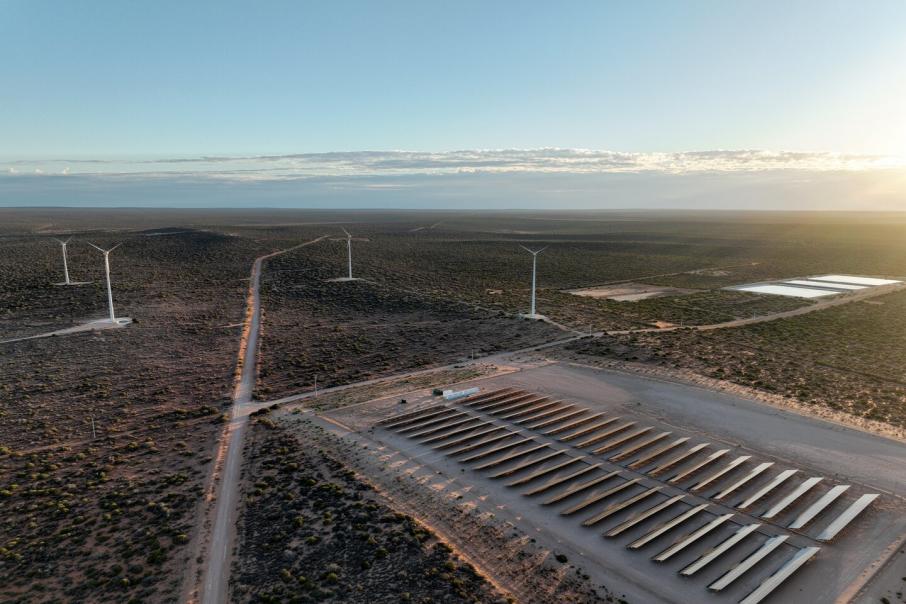


Economic challenges have dominated discussion in a hydrogen sector where driving ideology and market need are yet to align.
Corporate Australia is no stranger to the concept of the first mover advantage, rewarding the company that is brave and bold enough to lead the market on a new product or service.
Less well known, but perhaps more applicable in the recent narrative of the nation’s stuttering hydrogen sector, is the Dutch concept of ‘wet van de remmende voorspong’.
Coined by the journalist and historian Jan Romein in 1937 as Europe lurched towards a second global conflict, the phrase translates to ‘the law of the handicap of a head start’.
It is the conceptual contrast to the first-mover advantage; highlighting that moving first in a sector can, in some instances, hamstring progress, while setting the path for others to follow.
The handicap could apply to Chevron’s capture carbon efforts at the Gorgon project on Barrow Island, where the company pushed ahead to deliver the nation’s first carbon dioxide sequestration facility only to be plagued by inefficiencies in the years that have followed.
Carbon capture is fast becoming a need, rather than merely desirable, in oil and gas. Someone had to move first.
While Chevron’s efforts have been disrupted by the unexpected – sand in the water extraction process is the hindrance at Gorgon – others are able to learn from their experience.
The first mover, meanwhile, pours time and substantial cash into fixing its project.
Whether any such handicap applies to Western Australia’s hydrogen sector depends on how you define the traction achieved by those that have put money behind the grand ambition.
Can the progress made to date really be viewed as a head start? Maybe to the optimist.
Some in the sector have a better case for having started than others, but few are without their hurdles. There are many lessons to be learned from those that have tested the waters.
To the cynic, a slew of recent green hydrogen scale backs and slowdowns may also paint the picture of a false start.
And if we are to paint a picture, the hydrogen sector’s progress to date has been a bit like a Jackson Pollock: colourful, expensive, and open to interpretation.
Brushes down
Andrew Forrest’s Fortescue has been the leading voice in Australian green hydrogen for several years, and the company has put substantial cash behind its push to lead the sector.
Once the third force in iron ore, Mr Forrest wants Fortescue to be the world’s first force in green hydrogen, fuelling its iron ore mines and a vision for green steel beyond them.
It plans to use renewables to generate energy, which will then run through demineralised water in an electrolysis process that splits the hydrogen and oxygen components.
That hydrogen would be produced with zero emissions, making it green, and used to power the company’s iron ore mines and green steel manufacturing ambitions as it pushes to decarbonise by 2030.
As proof of concept for the use of hydrogen as a fuel, Fortescue has in recent years delivered three hydrogen electric fuel cell trucks and commissioned a $34 million hydrogen refuelling hub at its Christmas Creek mine in the Pilbara in August.
At the launch of the latest of the three trucks, Mr Forrest insisted he would personally turn off any Fortescue equipment still running on diesel and gas by 2030.
But moves by the company only a month earlier cast doubt on its ability to deliver green hydrogen as quickly as hoped.
In a July restructure, Fortescue cut its global workforce by 700 across its energy and metals divisions and scrapped a 15 million tonnes per annum green hydrogen production target, earlier slated for 2030.
Mr Forrest likened green hydrogen to a must-have item, like penicillin, but conceded the challenge was in working out how to produce the gas cheaply enough to make it economic.
Four hydrogen projects globally were deprioritised because of high electricity costs. In Canada, in October, Fortescue formally withdrew the mooted $3 billion Coyote green hydrogen project from British Columbia’s environmental assessment process.
“We have focused our energy project portfolio to include a pipeline of commercially viable projects to carry us forward and meet future demand, while acting in the best interests of our shareholders,” it wrote to the British Columbia Environmental Assessment Office.
“With that, we have decided to put on hold our project Coyote in Prince George until we are able to secure more favourable power pricing and availability.”
The company has started groundworks at its first green hydrogen facility in Arizona, where a final investment decision was taken in November 2023, but has yet to receive clarity on its eligibility for tax credits under the Inflation Reduction Act.
Fortescue insists green hydrogen is its future and has launched an electrolyser factory at the PEM50 project in Gladstone, Queensland.
That project and the Arizona facility are two of four initial green hydrogen focus projects for Fortescue, with others in Oman, Morrocco, Egypt and Jordan further back in the queue.
As a listed company, Fortescue must balance its green push against the financial discipline its shareholders expect.
“We will never do projects that are not economically viable,” Fortescue Energy chief executive Mark Hutchinson said on an investor call in July.
“As the green hydrogen market develops around the world, it is really clear that the cost of green power, which is obviously the way you start with green hydrogen, has to be in the US thirty-dollar range to make projects viable.”
However, achieving that price was a challenge in Australia, particularly in WA, he said.
Fortescue said it would invest in producing green electrons from its portfolios in WA and Queensland; focusing on renewable electricity while tempering green hydrogen expectations for the time being.
Changing hues
Woodside Energy’s hydrogen commentary has been equally value focused, but on the other side of the ledger.
The Perth-headquartered oil and gas producer has several early stage blue (not zero emission as it is produced using natural gas, but leveraging carbon capture) and green hydrogen projects on its books in Australia and abroad.
In October, Woodside inked an early-stage term sheet to supply liquid hydrogen to a Singaporean data company from as early as 2030.
It hopes to source the material from its H2Perth project, a proposed commercial-scale hydrogen and ammonia production facility in WA for which a final investment decision is yet to be taken.
Similar non-binding offtake term sheets have been signed with customers at Woodside’s H2OK blue hydrogen project in Oklahoma, where it is still waiting on federal government guidance over eligibility for tax credits under the IRA.
A final investment decision at H2OK is contingent on that tax clarity.
In March, Woodside chief executive Meg O’Neill flagged the immaturity of the hydrogen market as a barrier for the company’s hydrogen ambitions, with demand development a serious challenge.
“The progress in securing hydrogen offtake has been slower than initially anticipated,” Ms O’Neill said.
“We will continue to maintain discipline in our investment approach, and we will make positive final investment decisions when we are confident they are compatible with our capital allocation framework.
“We are working with potential customers to develop demand.”
The push from a producer to develop the demand for its own product highlights a serious challenge for those in search of a first-mover advantage.
A move toward lower-carbon ammonia production at the recently acquired Beaumont project in Texas is contingent on its ability to use carbon-abated blue hydrogen, facilitated by access to a CCS facility to be brought online by ExxonMobil in 2026.
But that investment was significant, at $3.7 billion, and marked a shift by Woodside towards ammonia production in the US.
Closer to home, CCS has become a focus point for Yara Pilbara, the north-west ammonia producer currently building a pilot-scale green hydrogen project called Yuri, in partnership with French power company Engie.
A first mover for certain, Yuri is slated to be one of the first industrial scale off-grid power-to-hydrogen projects in the world.
Yara general manager Laurent Trost dialled back his company’s green hydrogen rhetoric at the Australian Energy Producers conference in May.
It was there that Mr Trost revealed Yuri, which will be fuelled by a 20-megawatt solar farm to produce less than 1 per cent green hydrogen, with the balance to be grey hydrogen, extracted using natural gas, and no carbon capture.
“The economics is not there yet, and the electrification of the grid to bring massively green electricity to the place where we operate is not there,” he said.
“We need electricity twenty-fourseven, and the wind and solar is not yet guaranteed.
“It will take years to be capable of guaranteeing an economically viable green hydrogen, green ammonia production.”
As a result, Mr Trost said Yara had partnered with Woodside to explore CCS in the depleted Angel field and was looking at similar options for Santos’s Reindeer field.
Yuri’s plight highlights another challenge facing the emerging hydrogen sector: the availability of equipment.
When Business News wrote its 2023 hydrogen feature last November, Yara was waiting for the arrival of the all-important 10MW electrolyser needed to generate hydrogen at the site.
The electrolyser still hasn’t arrived. The solar array fuelling the green component of the hydrogen project’s output will be installed by December.
Yara’s latest guidance is that the electrolyser will be on site the same month, towards commissioning in the first half of 2025.
At a conference in October, Mr Trost said that, once Yuri was up and running, the project’s economics would need to be right to lift green hydrogen output above 1 per cent.
“We have the plans to expand the project ready to go,” he said.
“But we need economies of scale to make the numbers stack up.
“And we fear this will take time WA does not have.”

Yara's Project Yuri demonstration plant is under construction. Photo: Yara Pilbara
Time
Australia’s renewable potential should make it a hotspot for the green energy required to power a green hydrogen sector, but the economics of the technology remain a challenge for those seeking to deliver on a commercial level.
Deloitte Access Economics senior partner Matt Judkins, who leads the firm’s Australian Energy & Climate Advisory business, told Business News the hydrogen hype had been replaced by realisation of the economic reality.
“Offtake has been a challenge to find at scale,” Mr Judkins said.
“This is why we have seen so many early proponents pare back ambitions, including Woodside.”
However, Mr Judkins is a firm believer in the role of green hydrogen as a decarbonisation fuel, and said early proponents abroad were focused on technology before scaling up.
Australia’s renewable endowment means it needs to be ready to go before those large-scale investment decisions are made.
“We are still seeing pilot projects at a sensible scale proceed in Europe and elsewhere,” Mr Judkins said.
“The message coming from many of these developers is that these projects will be used to prove up the technology before they look to undertake scaled projects in the multi-GW capacity (up to tens of GW).
“This is where developers will look to Australia as having the environment to support these large projects, given our renewable resources and land availability.
“Our engagement and planning needs to ensure the approvals and enabling infrastructure for these projects is in place and ready to go.
“We also need active outreach to these developers to ensure global competition from the Middle East and elsewhere doesn’t steal our lunch.
“We have a bit of work to do here still.”
Elsewhere, small hydrogen aspirant Province Resources recently faced challenges in progressing its proposed green hydrogen project in the Gascoyne, which is to be powered by renewables.
Province management has been critical of the state government’s policies around land tenure, having earmarked a 595,000-hectare site across pastoral stations and Crown land near the Carnarvon coast.
The state gave Province lead agency status in 2021, but the company has accused it of dragging its feet on land tenure decisions.
Province managing director David Frances told Business News the government’s requirement that pastoral leases be reclassified as diversification leases made the future uncertain for landowners and left the business in a stalemate.
Mr Frances said Province only required a small part of the pastoral leases to facilitate its placement of wind turbines. The company had support of landowners, he added, but the requirement for a change of classifications was a bridge too far.
He said the issue of stalled land access had cost the company the interest of potential offtakers for its proposed green hydrogen.
“They kept saying, ‘Come back when you’ve got tenure,’” Mr Frances said.
“We had to keep saying, ‘Oh look, sorry, we haven’t got it yet, but we don’t think it’s too far away. Let’s keep talking and we’ll come back to you’.
“Twelve months rolls into two years, into two and a half years. And by this stage, the interest in the green hydrogen industry is pretty much waning anyway.”
He said WA had shot itself in the foot in terms of driving early interest in the space but credited former hydrogen industry minister Alannah MacTiernan for her work in the area prior to her political departure at the end of 2022.
That role was absorbed into the State and Industry Development portfolio held by Roger Cook after he became premier in June 2023.
“They lost that golden opportunity because they moved way too slowly,” Mr Frances said.
“It wasn’t iron ore, and it wasn’t gas, so while they’d kind of talk about it, they weren’t really interested in doing anything.”
A state government spokesperson levelled responsibility back at Province in response to the company’s decision to scrap the project.
“The WA Labor government passed legislation last year specifically to enable renewable energy projects on Crown land in WA,” they said.
“However, Province Resources opted to ignore this pathway, instead making a number of unreasonable and highly complex requests around land tenure.
“Despite this, the state government has worked hard to facilitate Province’s project – including granting lead agency status to the project – and we are disappointed that Province has now walked away from this opportunity.
“Our government remains supportive of opportunities for renewable hydrogen in WA, however, it should be noted that a number of large-scale hydrogen proposals have been deferred in recent months, given global market conditions.”
Province has made a series of recommendations in a letter to the Department of Jobs, Tourism, Science and Innovation since the project was placed on hold.
Effort
Questions were raised in July over the performance of a hydrogen plant at Denham, built by Pacific Energy and run by state-owned utility Horizon Power to test the concept in practice.
Early analysis of the plant, which is connected to a solar grid and has faced a series of challenges in its commissioning and delivery, drew the ire of the state opposition, which claimed its performance had been below par.
As of July 29, the $10 million demonstration plant – funded by Horizon, federal investment through the Australian Renewable Energy Agency (ARENA) and the state government – had turned 420,706 kilowatt hours of solar and 50,079 litres of water into 16,044kWh of hydrogen power.
Opposition energy spokesperson Steve Thomas questioned the logic of the spend, claiming the money would have been better invested in a battery to store the solar energy.
In conversation with Business News, project manager at the Denham plant, Renato Pascucci, said facility was conceived to grasp an understanding of the technology and its potential.
“We wanted to understand Horizon Power’s role in the future hydrogen market, and at the time, in 2019, there was a real lack of information,” he said.
“There were some estimations, some on a very large scale, which would not really fit for some of the reality in terms of regional power supply.
“Horizon Power said, ‘Okay, let’s investigate what hydrogen power actually means. Let’s go through a pilot project, a demonstration plant, mainly to learn about the technical requirements and skills that are required for a workforce to operate and maintain this equipment.’”
Power at the Denham plant is derived from a solar panel installation and hydrogen generated through an electrolyser.
Only some of the energy captured is used in the production of hydrogen, with the bulk of the solar energy supplied directly to the town during daylight hours.
The hydrogen is generated and stored during the day and used to support the local grid at night when the solar isn’t running.
The project sits in the shadows of the state’s first wind farm, which is reaching the end of its life and presenting challenges for a utility tasked with right-sizing a replacement in a sector where equipment is getting larger and larger.
Horizon’s hydrogen experience at Denham has not been without its hurdles. Mr Pascucci said the experience had taught the utility plenty about the intricacies of hydrogen development, with “difficulties and winnings” shared with ARENA and passed on to the industry.
He said while it was understandable criticism had been levelled at the plant, it was, nevertheless, an important piece of work for the state’s energy future.
“There is a lot of speculation about the price point and everything, and if someone is not fully briefed on the objective and you see the polar values, you will be frustrated,” Mr Pascucci told Business News.
“But if you go through and understand the purpose, which is about gaining knowledge, developing skills and understanding, and recognise that acknowledgement from the beginning that it was never going to be cost effective; especially on the scale we’re talking about.”
Like the progress made to date by many in the space, the value of Horizon’s hydrogen demonstration efforts depends on the lens through which its work is viewed.
Horizon Power's Denham demonstration plant. Photo: Horizon Power
