Greg Morris has spent most of his working life at large insurance companies but sees a big opportunity to grow the much smaller and localised business he now leads.
Since joining Perth-based health fund HIF at the start of the year, he has been overseeing a shift in the not-for-profit’s strategy.
“I’m trying to focus the business on believing more in the Western Australian story, I think we we’re focused too much on the eastern states,” Mr Morris told Business News.
“We have a proud 72-year history based in WA, why are we not growing faster here?
“We have about 60 per cent of our business here, why is it not 75 per cent?”
It’s a strategy that aims to find a larger niche for HIF as it competes against national companies such as Medibank and BUPA, and the biggest player in the WA market, fellow not-for-profit HBF.
The decision to focus on its home market of WA seems a logical choice for a business like HIF.
What is more surprising is Mr Morris’s assessment of HIF’s financial position.
“In my opinion, our capital base is too strong,” he said.
At its last balance date of June 30 2025, HIF had total capital of $142 million.
That is about 3.2 times the prescribed requirement set by the Australian Prudential Regulation Authority.
In financial services, many organisations would boast about such a strong capital base. For Mr Morris, however, it makes no sense.
“There has been this not-for-profit ethos that we are financially strong for our members, but to what end?” he said.
“Is that a sign of strength, or is it a sign maybe that we are not giving enough back to our policyholders?”
As a not-for-profit, HIF does not have shareholders to give any surplus capital.
Instead, Mr Morris sees potential to invest in better services for members.
“When you have a much healthier number, you can actually afford to invest in the business and carry a higher expense line,” he said.
This includes more spending on its technology and back-end systems.
“Our technology, we did not invest in it adequately,” Mr Morris said.
“We should have technology that is every bit as good as our for-profit competitors
“Our online portal is not where I want to see it.
“Calls need to be answered just as fast.
“Every week I look at our average call wait time.”
A central aspect of HIF’s new strategy is a greater focus on direct sales rather than using aggregators or brokers.
That is a shift from what HIF has done for the past decade as it chased more customers on the east coast.
“It was a growth agenda premised on purchasing growth,” Mr Morris said.
“It was very much aggregator led, and what happens then is that people are not buying into your value proposition, they are buying into your pricing.
“I prefer a value play to a price play as a sustainable business, especially as we are a not-forprofit that should be focused on the value we give to members, to policyholders.”
Mr Morris draws on his extensive industry experience to conclude that customers chasing price do not stay around.
Born and educated in South Africa, his experience included working for a major health insurance company in that country, Discovery.
A long period in Hong Kong was followed by five years in Sydney with AIA Health.
After working in businesses with thousands of staff, Mr Morris was attracted to leading a smaller business.
“I wanted to go to a business where I could know everybody by name again and I could be responsible for driving the change,” he said.
Mr Morris said an added attraction was living in Perth, where he had visited previously but never lived.
“Perth was an attraction. It’s now a small city, it not a big town.”
He characterises the new strategy as a fine-tuning that builds on a solid base.
“It’s not a massively different strategy, it is refocused,” Mr Morris said.
For instance, HIF will continue working with aggregators, which have been bringing in about 60 per cent of new business in recent times.
“Aggregators categorically have a role to play but not the majority, certainly less than half,” he said.
“I would be comfortable with one in three or one in four.
“I’m putting more focus on our own capabilities and getting our call centres to close sales.”
Industry scale
HIF is competing in a very large and highly concentrated industry.
KPMG’s latest review of the sector, Private Health Insurance in Focus, suggested the big players were poised to get even larger.
“Australia’s private health insurance sector is growing, but rising costs, changing consumer behaviours and increasing regulatory expectations are creating new challenges for insurers and consumers,” it concluded.
“The top five insurers account for almost 80 per cent of the $31.1 billion industry premium revenue, highlighting the importance of scale in an increasingly competitive and rapidly evolving market.”
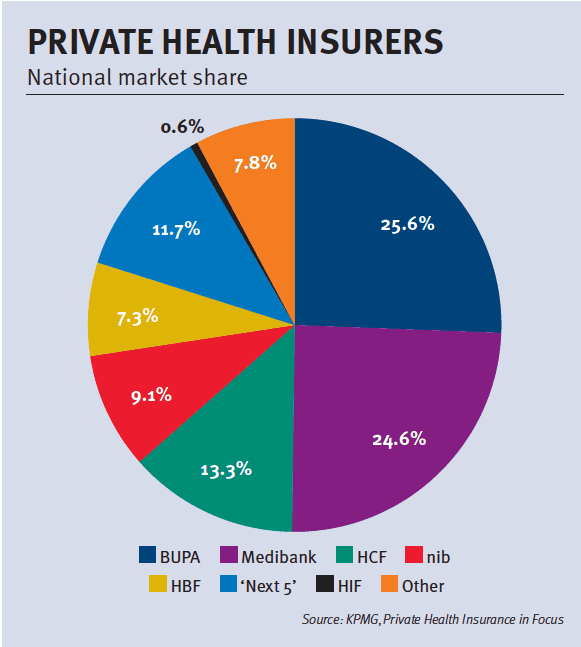
The big-five players are Medibank, BUPA, HCF, nib and Perth-based HBF (see graphic).
“Scale may support insurers in managing regulatory requirements, investing in technology and improving operational efficiency,” KPMG said.
The next five players, including Teachers Health and Australian Unity, hold about 12 per cent of the market.
That leaves the remaining 18 players fighting over a small part of the market.
HIF has about 96,000 customers and reported insurance revenue of $184 million in the year to June 2025.
That equates to a 0.6 per cent share of the national market.
For context, WA market leader HBF reported group revenue of $2.32 billion last financial year.
It has 1.2 members nationwide, with one quarter living outside WA.
Mr Morris believes the overall growth of the sector will provide opportunities for HIF.
“The industry has been growing and will continue to grow,” he said.
This is borne out by KPMG’s analysis, which found the industry’s total premium revenue has grown faster over the past two years than the approved premium rate increases.
In 2025, revenue was up 5.6 per cent while the approved rate increase was 3.7 per cent. The differential was even wider in 2024.
Mr Morris also believes HIF has a compelling offer compared to the big for-profit players.
“I think their value proposition is not a good as ours,” he said.
“What we have done really well over the past couple of years [is] we have lower-than-average premium increases.
“That is not unique to HIF, it is a lot of the not-for-profit funds.”
Another positive he points to is a big investment many not-for-profit health funds have made in their joint policyholder administration platform.
“It has been a six-year project but that will come to fruition next year,” Mr Morris said.
He added his goal was to win market share from the big for-profit health funds.
“I’m more focused on the national players and winning that market share, rather than HBF.
“We’ve both got history and credibility and we are employing people in WA in financial services, when a lot of other organisations are merging.”
On the service front, Mr Morris said it was useful to remind people in the industry why they had a job.
“Our role is to pay claims,” he said.
“The only reason we have a job is because we pay claims.”
He believes HIF’s partnership with St John Urgent Care and its dental network are important points of difference and is aiming to add more dental practices to the network. One area the new chief executive wants to modify is HIF’s focus on complementary treatments.
It was one of the first health funds in Australia to offer rebates for medicinal cannabis treatment and partnered with Perth company Little Green Pharma on a research project.
“Over the past five years we have arguably been too niche,” Mr Morris said.
“I’m directing more focus on things that will affect 75 per cent of the population and not one per cent.”
More generally, he wants HIF’s 130 staff to remain focused on serving and educating their customers, noting that HIF’s customer satisfaction has never dropped below 90 per cent.
Policy shift
A major issue facing the sector is the proposed cut to the private health insurance rebate, which subsidises people aged 65 or more.
Since 2004, Australians aged 65 and over have received a higher rebate than younger people, in recognition of the fact they tend to use hospital cover more.
People aged 70 and over get an even larger rebate.
The size of the rebate is also tied to the individual’s income.
From April 1 next year, the government plans to scrap the special rebate for seniors, arguing it will reduce intergenerational inequity and free-up money for extra aged care support.
The industry argues that elderly Australians will be inclined to drop their private health insurance or reduce their level of cover, which will put more pressure on public hospitals.
HIF and other players in WA are concerned the policy shift will have a bigger impact in this state.
That’s because WA has 54 per cent penetration for private health insurance compared with 46 per cent nationally.
The industry is lobbying Canberra to scrap this policy before it is implemented next year.