Support for decarbonisation remains strong in Western Australia, but industry leaders say the transition will ultimately be driven by commercial realities.
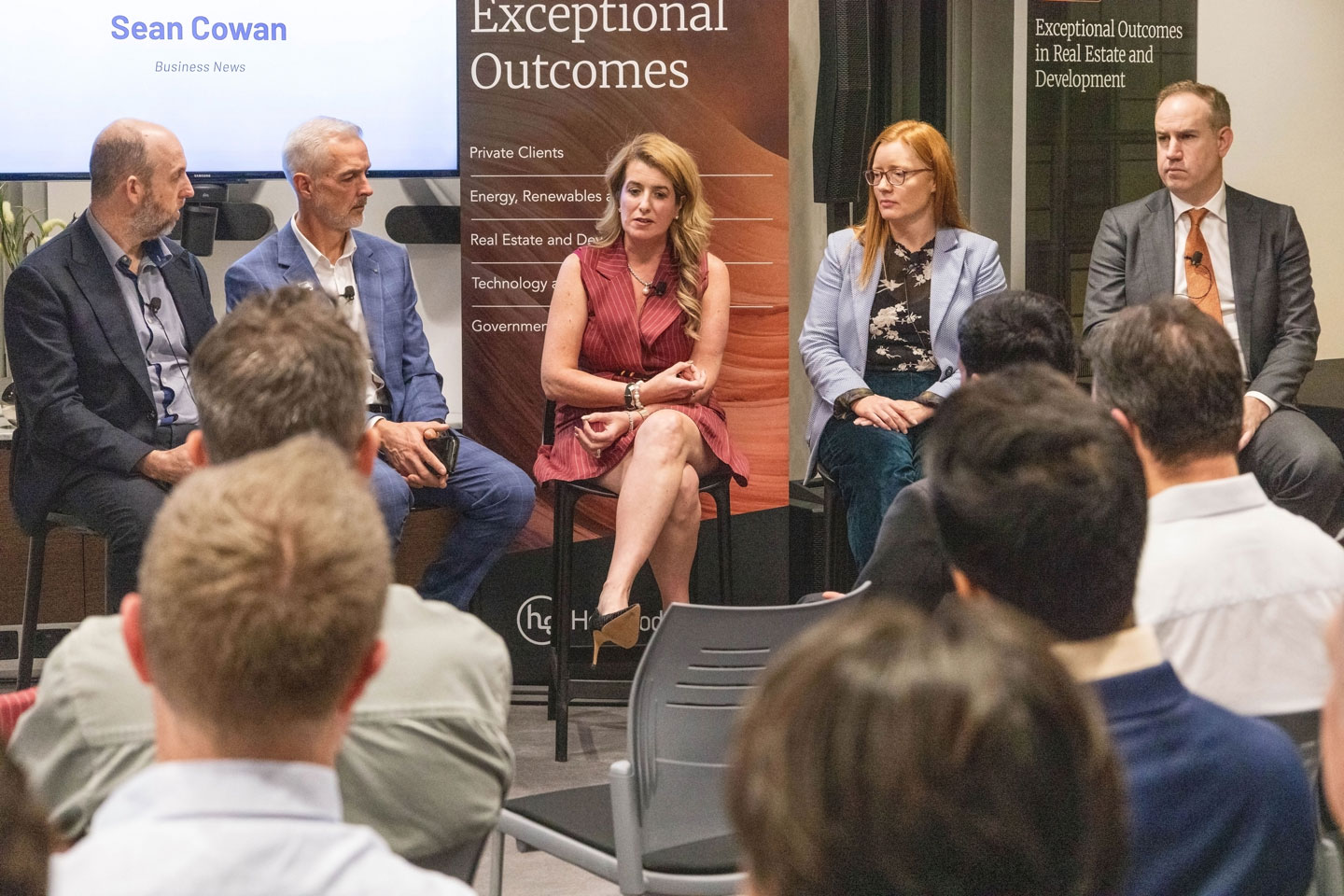
At a recent HopgoodGanim Lawyers and Business News panel discussion in Perth, energy, mining and industrial executives said decarbonisation across the State is heavily reliant on renewable energy and the energy supply mix must be reliable, scalable and commercially viable.
WA’s renewable capability
Panellists said demand for renewable energy solutions across industrial sectors remained substantial.
Michael Buzzard, Zenith Energy executive IPP growth, said renewable energy had become a standard requirement across most new mining developments.
“99.9 per cent of the proposal requests we receive incorporate some form of renewable energy, either immediately or in the future,” he said.
Mr Buzzard said WA’s mining sector has become a world-leading proving ground for remote renewable integration.
"Mining operations across the Pilbara and Goldfields have adopted hybrid power systems, battery storage and off-grid renewable generation at industrial scale,” he said.
That demand is increasingly driven by investor expectations, emissions frameworks, export market requirements and safeguard mechanism obligations.
But panellists said commercial viability often relied on the lowest cost of energy, which often remained the decisive factor.
For many industrial users, decarbonisation is becoming operational rather than reputational.
HopgoodGanim partner Jo Garland is a leader in energy transition, having advised on many Australian renewable and decarbonisation projects.
“Decarbonisation for many industries is no longer a choice,” Ms Garland commented.
She said international markets were increasingly embedding emissions expectations into procurement decisions.
“There might not be an established green premium, but there is a green preference,” she said.
Ms Garland said one of the biggest challenges was the cost of supporting infrastructure required to deliver renewable energy at industrial scale.
“The infrastructure needed to deliver renewables at scale isn’t cheap. Regardless of sector there still remains a strong preference for green, particularly when looking at the longer-term viability of a project, including when we take into account the safeguard mechanism and changing customer and community expectations,” Ms Garland said.
Transmission infrastructure and grid connections were all adding to project costs and affecting delivery timeframes, she said.
Infrastructure constraints
Utility infrastructure emerged as one of the biggest constraints on the next phase of the energy transition.
Across industrial development, renewable integration and advanced manufacturing, panellists repeatedly pointed to delays in power, transmission and utility infrastructure.
Developer Julie Drago, founder and chief executive of Realside Ovest, said industrial developers were increasingly constrained by delays in securing power connections.
An 18-month wait from a standing start on a site without power was becoming increasingly problematic as industrial users adopted robotics, automation and energy-intensive manufacturing systems.
“We need economic and really good baseload power,” Ms Drago said.
“They need to produce 24 hours a day.”
The issue extends to newer industries such as data centres, which require large energy loads, water access and substantial infrastructure redundancy.
Suitable land and infrastructure remain limited despite growing demand.
“I get people ringing all the time saying: ‘Can you find me some land for a data centre?’” Ms Drago said.
The economics remain difficult
Panellists reflected a more cautious view of the economics of transition.
“When anyone talks about renewable and they say it’s cheap, I don’t know if it’s cheap,” Ms Drago said.
Warren Pearce, chief executive of the Association of Mining and Exploration Companies, said many new projects now incorporated renewable generation because the long-term economics increasingly supported it.
“If you’ve got a long enough runtime, you make that back after a period,” Mr Pearce said.
Safeguard mechanism obligations are also beginning to influence project economics more materially.
Panellists cautioned that WA’s competitiveness still depended on maintaining internationally viable cost structures.
Indonesia’s lower-cost nickel production was cited as an example of how difficult it remained for higher-cost jurisdictions overly relying on green premiums.
Execution remains the issue
Earlier in the evening, WA chief scientist Professor Sharath Sriram outlined a broader vision for a diversified economy driven by innovation, commercialisation and advanced industry.
“We have to drive this collectively,” Professor Sriram said.
WA retains significant advantages – renewable resources, engineering capability, mining expertise and global demand exposure.
But panellists said the transition would only translate into long-term investment if infrastructure, approvals and commercial timelines aligned.
Projects require land, transmission, water, approvals, planning certainty and capital confidence.
The next phase of WA’s energy transition would depend on execution.

HopgoodGanim is a leading Australian legal services provider at the forefront of expertise and service delivery in our key client markets. We provide exceptional outcomes to our Australian and international clients from our offices in Brisbane and Perth, spanning the east and west coasts of the country. Discover the markets we focus in


 By HopgoodGanim Lawyers