

 20 Mar 2024
Developers capitalise on demand




Demand for residential land in Perth’s metropolitan corridors shows no signs of slowing.
In the 12 months to December 2023, the Urban Development Institute of Australia WA reported a 32 per cent increase in lot sales, from 6,569 in 2022 to 8,644 last year.
Comparing the final quarter of 2023 with the prior corresponding period reveals a 91.7 per cent uplift in sales, from 1,273 in the fourth quarter of 2022 to 2,440 in the most recent quarter.
Strong housing demand coupled with low supply has boosted prices in the state’s land market, with developers’ forecasts 12 months ago coming to fruition.
Further, UDIA research shows the ratio between the number of lots expected to sell compared with the number of lots available over the next six months has fallen to its lowest level since 2013.
In the 12 months to December 2023, UDIA recorded a 6.7 per cent increase in lot prices in Western Australia, with the average sale price in 2022 at $235,854 compared with $251,608 in 2023.
Growth has continued throughout the 2024 financial year, with the average price of new residential lots in Perth in the December quarter up to $266,105.
Australian Bureau of Statistics data shows that, for the 12 months to June 2023, WA had record levels of population growth at 78,342 people.
Urbis director property economics and market research David Cresp, who helped compile the UDIA data, said prices had increased accordingly.
“The shortage of available land supply, together with continuing strong population growth, was forecast to see prices continue to rise,” he said.
The City of Wanneroo, which includes Alkimos, Yanchep and Eglinton, continues to be the fastest growing of the growth corridors, with the most lots sold in 2023.

Market moves
Cedar Woods Properties WA state manager Ben Rosser said Eglinton was the standout among the company’s 35 estates nationally in terms of sales rates during the past six months.
This is despite a 13 per cent price rise for a standard 375 square metre lot in the estate in the three months to January 31.
ASX-listed Cedar Woods purchased the 1,260-lot estate near Yanchep in late 2021 for $49.5 million from an entity linked to the Copley family.
The purchase marked Cedar Woods’ entrance into the north-west corridor and bolstered its total number of projects in the state to 13.
Cedar Woods wanted to establish a point of difference at its Eglinton development, as well as tap into the growing need for renewable energy.
The West Perth-based land developer will install the state’s first community energy sharing network at the 86-hectare site.
Residents will have access to a large-scale battery, operated by Zenith Energy, via their rooftop solar.
Zenith Energy will pay for the installation of solar panels on the estate’s homes for individuals who opt into the system.
The energy storage network will reduce pressure on an already strained South West Interconnected System and result in a 20 per cent reduction in energy costs for residents.
Mr Rosser said getting the energy system over the line with authorities was challenging, as it departed from conventional development methods.
“If you looked at it from a lens of conventional land development it would never get up,” he said.
“But if you are prepared to look outside that square, you’ll find it will.”

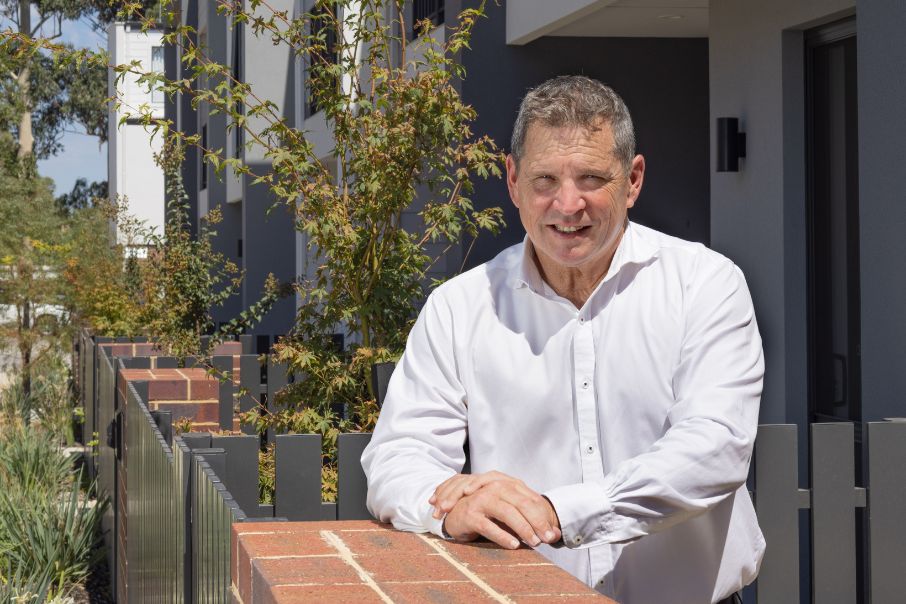
Col Dutton says investors are a growing cohort of buyers. Photo: Michael O’Brien
Demand shift
Investors are a rapidly growing market segment for land developers.
UDIA executive director of strategy and policy, Sarah Macaulay, said this segment had driven land sales in the greenfield market during the past 12 months.
“[Investors made up] thirty-seven per cent of sales over the course of the year, compared to seventeen per cent two years ago, so we’re seeing significant growth,” she said.
Ms Macaulay said the north-west and south-west corridors had reported the highest percentages of investor sales, with 50 per cent and 34 per cent of sales respectively.
For national developer Stockland, this growing investor interest is reflected in sales.
“Investors [represent] around thirty per cent [of sales] in our projects at the moment, which actually reflects the Perth percentage in rentals,” the company’s general manager WA residential, Col Dutton, said.
“Historically, Perth first homebuyers dominated the greenfield market ... say fifty per cent, upgraders or downsizers probably make up forty per cent … [and] … investors would be less than ten per cent.
“The attractiveness of Perth has come through in the past twelve months … [and] … investors see the value in both capital growth and yield, so there’s certainly been a run in the past twelve months.”
For Cedar Woods, investor interest has been stronger still, with up to 50 per cent investor sales in its north-west estates.
Mr Rosser said this was considered out of balance and the company was taking steps to reduce this proportion: providing more opportunities for local buyers.
Satterley Property Group chief executive Nigel Satterley, whose company bolstered its dominance in the land market late last year after a deal with LWP (see page 34), is taking a similar approach.
“The investor activity [is coming] from Melbourne and Sydney,” Mr Satterley said.
“They can’t believe how cheap the land is per square metre, and how cheap it is to build and get a rental return.
“We’re leaning towards now … [a]… commitment to prioritise families, local Western Australians, not the investors so much.”
A reduction in average lot sizes is pervasive across most new land estates, with the average lot size in Cedar Woods estates about 360sqm.
This compares to about 430sqm about a decade ago.
“Lot sizes are reducing, which is a factor of cost, otherwise they would be taken out of the reach of our target market, which is predominantly first home buyers,” Mr Rosser said.
In terms of demand, Cedar Woods recorded its strongest second quarter in two years in its latest half-year results, largely driven by sales at its Perth projects.
“Demand is strong and if we were not careful we would sell out rapidly,” Mr Rosser said.
“Managing our limited supply through price growth is how we are dealing with this.”
For Peet, which Data & Insights lists as the third largest land developer in the state, there has been a material improvement in sales across its portfolio.
“This includes increased volumes and price growth, a trend unseen in the market for a number of years in WA,” Peet managing director Brendan Gore said.
The listed developer reported strong sales at its Alkimos, Yanchep, Brabham, Golden Bay, Lakeland and Wellard estates in the second half of 2023.

Mark Hector says energy efficiency measures are a must in land development. Photo: Michael O’Brien
Energy shift
While some developers are phasing out gas in new projects, most new land estates in WA are connected to gas supplies.
Mr Rosser explained that consumers still showed a preference for using gas for cooking and water heating.
“The time will come [when gas is phased out in residential development], but we don’t think it’s just yet,” he said.
Satterley Property Group managing director Brendan Acott agreed, on the basis that a lot of his buyers came from India, where gas cooking was preferred.
“With that sort of diversity and multiculturalism, we’re seeing an appetite from a number of buyers to want to use gas when they cook, so we maintain the supply of gas,” he said.
Stockland, however, is planning to deliver the state’s first all-electric estate, in Piara Waters, meaning there will be no connection to the gas network.
Mr Dutton acknowledged there was some resistance to the idea among some buyers, but consumers were warming to the concept as they learned more about it.
“There was a bit of uncertainty from customers to begin with because it’s new in WA, but certainly it’s got momentum now,” Mr Dutton told Business News.
“I think education and information is really important in regard to innovations like that.”

Qube Property Group’s Apsley estate in Mandogalup. Photo: Qube Property Group
Stockland is set to strengthen its position in the state’s land development space following its agreement to buy Lendlease’s two Alkimos estates, which are expected to settle next month.
Elsewhere, Qube Property Group includes solar cells and waterwise gardens in its estates.
The Subiaco-based land developer’s managing director, Mark Hector, told Business News the company had taken this approach for the past six years.
“Since 2018, each metropolitan lot that we develop and sell, included in that is a solar package, which is mandatory,” Mr Hector said.
“[Solar] is part of the contract. You have to have it. There’s no ‘Can I have the money in exchange for it?’
“Waterwise gardens are also included.”
He said improved market conditions beyond the issues associated with COVID had provided a positive outlook.
“I think we are through the most challenging time,” Mr Hector said.
“We’re continuing to deliver land as fast as we can and I think were through the COVID issues, but that’s not to say the state’s awash with capacity.”
He said competition with state infrastructure projects remained an issue for developers.
 Stockland’s Wildflower estate in Piara Waters is set to contain all-electric homes, meaning no gas connection. Image: Stockland
Policy push
The UDIA’s Ms Macaulay said the government should prioritise unlocking more government-owned land, which could be feasibly delivered for housing supply.
She said the state government’s $2.6 billion housing diversity pipeline, which includes the delivery of 4,000 new social and affordable homes, was a good start, but a lot of the sites identified through this were “high-hanging fruit”.
“They’re not necessarily the ones that can be feasibly developed in the short term,” Ms Macaulay told Business News.
Planning Minister John Carey said the state government facilitated an expressions of interest process for the first tranche of the $2.6 billion pipeline, which included nine sites statewide.
“Separately, the state government works with local governments to identify both Crown land and local government land that may be suitable for housing developments,” he said.
Mr Carey said the Department of Planning also invited submissions for specific unallocated or unused Crown land not currently identified as surplus to government requirements, and that DevelopmentWA had 500 development-ready lots on the market.
Ms Macaulay said while construction cost pressures were easing and activity was lifting, significant labour shortages remained.
She said 24,000 homes would need to be built annually if WA were to achieve its portion of the federal government’s planned 1.2 million homes nationally.
“We’ve only got about the capacity to deliver around 16,000 new homes per year with the current capacity of the construction industry,” Ms Macaulay said.
She added the UDIA was seeking a construction workforce attraction and retention strategy for Perth and Peel and, as part of that, a construction industry labour agreement.
Training and Workforce Development Minister Simone McGurk said the state government had implemented several initiatives to attract people to the construction industry.
She said Immigration Minister Andrew Giles had been asked to overturn cuts to WA’s number of places on the State Nominated Migration Program.

