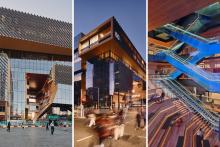
Subiaco architecture practice MJA Studio has become a household name in Perth’s multi-residential space.
MJA Studio is used to riding the waves of market volatility.
It’s a handy perspective to have, given Perth’s property industry has experienced a tumultuous period in recent years.
As recent data from Urbis shows, just 19 per cent of apartment projects approved in Perth between 2020 and 2025 started construction.
This, coupled with competition for large-scale projects among a select few architects, has dented the confidence of design firms.
Some practices had to lay off workers if they were unsuccessful in bidding for projects.
Subiaco-based MJA Studio managed to maintain a steady workforce in the five years following Covid.
In 2025, as the market made its recovery, MJA had its strongest growth in staff numbers yet.
The studio started the year with 40 staff and finished with 50 employees, 20 of them registered architects.
This year marks 10 years since the practice was rebranded from McDonald Jones Architects to MJA Studio.
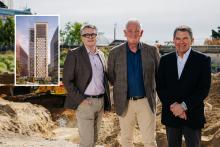
In 2016, Wes Barrett, Jimmy Thompson and Mark Ciesielski bought out the then owners, Danny Jones and Ross McDonald, who founded the firm in 1999. Managing director Mr Barrett, who joined the business at its founding, said the process of taking over the firm began in 2011.

MJA Studio collaborated with Singaporean architecture firm WOHA on Applecross’ Forbes Residences. Photo: Dion Robeson
This was when MJA Studio creative director Mr Thompson joined the business and a decade on from when the late Mark Ciesielski, former project director at MJA, joined.
“There were two older directors and they both wanted to retire,” Mr Barrett said.
Mr Thompson added that the former directors realised the business needed a shake-up.
“The studio needed to evolve with everything that was happening with design review panels and incentive-based planning policy,” Mr Thompson told Business News.
“That was the opportunity for Wes, Mark and me to change the practice and turn it into what it is today.”
MJA Studio is arguably Perth’s most active architecture firm in the multi-residential space, and the size of jobs it takes on has grown considerably in recent years.
“Our bread-and-butter project size was probably $40 [million] to $50 million and now it’s $100 [million] to $300 million quite regularly,” Mr Barrett said.
“And we’re comfortable in that space … we still really enjoy those smaller projects, [but] they become case-study passion projects or things that we want to learn or know.”
MJA currently has 5,450 dwellings in the master planning stage, including the redevelopment of Edith Cowan University’s Mount Lawley campus.
The practice has 1,370 apartments in the design phase and 765 under construction, and is currently overseeing the design of 3,350 student beds.
Repositioning
MJA Studio has undergone a significant shift in recent years.
This is partly due to the sudden death of former director Mr Ciesielski in mid-2024.
Reflecting on the event, Mr Thompson said it was traumatic, but the firm was equipped to handle it.
“I wish he could have seen the last year’s growth, because he would have been really into it,” he said.
“We’d fortunately probably catastrophised situations over the years and were well prepared for the business implications of a disastrous thing like that happening.
“This is why succession planning is so important; because we had people who could help support director roles.”
MJA associate directors Stephen Corns and Jesse Swan stepped up to pick up a lot of Mr Ciesielski’s work in the months following his passing.
The pair was brought in as equity partners in 2021, along associate directors Megan Cordin and Matt Middleton.
Mr Thompson explained that the move to distribute the ownership of the business among more of its staff was part of future-proofing the company.
“We always wanted to be really careful about how we manage and deal with succession planning to create opportunities for people [and] for the business to grow,” Mr Thompson said.
“A lot of the older architecture practices have struggles when the older guys have held onto the business for too long and haven’t created opportunities for their best people to get involved.
“We’ve always wanted to have a different type of model, where we grow slowly and sustainably.”
Mr Thompson said many larger practices hired and fired based on the volume of jobs coming through the door, which MJA wanted to avoid.
Bidding on jobs and not winning them is one of the brutal realities of the business.
When asked about how MJA dealt with this, Mr Barrett said diversity and discipline were key.
“We are very focused on making sure we have a broad spread of projects, but also [on] not taking on too much,” he said.
“Sometimes it’s about what you have to say no to, so that you can just ride that roller coaster of design and documentation.”
Mr Thompson said reputation meant everything in a city of Perth’s size.
“Perth is a small place … [and] … you always know you’ll get good work by reputation,” he said.
“But if you mess anything up, you can lose it pretty quickly.
“I think that’s ... really important in business. Not just saying yes to everything and not stretching yourself too far and then not being able to deliver what you’re actually about.”
Focus
MJA Studio’s projects are mainly spread across the build-to-sell, student accommodation, hotel and hospitality sectors.
Its largest completed project to date is Blackburne’s $380 million The Grove apartment building in Claremont.
The 230-dwelling complex sits on the border of Peppermint Grove and Cottesloe.
MJA Studio won the project in 2019 and received several design awards for the building following its completion in 2024.
The firm is working on several other Blackburne projects, including the planned Ocean Village mixed-use precinct, and apartment projects in South Perth and Scarborough.
MJA’s collaboration with Singaporean design firm WOHA on the $89 million Forbes Residences in Applecross garnered widespread industry attention for its unique design.
The building’s façade featured aerated concrete on a high proportion of the external walls, inspired by Perth’s limestone and a green canopy cover.
Mr Thompson said the studio would seek to collaborate further with international design firms, which is common practice for Perth studios.
Hassell’s work with Rotterdam-headquartered OMA on WA Museum Boola Bardip and With Architecture Studio’s work with OMA on Perth Concert Hall are examples of this.
Copenhagen architecture giant Henning Larsen is also eyeing work in Perth following its entry into the country last year via its new Sydney office.

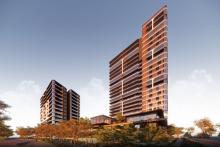
MJA is designing a 21-storey student housing tower for Erben in Perth. Image: MJA/GBANGS
Other residential projects MJA is working on include Megara Property’s $74 million Sorrento project Ora, which is due for completion this year.
It also designed a 17-storey tower for Subiaco developer Property Blue on Brighton Beach.
Student accommodation is fast becoming a significant chunk of MJA’s portfolio, with the architect working on designs for close to 3,500 student beds.
Among these are ADC’s Perth Girls School project in East Perth, which has recently been revised from a build-to-rent and affordable housing project to a student accommodation development.
The developer plans to include 1,200 student beds across two towers in that project.
South Perth developer Erben has also engaged MJA to design its 21-storey student housing tower on Lot 19 in Perth City Link, where 1,146 student beds will be added.
Aged care and affordable housing are also significant growth sectors for the firm.
As Mr Thompson explained, Perth was playing catch up in a lot of areas when it came to housing parts of its population.
“Covid saw, basically for five years, no student housing and no aged care get built,” he said.
“Aged care is what will really start to happen this year; I think you’ll start to see many more acquisitions and approvals.
“With student housing, the market was uncertain during Covid in terms of international visitors. But now, especially with Edith Cowan [city campus], we are doing a lot of inner-city student housing projects.”
The firm is also working with Sirona Urban on its proposal to bring 800 student beds to Kings Square in Perth.
In terms of affordable housing, MJA is designing a 30-storey social and affordable housing development on Roe Street for the state government.
The hotel and hospitality sector is another area in which MJA has expertise. Current projects in that space include Wallcliffe House for iron ore heiress Alexandra Burt and Bullo River Station in the Northern Territory.
Mr Barrett said there were a lot of intersections between the projects MJA worked on.
“We’re taking a lot of lessons from hospitality projects and student accommodation, and it relates really well to aged care,” he said.
Mr Thompson said the psychology of aged care and student accommodation were closely linked.
“If you look at the psychology of student housing and aged care, [they are] actually kind of similar, even though the cohorts are quite different,” he said.
“The risk profile of social isolation... and boredom works with both of them.
“So you’re trying to create, through the plan and through the architecture … opportunities for people to gather, to meet people, to actually have sense of community.”
Future
MJA Studio is preparing to move into a new studio on Rokeby Road, following the $2.25 million divestment of its Railway Road offices to Perth Construction Hire.
The architecture practice will share a premises with Adrian Fini’s H-U and Valtari Construction, in the former Red Sea building at 85 Rokeby Road.
MJA will occupy a floor plate twice its current allocation, allowing room for further growth.
But as Mr Thompson explained, growth would be natural rather than forced.
“Growth for growth’s sake makes no sense to us,” he said.
“If there are good projects that demand additional stuff, then [we’d] definitely be interested.
“But certainly, there is some capacity within that building [to grow].”