Momentum is growing among Perth developers to include co-living dwellings in their offering.
Western Australia’s pervasive housing crisis is prompting developers to look beyond traditional means of delivering residential projects.
The co-living model has a decades-long history in Europe, the UK and US, and the offering is now growing in popularity here.
Sitting between build-to-rent and purpose-built student accommodation (PBSA), co-living offers flexibility of tenure for residents and an income stream for investors.
Its distinction from a typical build-to-rent project lies in its relative affordability and abundance of communal facilities.
Co-living units are smaller than most built-to-rent or build-to-sell apartments, with a focus on shared amenity.
When compared with student accommodation, co-living spaces have larger rooms than PBSA and often have a greater emphasis on communal areas.
However, there are significant overlaps between the three housing types.
Residents taking up co-living accommodation generally live on their own, with young professionals, students and digital nomads the common demographics.
Australian Bureau of Statistics data shows that lone-person households are expected to increase by up to 50 per cent between 2021 and 2046 across the nation.
This, coupled with population growth generally, has led to a growing interest in the co-living model among developers.
In practice
Architecture firm Cameron Chisholm Nicol has helped design several co-living projects in Perth in recent years, including a proposal for 63 co-living units within West Perth’s Sydney Charles Quarter.
The $140 million project, spearheaded by Michelle Prater’s APPL Group, consists of residential, hotel, retail and hospitality spaces, and is currently under construction.
Cameron Chisholm Nicol managing director Dominic Snellgrove said the recent economic conditions experienced in WA had aligned for co-living.
He said high construction costs made it difficult to deliver residential accommodation at affordable rates.
The shared amenity aspect of co-living developments meant the apartments were smaller, making it more cost effective for developers, Mr Snellgrove added.
“It’s a model of living which is really driven not just by affordability, [but] ... affordability is a key component of it,” he said.
“When combined with the social aspects, co-living really starts to make a lot of sense as a piece of the jigsaw in residential supply.”

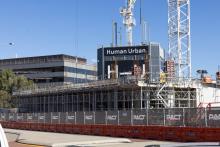
PACT Construction is building 63 co-living dwellings as part of West Perth’s Sydney Charles Quarter precinct. Photo: John Madden
In terms of affordability, co-living sits between build-to-rent and student accommodation.
A typical co-living apartment in Sydney, where the living arrangement is common, is between $500 and $600 per week.
Mr Snellgrove said the inclusion of shared amenity and utilities in the rental price meant co-living provided an affordable way to live in central locations.
“Things like WiFi are included, and cleaning of common areas are included, servicing and so on and so forth,” he said.
“What it means is it makes living near or within a town centre or city centre, close to amenities, close to public transport, affordable in a way that wouldn’t be imaginable with traditional apartments and dwelling typologies within the city centre, where rents would be extremely high.
“It’s a one-stop shop, from a rental point of view.”

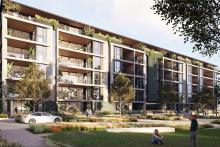
Sydney Charles Quarter will feature split-level apartments. Image: Cameron Chisholm Nicol
Cameron Chisholm Nicol has also designed co-living spaces for NSW-based Marprop Real Estate Investors, in Perth and Fremantle.
Marprop has received development approval to build 88 co-living apartments on Stirling Street in Perth and 119 rooms in Fremantle.
The projects, costing $22 million and $55 million, respectively, represent Marprop’s focus on WA as the hub of its co-living portfolio.
Speaking to Business News, Marprop Real Estate Investors representative James Theodore said the company believed Perth represented a standout opportunity for WA.
“The city is hitting all the right demographic notes; from east coast residents priced out of their markets, to digital nomads, fly-in, fly-out workers, and professionals who split their time between Perth and other states,” he said.
“Perth’s same time zone as Asia adds to its global connectivity, making it an attractive base for a mobile workforce.
“We’re also seeing demand from people with families on the east coast who spend a substantial part of their week in Perth and don’t want to live in a hotel all their lives.”
Mr Theodore said Marprop’s co-living projects were at the high-quality end of the scale.
“Our focus is on premium co-living; not cookie-cutter, cramped spaces, but experiential environments where people genuinely want to stay longer,” he said.
Marprop’s Fremantle project, at the Shacks Holden site on Queen Victoria Street, includes 119 co-living units and 83 hotel rooms within a six-storey building.
At the time it was mooted, the proposal drew criticism for the low number of car bays and size of its apartments.
The project includes 65 car bays, departing from the 332 resident bays required for a standard residential project in the area.
Apartments within the project range from 28.5 square metres to 82sqm.
The developer sought dispensation from planning authorities to get its project over the line, given aspects of it fell outside of the prescribed requirements for the area.
In its development application, Marprop outlined the reasons for the size of the units within the project, stating that they were “appropriate to the innovative co-living nature of the proposed development”.
Mr Snellgrove added that co-living projects lent themselves to shared vehicle arrangements, which saved cost for developers and residents.
“Car parking is probably one of the single biggest impediments to financial feasibility on residential projects,” Mr Snellgrove said.
“With co-living, we’ve been looking at incorporating shared car use within the building, and usually electric vehicles as a share car.
“People within the co-living community can book a car when they need it and not have the expense of having to park a car or maintain a car or service a car permanently.”
Marprop also has approval for 216 build-to-sell apartments in Burswood but is considering amending that development application to co-living.
Other projects
H-U, led by Adrian Fini, Rowan Clarke, Jamie Fini and Kyle Jeavons, has approval to redevelop Fremantle’s Elders Wool Stores into a mixed-use precinct.
Of the 213 apartments in the proposal, 174 will be co-living.
Speaking to Business News about the rationale behind including this housing type into the project, H-U director Mr Jeavons said the timing felt right.
“We need housing diversity in Perth,” he said.
“It’s typically luxury apartments or four-by-twos in the suburbs, and we think this adds diversity.
“There is still a significant lack of housing choice in Perth and we don’t see that disappearing quickly.”
Mr Jeavons, who also took on the redevelopment of the State Buildings in Perth in 2015 with Adrian Fini, said co-living wasn’t suited to every location.
“In Perth in particular, I don’t think co-living can work everywhere; it needs to be in high-amenity areas,” he said.
“Fremantle is a great example, and we are considering whether we will do it in Leederville as well.”
Having bought the 14,600sqm site in 2023, H-U is planning to transform the car park between Frame Court and The Avenue in Leederville into a $300 million high-rise project.
Details of the plan are yet to emerge, but H-U says it will include apartments, office, retail and hospitality components.
H-U’s Wool Stores project classifies as adaptive reuse, in that a historic building will be converted into a new structure that serves a different purpose.
In the case of the Wool Stores, the building has been vacant for four decades.
Mr Jeavons said that, given the complex nature of the development, H-U decided to divide it into different components.
“It’s a really complicated project and we needed to break it down into a number of different asset classes,” he said.
“It’s a huge building, so to do one [asset class] would have proven relatively challenging.”
The project contains offices, retail and residential spaces, with townhouses as well as apartments.
Mr Jeavons likened it to the overhaul of the State Buildings, which has been touted as one of the most complex but successful developments in Perth.
“I’d almost say it is more complicated [than the State Buildings] because of the condition of the buildings,” he said.
H-U is currently engaging with subcontractors on the Wool Stores project and aims to commence construction this year.

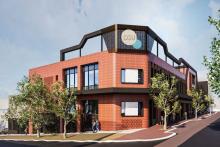
H-U is including 174 co-living apartments in its Fremantle Wool Stores project. Image: spaceagency architects
Adaptive reuse
Globally, developers are looking at ways to convert existing buildings into housing, and co-living lends itself to adaptive reuse.
While it has its challenges, the practice of repurposing a building is considered a far more sustainable approach to development than the demolition or construction of a new structure.
Mr Snellgrove said his practice was investigating several opportunities to convert office buildings in Perth to co-living buildings.
“Where we have empty or underutilised or partly vacant, B-grade or even C-grade commercial office buildings within Perth,” he said.
“There’s a real capacity to imagine those as co-living opportunities because they’re usually well located.
“They’re within or close to the CBD, they usually have floor-to-floor heights, which are probably not so generous for repurposing into A-grade commercial space, but are generous enough for residential.
“We’ve had a number of projects we’ve looked at for various owners over the past 12 months to look at converting office, underutilised office space, into co-living.”