Skilled migrants and apprentices are helping fill personnel shortages in the state’s construction sector.
A shortage of skilled workers has been a persistent theme across Western Australia’s construction industry in recent years.
The issue is particularly prevalent in the residential market, where a reduced labour pool has contributed to a slowdown in dwelling completion rates.
That’s problematic for several reasons, chief among them WA’s requirement to build at least 24,000 homes annually under the federal government’s national target of 1.2 million dwellings by mid-2029.
A recent Bankwest Curtin Economics Centre report on the building sector found WA will not reach this goal at current dwelling completion rates.
Released in July, the report garnered widespread industry attention for its frank and in-depth assessment of the state’s capacities.
It pointed out that, between 2014 and 2016, WA exceeded this target, with 32,000 dwellings delivered in 2015.
Last year, close to 17,000 homes were built across the state, up from about 15,000 the year prior.
BCEC said while WA had delivered a large volume of homes historically, the sector’s ability to respond to demand was hampered by a lack of capacity in recent years.
“Rising construction costs, a financially precarious contracting model, and the sustained leakage of skilled construction trades workers have all conspired to erode the productive capacity of WA’s building and construction industry,” the report found.
An economic downturn between 2015 and 2021 led to a significant erosion in the number of construction workers in WA, from a peak of 157,000 to 116,000.
That figure has since recovered to at least 140,000 this year, indicating the state has made progress in attracting workers.
Industry bodies including the Master Builders Association of Australia estimate that WA needs up to 50,000 more construction workers by the end of 2026.
There is a general consensus that skilled migrants and apprentices play a crucial role in filling the state’s workforce capabilities.
The Housing Industry Association of WA says the state’s construction sector needs about 9,000 apprentice commencements and about 3,000 skilled migrants each year to meet demand.
Migration piece
Overseas migration accounted for more than 70 per cent of the state’s 86,800 new residents in 2023, according to the Australian Bureau of Statistics.
The high demand for trades has been a factor driving population growth in WA.
Peloton WorkReady chief executive Brett McPhee, who specialises in recruiting Filipino workers to WA, has experienced an uptick in growth in recent years.
Mr McPhee said the current period was among the busiest ever in his two decades in the industry.
“In the past two years we’ve doubled the amount of people we’ve brought in,” he said.
However, the competition for Filipino workers was global.
“There’s a worldwide demand for labour, not just in Australia,” he said.
“That makes it harder to find people. It’s not easy to find these guys, because everyone’s tapping into them around the world.”
Mr McPhee said a reduction in backpackers coming to Australia since COVID partly led to an increase in demand for his services.
Meanwhile, the state government’s Construction Visa Subsidy Program (CVSP) has provided a significant boost for skilled migration into WA.
The program, which provides employers $10,000 for each skilled migrant they bring in, was recently extended for another year following its initial success.
Last week, Training and Workforce Development Minister Simone McGurk announced that the program’s 1,100 initial places had been filled and it would be extended due to ongoing, strong demand.
Announcing the move, Ms McGurk pointed to the government’s investment in vocational education and training, which had led to record TAFE enrolments.
“But skilled migration is also a necessary part of the mix to fill the positions that can’t be filled locally,” she said.
“This is why, in addition to the CVSP, the Cook government advocated for and successfully negotiated with the Commonwealth to secure 10,000 skilled migration places for 2024-25.”
For Mr McPhee, the state government’s program has been a boon for business.
“It’s a significant part of the evaluation process companies go through [to decide] whether they’re going to move ahead with foreign labor,” Mr McPhee told Business News.
“It [bringing in skilled migrants] is a big investment.”
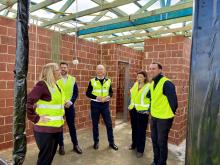
Tiffany Allen says skilled migrants and apprentices are both important parts of the state’s labour pool. Photo: Michael O'Brien
HIA executive director WA Michael McGowan, who was instrumental in lobbying for the initiative, said the average cost for an employer to bring in a skilled worker was $20,000.
“It’s still a complicated process for a business to navigate but lessening the cost and increasing the support services provided by the state government has removed significant barriers for employers to get involved,” he said.
The government has been criticised for the program’s slow rollout, with about 230 migrants who qualified for the subsidy working in WA as of mid-August.
A further 120 are expected to arrive by September.
Ms McGurk said the average time between migrants having their visas granted and starting work was about 30 days, and the workers were progressing through the system as quickly as possible.
Positions filled via the program to date include air-conditioning and refrigeration mechanics, roof plumbers, carpenters, glazers, electrical services, bricklayers, civil engineers, plasterers, cabinet makers, and wall and floor tilers.
Most of these workers are coming from the Philippines, followed by the UK, Ireland, South Africa and Italy (see table).
WA builders including Summit Homes and Scott Park Group have engaged with the CVSP to bolster their workforces.
Scott Park Group chief operating officer Craig Foster told Business News the company had brought several migrant workers into its glazing business, Glass Co, this year.
“It doesn’t matter what trade you’re talking about … they are stretched, but particularly with some of the finishing trades there are real challenges,” Mr Foster said.
“By getting glaziers in, that’s assisting production on site over and above what we’re able to recruit locally.”
Scott Park Group has brought in six Filipino workers to date, with plans to place a further three glaziers and three ceiling-and-wall technicians.
Finding accommodation for these workers can be problematic, given the state’s housing shortage, but as Mr McGowan explained, employers always find a way.
“We are seeing all types of options cropping up. [If] it’s a small employer, they might live with that family until they get their feet on the ground,” he said.
Scott Park Group said it sourced rental accommodation for its workers.
Grass roots
Mr Foster said the appetite of residential builders to take on apprentices often ebbed and flowed with the state’s economic cycles.
While some volume builders continued to take on significant numbers of apprentices, others, including Scott Park Homes, took a more pragmatic approach to the number of workers trained.
Mr Foster said bringing in skilled migrants was one way to fill the void of apprentices.
“If there was something that was considered by industry participants as being superfluous through those really tough periods, apprentices were unfortunately one of the programs,” he said.
“What skilled migration is doing is getting us to look back in that arena of the training of trades. Both [apprentices and skilled migrants] play an important role in the industry.”
Levels of apprenticeship commencements have increased significantly in WA since 2020, in part due to a range of federal and state government subsidies.

Construction Training Fund figures show the number of apprenticeship starts in WA grew from 6,827 in 2020 to 10,720 in 2021 and 10,929 in 2022.
Apprentice commencements dropped to 9,071 last year, as federal wage subsidies for employers taking on apprentices during COVID fell away.
These included payments of up to $7,000 per quarter for employees to cover half of an employee’s wage, as well as payments for each year of training an apprentice was able to complete.
Construction Training Fund chief executive Tiffany Allen described these incentives as sugar hits that served their purpose.
“They did what they needed to do … what we want to do now is sustain this level,” Ms Allen told Business News.
Ms Allen said the numbers of apprentices in training was on the right track, with about 4,500 apprentice starts in the first five months of 2024.
“The trends are looking good … but we want to keep that pressure on to continue to attract people to the work,” she said.
Ms Allen pointed out that, when the state’s construction workforce was at its highest in 2015, there were about 8,000 apprentice commencements.
“Now we’ve got another 1,000 people commencing each year,” Ms Allen said.
“We built 30,000 homes at that period, [but] the problem is we’ve got every industry working at the same pace [now], whereas in the previous boom it was a lot more just residential.”
She said migrants were a key part of the overall construction workforce.
“Skilled migrants coming in helps us have supervisors who can then train other apprentices, because sometimes the barrier is having enough people to train,” she said.
“Sometimes people say to me ‘Do you get upset about migration … you should be training your own’, [but they are] actually all part of the same picture, and you need them.”