A career in landscape architecture has led Natalie Busch to the top of Hassell’s Perth operation.
Natalie Busch has built a career navigating the nexus between landscaping and architecture. Recently appointed as Hassell Perth managing principal, Ms Busch grew up with a love of outdoor spaces and design.
Following her graduation from the University of Western Australia in 2004, Ms Busch joined a small Perth firm Arbor Vitae, specialising in landscape architecture.
A year later, Arbor Vitae merged with Hassell, becoming the landscape architecture arm of the global firm.
“It was a good fit because I felt like I was always in an in between space,” Ms Busch told Business News.
“I was working in landscape, I studied architecture, but I was interested in how the two went together.”
Ms Busch joined Hassell as a senior associate in late 2005, focusing on the urban design components of large-scale projects.
During her 17 years at the firm, she has helped design Fiona Stanley Hospital, Karratha Health Campus and UWA’s engineering and maths precinct, E-Zone.
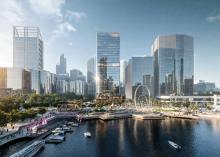
Her current portfolio includes Brookfield Properties’ One The Esplanade and Hesperia’s Murdoch Health and Knowledge precinct.
“I tend to work on bigger precinct projects, where the landscape is interwoven with the building,” Ms Busch said.
“They’re the kind of projects I’ve always done; I feel like I have the knowledge and interest of the architecture and the landscape.”
Major projects
Ms Busch said her work on One The Esplanade involved designing the parts of the building that joined it to the street, including the ground areas that facilitate pedestrian movement.
She helped design the spaces that connect the building’s offices with food and beverage areas, as well as its landscaped rooftops.
Hassell is also working with the traditional owners of the Elizabeth Quay site, the Whadjuk people, to encourage visitors to the building to recognise the location’s cultural importance.
Ms Busch described her engagement with the site’s traditional owners as one of the most rewarding parts of the project.
One The Esplanade is about to top out and is on track for completion in the first quarter of 2023, with the landscaping component due to begin later this year.
Hassell is also undertaking design work for neighbouring Nine and Fifteen The Esplanade (lots six and five Elizabeth Quay, respectively), also being developed by Brookfield Properties.
Ms Busch said most projects she worked on took about a decade from conception to the end product.
“I would say those projects are in office for 10 years,” she said.
“We start doing feasibility studies and working with the clients, then we get to a stage where we work on the design, and that will get all the stakeholders in place.
“With those projects, there’s probably a good three or four years before they even break ground, and there might be a two-year construction process.”

One The Esplanade.
Green spaces
Throughout her career, Ms Busch has gained a growing realisation of landscaping’s importance in terms of its impact on people’s lives.
“There are so many studies around how green spaces can affect your mental health … [and] affect how people live and play,” she said.
“From an ecological perspective, creating places that encourage the natural systems to work in a better way, whether that be the water systems or habitats [is important].”
Ms Busch, who also sits on the State Design Review Panel, said planning bodies were increasingly aware of the significance of green spaces in development.
“I think there is a lot of intent to change things,” she said.
“The WA Planning Commission and State Design Review Panel have started to have landscape architects on the panel, alongside planners and architects, to be there as part of that upfront discussion.”
Previously, Ms Busch said, planning discussions focused largely on issues around traffic and parking, whereas now there was scope for broader thinking.
“I think it has been restricted in the past, but there’s a bit of change coming,” she added.
Health emphasis
Ms Busch said her work with Fiona Stanley Hospital early in her career was a key driver of her professional growth.
As a relatively young architect, she was assigned as project lead on the $2 billion Murdoch hospital in 2008, working with Hames Sharley and Silver Thomas Hanley architects.
“I think that was pretty careerdefining,” she said.
“I had never done a health project before that one and I really liked it, it really fed my soul doing something worthwhile.”
The hospital’s design drew upon international research around the health impacts of natural environments, for example, connecting the wards to courtyards for patients to easily access fresh air.
“I look back and go ‘Wow, they let me kind of figure that out’, it was really cool,” Ms Busch remarked about the Fiona Stanley project.
In 2016, Ms Busch won the National Association of Women in Construction Award for Creating the Best Project for her work on the hospital.
This led her to join NAWIC, where she stepped up to the role of Western Australian president for several years.
Career moves
Ms Busch took a break from full-time work to have her two children about a decade ago but headed teams for major design pieces.
“Even though I was part time I was quite keen to be doing important roles on projects,” she said.
“I really care not just about the projects but the culture of working and how people and teams work, so I had a natural progression to managing teams and managing people.
“I never asked for a promotion, but it feels as if I have naturally liked those sorts of roles.”
In response to her appointment as Hassell’s Perth managing principal last month, Ms Busch said she wanted to lead the firm to more sustainable ways of working.
“I don’t want to just maintain the status quo,” she said. “I feel like [Hassell] is this well nurtured, crafted company, which is valuable, but there are so many fresh perspectives on how to keep growing.
“There is a lot around the sustainability framework and how we make the impact with the buildings we design and the projects we do … so I think part of my role is making that really meaningful.”

Fiona Stanley Hospital.
Minority
Ms Busch said landscape architecture was less male dominated than the overarching field of architecture, but being a woman still put her in the minority.
“I don’t want to say I’ve been lucky or fortunate, but I have worked on projects that have enabled me to still play the role I want to play [and] … I had people around me to support that,” she said.
“I am still in meetings where I am the only female around the table … it doesn’t worry me as much now as it did when I was younger.”
She said Hassell embraced flexible working arrangements, demonstrating that team members did not have to be at their desk all the time to deliver on projects.
Perth vision
Ms Busch said she hoped to see Perth’s landscape become more connected to its cultural heritage in a way that promoted understanding of traditional owners’ stories.
“What I’d like to see is kind of more connection to what this place is all about, so really connected to what it means to be this place,” she said.
“I think part of that is about … a connection to traditional owner stories, and not even just the story, but their understanding of what it means of this place.
“I’d like to see the city planting trees of this place and being really reflective of Perth, as opposed to trying to be Melbourne in Perth.”