ANALYSIS: Middle Eastern airlines are benefiting from years of flexibility and strategic investment.
For centuries, the fortunes of nations have risen and fallen with their ability to trade, to control trade routes, and to adapt when those routes shifted.
Prosperity has rarely belonged solely to the strongest. Instead, it has tended to reward the most agile, the societies and businesses willing to alter course when changing economic tides demanded.
Aviation, in many ways, is simply the modern extension of that centuries-old dynamic.
In the 21st century, with globalisation and open-skies agreements in full swing, major Middle Eastern airlines have demonstrated just how powerful adaptability can be.
Financially robust, strategically located between east and west, and deeply supported by governments intent on turning their cities into global crossroads, these carriers have reshaped the international aviation map.
For millions of passengers and freight forwarders, airlines such as Emirates and Qatar Airways now offer the fastest and most convenient routings between Asia and Europe, as well as highly competitive one-stop links to North America.
The impact has been profound. Led by Emirates, Qatar Airways and, to a growing extent, Etihad Airways and flydubai, the Gulf carriers have disrupted long-established travel patterns and sent tremors through the boardrooms of many once-dominant legacy airlines. Their headline-grabbing aircraft orders, which were evident at the recent Dubai Airshow, have only intensified that anxiety.
Some Western airline board members go so far as to compare today’s Gulf airlines to the pirates of the 16th Century, who once roamed the region’s waters. That era gave parts of the Arabian coast the nickname ‘Pirate Coast’, as raiders targeted vessels moving between Britain and India.
While the comparison is clearly colourful rather than literal, one aspect rings true. The Gulf carriers are certainly plundering traffic, and they are doing so in much the same way Western airlines once did when aircraft had to make multi-stop journeys across continents.
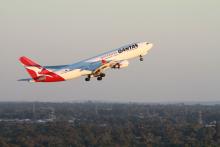
A look through historical timetables makes the point clearly. Carriers such as Pan Am, TWA and Qantas all operated complex around-the-world services, collecting and depositing passengers across numerous stops. Singapore Airlines didn’t begin life as an independent carrier until 1972. Cathay Pacific was a small regional operator through the 1950s and 1960s.
Emirates’ first flight wasn’t until 1985, Qatar Airways launched in 1994, and Etihad Airways entered the market in 2003. In other words, most of the world’s current aviation powerhouses are relatively young, and their rise has been fuelled by strategic government investment and bold commercial vision.
A key part of this success lies in national focus on trade and infrastructure. Airports in Dubai, Doha, Singapore and Hong Kong are not merely transit points; they are carefully engineered super-hubs, designed to stay far ahead of growth curves that have overwhelmed many Western airports. These hubs consistently win global awards for efficiency, passenger comfort and innovation, reinforcing the competitive advantages their airlines enjoy.

Qatar is one of the world’s most formidable long-haul airlines.
What is less widely discussed but equally significant is the major role Middle Eastern and Asian airlines have played in shaping new aircraft. Their demands have repeatedly influenced the design and evolution of the world’s most successful long-haul jets.
Singapore Airlines’ requirement for a nonstop Singapore-London capability was the catalyst for Boeing’s development of the 747-400, ultimately the most successful 747 variant.
Emirates president Sir Tim Clark has pushed manufacturers further and more aggressively than any other airline leader. His insistence on improving the 777-300 led directly to the 777-300ER, now the backbone of many global fleets and the most successful 777 model to date.
Sir Tim was also critical to the success of the Airbus A380, helping iron out early issues and championing the aircraft when sceptics predicted failure. When Airbus launched the A350, he demanded an all-composite fuselage, which Airbus had initially resisted.
Sir Tim’s influence has not diminished. Boeing’s next-generation upgrades to the 777, including the 777-8 and 777-9, also owe much to his pressure.
At the recent Dubai Airshow, he went a step further, pushing for a study into an even larger 777-10 variant.
This year’s Dubai Airshow underscored just how powerful Middle Eastern carriers have become. Over the five-day event, more than 600 aircraft orders and commitments were announced, signalling unprecedented demand for next-generation widebody aircraft and a rush by airlines to secure delivery slots stretching well into the 2030s.
Emirates, as usual, dominated the headlines. The airline unveiled a firm order for 65 additional Boeing 777-9s, lifting its total 777X commitment to a staggering 270 aircraft and reaffirming its status as the program’s anchor customer.
Emirates also added eight more Airbus A350-900s, taking its A350 orderbook to 73. The strategy is clear: operate very large, long-range twin-engine jets to feed Dubai’s giant connecting hub, while using the more fuel-efficient 787s and A350-900 on thinner long-haul markets where the 777X would be oversized.
Notably, Emirates again ruled out the A350-1000, citing concerns over Rolls-Royce engine durability. At the same time, it used its platform to signal strong interest in Boeing’s proposed stretched 777-10.
flydubai break
One of the more significant strategic announcements came from flydubai. In a major shift from its all-Boeing history, the carrier signed a memorandum of understanding for 150 Airbus single-aisle A321neos, with options that could take the order to 250.
This move gives flydubai access to higher-capacity, longer-range narrowbody aircraft as Dubai plans major future expansion at Al Maktoum International Airport. flydubai also placed an order for 75 single-aisle Boeing 737 MAX jets, matched by 75 options, ensuring crucial delivery slots and hedging against supply-chain uncertainties. Those commitments take the airline’s orders and options past 500 aircraft.
This hedging behaviour is becoming increasingly common across the industry. With ongoing production delays at both Airbus and Boeing, airlines can no longer safely rely on a single manufacturer.
With their massive volumes and long-term strategies, the Gulf carriers are leading this shift toward dual-sourcing major fleets.
Beyond Dubai, the power of Middle Eastern carriers has been evident elsewhere. In May, Qatar Airways placed a historic order with Boeing for up to 210 widebody jets, the largest widebody order in Boeing’s history.

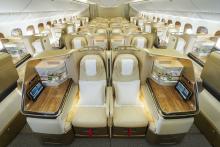
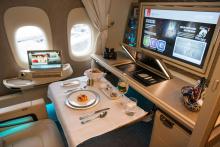
The Qsuite shows why Qatar Airways is a leading innovator in the sector.
The deal included 130 Boeing 787s and 30 Boeing 777-9s, with options for 50 more. It cements Qatar Airways as the largest 787 operator in the Middle East and one of the world’s most formidable long-haul airlines.
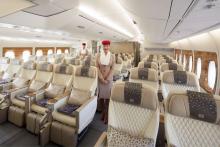
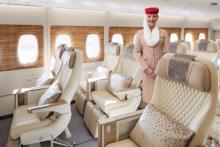
Qatar has been at the forefront of cabin innovation with its Qsuite for business class, while Emirates’ bar in premium classes is a huge drawcard, as is its ICE inflight entertainment system.
The scale of growth among Gulf carriers is extraordinary. Emirates now operates a fleet of 258 widebody aircraft, with a further 365 on order. Qatar Airways operates 260 aircraft and has 332 more on order. Combined, their outstanding commitments exceed the entire fleet sizes of many long-established national carriers such as the US-based United, American and Delta airlines.
Emirates is now the world’s largest international airline.
As the world’s aviation landscape continues to shift, the success of Middle Eastern airlines underscores that flexibility, strategic investment and geographic advantage can reshape entire industries.
Just as control of maritime trade routes once determined global fortunes, the ability to command the world’s air corridors is now reshaping the balance of power in international travel.
For the foreseeable future, the Gulf carriers will continue to sit at the heart of that transformation.