We’re four years into the great AI experiment for business writing and the cracks are showing. AI makes all kinds of business writing faster and cheaper, but is AI making anything better? It’s easy to assume what it produces is good, or even good enough.
According to new research from the Content Marketing Institute (CMI), AI may be saving you money on marketing and content expenses, but you’re paying in other ways.
The B2B Content and Marketing Trends: Insights for 2027 report from CMI and MarketingProfs surveyed 861 B2B marketers between June and August of this year. Nearly all of them (88%) use AI to generate content, with 60% saying they expanded their use of AI in the past year.
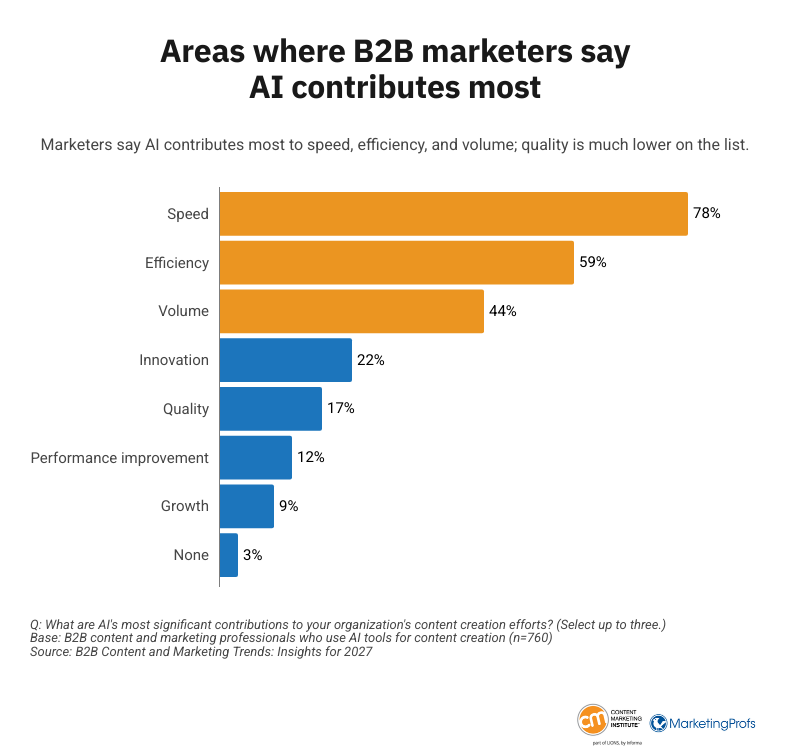
Respondents reported the top three contributions of AI are speed (78%), efficiency (59%), and volume (44%). From an ROI perspective, the findings are grim. Quality (17%), performance improvement (12%), and growth (9%) ranked lowest.
In my experience, those are the returns leaders want most. We’re producing greater volumes of content, but we’re not getting much for it.
Generic has never been competitive
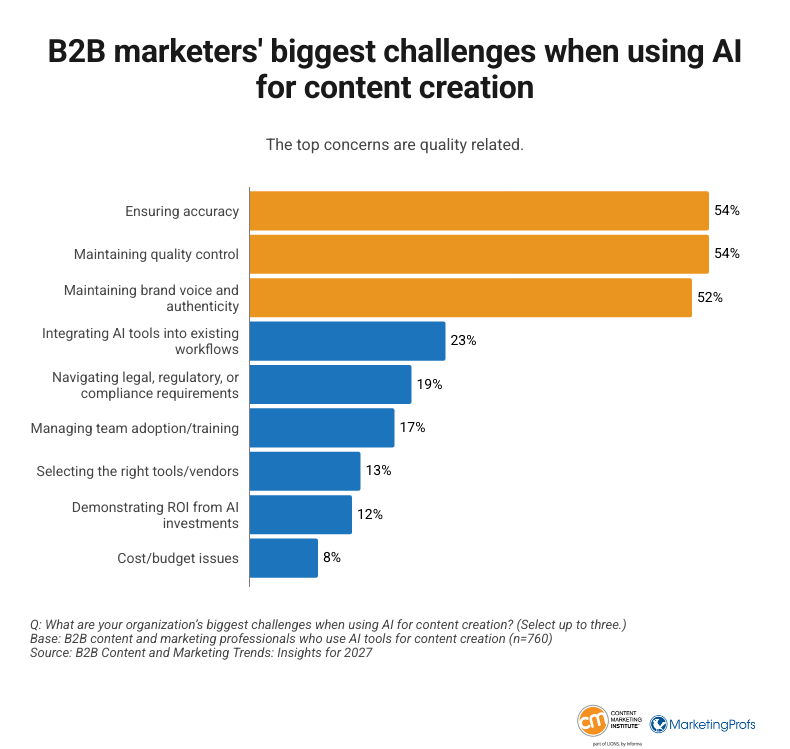
Marketers who rated their marketing effective cited content relevance and quality (47%) and team skills and capabilities (43%) as key contributors to their success, while rating AI tools much lower (14%). More than half report problems with accuracy (54%), quality control (54%), and brand voice (52%).
Fast and efficient don’t translate to good; respondents pegged a focus on speed for producing less original thinking (32%) and more generic content (29%). I call this the great blanding of brand communications. Ironically, AI search tools are unlikely to cite generic content. They look for fresh insight too.
If your AI-generated content isn’t delivering the return you expected, it’s time to consider how your organisation uses those tools.
Generative AI is a terrible thought leader
Readers are craving original insight, making your expertise and ideas highly valuable. Even being able to string a sentence together is becoming a competitive advantage as the whole world wearies of AI-speak.
This is backed up in the 2025 B2B Thought Leadership Impact Report by Edelman and LinkedIn. It surveyed 1,934 executives and found finance, operations, and procurement leaders want fresh insights into their business (91%) and ideas to challenge their assumptions (86%). Overall, the report showed 64% of executives trust thought leadership more than marketing materials.
That’s why going faster isn’t the answer. You can’t “efficiency” your way to improving brand reputation or convincing potential customers you’re the best company to work with. You need someone who knows how to tap into what your customers want and develop content to inspire new thinking. That means interviewing your internal experts, translating your expertise into plain-English prose, writing in your brand style, and publishing on a regular cadence.
A journalistic approach to thought leadership also levels the playing field. Edelman found 53% of buyers care much less how well known a supplier is if its thought leadership is strong. I learned that in my first sales role selling enterprise software in a market where nobody knew my company. I had a multimillion-dollar quota and lived on commission. I wrote case studies and white papers from my experience as a developer using the products. It was the most effective thing I did and was instrumental in closing sales from US$60,000 to US$10 million. I’ve been a fan of content marketing ever since.
Why “human in the loop” doesn’t work
Too often, the first thing produced by an AI tool is published because, “that’s better than I could have done”. You don’t want AI in charge, with someone on your team checking the work. You want someone with the right judgment and experience orchestrating the work with “AI in the loop” to assist.
A fractional content leader gives you that without the full-time salary. In a recent engagement as part of the senior leadership team (SLT), I recruited new writing staff, developed commercial offerings, set up processes, went on sales calls, and built internal capability so I could exit. In others, I work a set number of hours per week delivering strategy and content.
Sometimes it starts small, with a messaging workshop to gain internal consensus on how to attract your ideal customer. A good fractional leader begins with an agreed outcome and an end date.
Ensuring you’re getting value from your marketing investment
Here are three questions for your SLT:
1. Is AI making your content and communications better?
2. Are speed and efficiency costing you quality?
3. In your last five published pieces, where is the expert, the customer, or the original idea? If you can’t tell, neither can your buyers.
The lessons I learned in that first sales role still apply. Content demonstrating experience and a unique perspective builds trust and gets you closer to the deal.