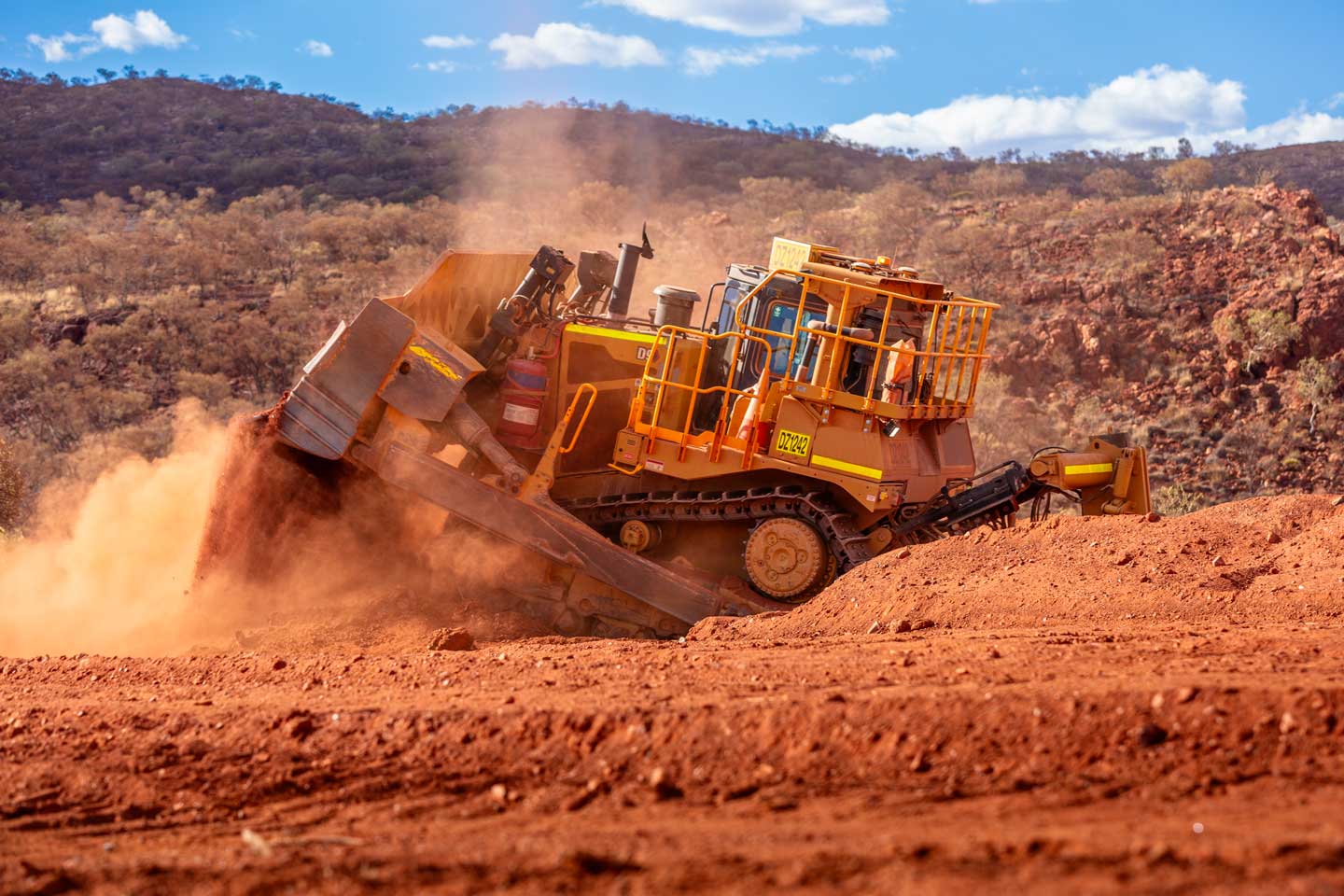
Mining has long relied on specialist contractors to deliver the work required to build, operate and rehabilitate projects.
But as projects have become more complex, so too has the role of the contractor.
The focus is increasingly moving beyond completing an individual scope of work towards maintaining continuity across the project. For mining clients, the ability to coordinate people, plant, maintenance, logistics and site activities can be as important as the individual service being delivered.
For Australian Indigenous Group (AIG), this shift has shaped the development of its business.
From individual capability to integrated delivery
AIG is a 100 per cent Indigenous family-owned business operating across civil construction, earthworks and rehabilitation within Australia's mining sector.
Its development reflects a broader change in what is required to keep mining projects moving.
A mining operation can involve civil construction and earthworks, load and haul, plant and equipment, maintenance, logistics and rehabilitation. While each activity requires its own expertise, the activities are closely connected.
Plant needs to be available when work starts. Equipment needs to be maintained to remain productive. Parts and machinery need to reach often remote project locations, while completed works need to transition into the next stage of the project.
AIG has responded by building capability across these connected requirements rather than remaining focused on a single specialty.
The AIG Group now includes Equipped Plant Hire (EPH), Waalitj Freight and Logistics (WFL) and Munjina Maintenance Service (MMS), with each business providing a complementary capability within the broader group.
Building capability around the project
Equipped Plant Hire forms an important part of that model.
Plant and equipment are fundamental to civil construction, earthworks and rehabilitation, making access to suitable machinery a key component of project delivery. As part of the AIG Group, EPH provides plant hire capability alongside AIG's contracting operations.
That connection extends into maintenance through Munjina Maintenance Service.
Equipment availability means little if machinery cannot remain operational. MMS provides maintenance support across AIG's operations, creating a direct connection between the equipment being used and the capability responsible for keeping it working.
The same principle applies to logistics.
Waalitj Freight and Logistics provides general freight, heavy haulage and vehicle relocation services, connecting Perth with remote project locations. For AIG, that capability supports the movement of machinery, parts and other resources required across its operations.
Each business remains capable of delivering its own service, but its position within the group creates an additional connection between the different requirements of a mining project.
The value of keeping things moving
This is where the value of integration becomes practical.
A project does not stop being interconnected simply because its individual requirements have been divided into separate scopes.
A delay in equipment availability can affect earthworks. Maintenance downtime can affect production. A delayed delivery can prevent machinery or parts from reaching site.
By bringing complementary capabilities together, AIG is creating greater visibility across some of the dependencies that sit behind project delivery.
The model is not about replacing specialist expertise. It is about connecting that expertise.
For a mining client, this can mean dealing with a group that understands the relationship between the work being performed, the equipment required to perform it, the maintenance needed to keep that equipment operating, and the logistics required to support it.
That creates a different proposition from simply delivering a completed scope.
People remain central to the model
Integration is not simply about connecting equipment, services and logistics. It is about bringing the people and expertise behind those capabilities together as part of the same delivery model.
Plant, maintenance and logistics all rely on skilled people to operate, coordinate and deliver them. For AIG, its workforce is therefore a fundamental part of the integrated model, connecting capabilities and keeping projects moving.
From doing the work to supporting the outcome
The evolution of AIG reflects how the role of mining contractors is changing.
Where a traditional contracting model can separate civil works, equipment, maintenance and logistics into individual requirements, an integrated group can bring those capabilities together around the same project.
For AIG, the development of EPH, WFL and MMS has created a connected group of businesses while retaining the specialist expertise of each operation.
That model allows AIG to support more of the practical requirements surrounding a project, from civil construction, earthworks and rehabilitation through to plant, maintenance and logistics.
As mining projects continue to operate across remote locations and increasingly complex supply chains, the ability to maintain continuity becomes an important part of delivery.
The business of mining contracting is therefore evolving beyond simply asking who can complete a particular scope.
For AIG, it is about building the capability to support what comes before, during and after the work — and connecting the people, plant, maintenance and logistics required to keep the project moving.


 By Australian Indigenous Group