


Industry leaders, developers, planners and senior government representatives gathered for the sold-out South East Corridor Council Alliance (SECCA) Housing Forum, a breakfast event that made one thing clear, Perth’s south-east corridor is entering one of the most significant growth phases in Western Australia’s recent history.
Representing the Cities of Armadale, Canning, Gosnells and Town of Victoria Park, SECCA outlined a united vision for a corridor defined by rapid population growth, unprecedented infrastructure investment, unparalleled lifestyle, and strong market confidence, positioned along major transport routes.
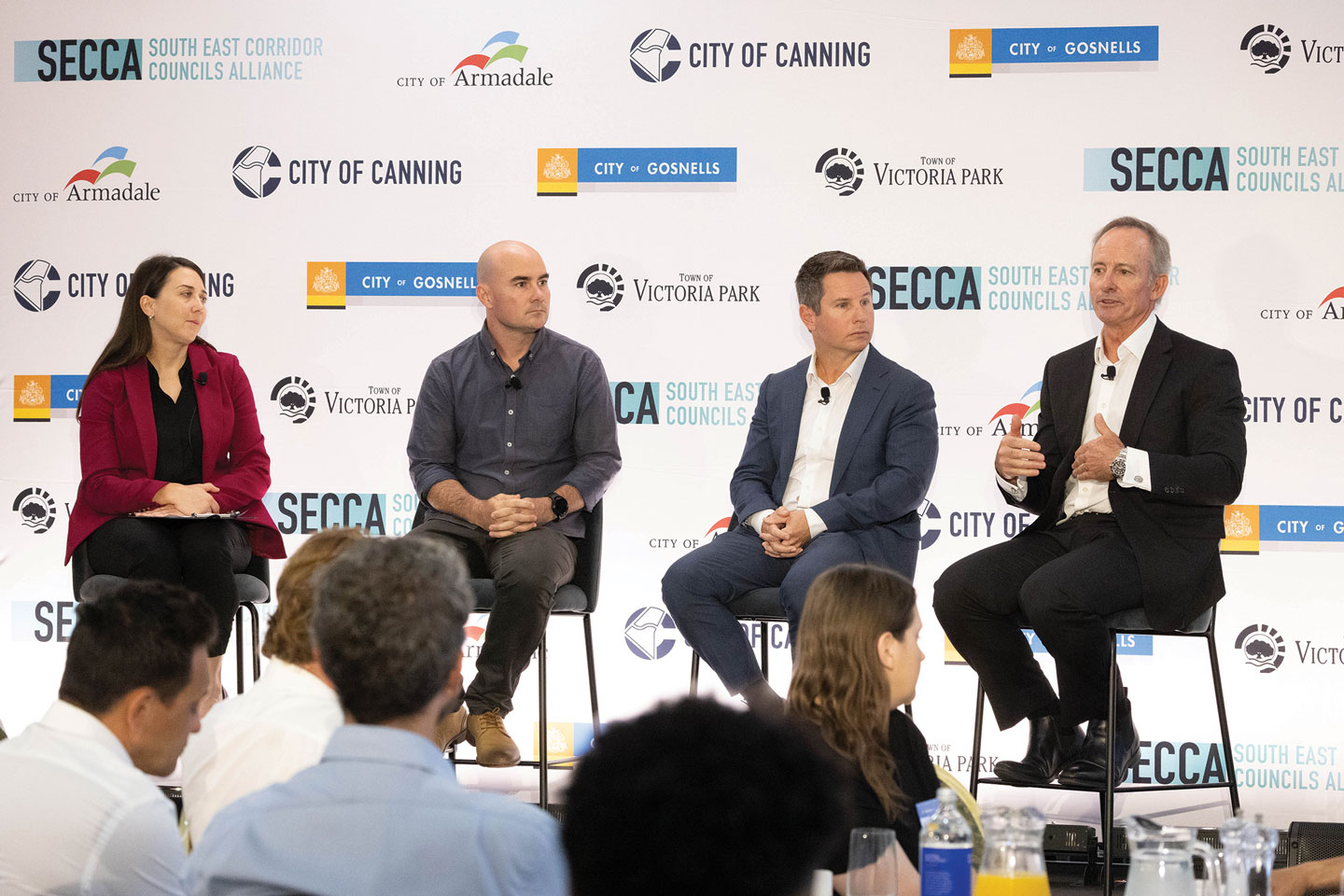
Moderated by Business News senior journalist Claire Tyrrell, the panel, featuring Urbis Urban Economics Lead Tim Connoley, Celsius Property Group Managing Director Richard Pappas and Cedar Woods WA State Manager Ben Rosser offered sharp insight into the drivers shaping the corridor’s trajectory and the housing opportunities ahead for the private sector. From migration-led population uplift to increasingly diversified employment centres, the south-east corridor is advancing as a strategically located, well balanced resilient market, positioned for high-density living.
City of Canning Mayor Patrick Hall described the region’s momentum as transformative, calling SECCA “Perth’s next economic powerhouse” and pointing to $2.12 billion in development already approved across the corridor in 2024/2025. The region supports 175,000 jobs, meaning approximately one in every nine jobs in Western Australia is located within this growing corridor.
United in purpose, the four SECCA Mayors emphasised the strategic opportunity for Perth’s south-east corridor to harness the State Government’s major investment roll out in the METRONET project. This unprecedented infrastructure program has created a once-in-a-generation opportunity to redefine the south-east corridor as Perth’s leading transport-oriented growth region. The Mayors noted that major rail upgrades are reshaping the corridor by improving access to jobs and education, reducing travel times, and creating new station precincts with the capacity to deliver higher-density housing. Together, these changes are shifting the region into a connected urban spine with the transport capacity, land supply, and development momentum needed to support significant residential and economic growth.
With 200,000 new dwellings planned by 2046 across the region, and forecast population growth to 520,000 residents, the corridor represents Perth’s leading opportunity for true transit-oriented development. They urged State agencies, industry and local governments to collaborate early, ensuring density can be delivered with supporting infrastructure, planning certainty and market-ready precincts.
Developers and builders were called to partner early with SECCA to unlock medium- and high-density opportunities around train stations, address infrastructure and planning requirements, and design vibrant, liveable precincts that maximise the value of investment by the WA Government. Their united message was clear, with rail corridors upgraded, demand rising and land still available, Perth’s south-east represents one of Western Australia’s most compelling opportunities for high density housing development, and SECCA is ready to work with industry to make this next chapter of Perth’s growth a reality.
Together, the four local governments govern a market that already supports 175,000 jobs, 32,000 local businesses, and holds 427 hectares of developable land along the railway line, one of the few remaining corridors in Perth capable of supporting the scale of population and housing growth forecast over the next two decades.
Urbis’ Tim Connoley described the corridor as one of the most dynamic and diverse growth areas in the state and noted that residents “do not have to travel far” for employment, a major factor in household decision-making and population retention. Connoley also underlined the region’s multicultural profile “a melting pot” with the highest concentration of overseas-born residents in Perth, strengthened by consistent international and skilled migration.
Celsius Property Group Managing Director Richard Pappas pointed to the south-east corridor as one of Perth’s most balanced markets. He praised the proactive approach of government and SECCA’s member councils, noting that “different housing works in different locations,” and the corridor’s mix of price points gives it unique development flexibility. Pappas explained that owner-occupier demand is particularly strong, with Celsius now selling about 80 percent of product to people choosing to live in the area, a sign of deepening confidence. Importantly, he highlighted that the region still has developable land, making medium and high-density projects both possible and viable when planned carefully.
For Cedar Woods WA State Manager Ben Rosser, density is not an aspirational idea but a structural necessity. “Density done well is fantastic for communities,” he said, adding that apartments and townhouses delivered in the right locations especially around METRONET stations can reduce congestion, improve affordability and open doors for residents who might otherwise be priced out of the market. Rosser highlighted the reality of Perth’s housing supply constraints and warned that traditional land development is becoming increasingly challenging. Higher density living, he argued, is the pathway that will allow Perth to grow sustainably without compromising liveability. He also stressed the important role alternative construction methods including modular and prefabricated building will play in accelerating delivery.
Throughout the morning, the alignment between SECCA’s long-term planning vision and industry’s appetite for certainty was evident. Perth’s south-east corridor is emerging as a focal point for Western Australia’s residential, commercial and employment expansion.
The statements provided by SECCA’s Mayors reinforced the corridor’s shared ambition, while the panel’s insights highlighted the commercial realities and opportunities underpinning that ambition. Together, they conveyed a clear message, the south-east corridor is not only growing, but also becoming the place where Perth’s future will be built.
Backed by strong demographic fundamentals, infrastructure readiness and coordinated planning across four local governments, SECCA is positioning itself as a partner to industry and a catalyst for long-term economic growth. For developers, investors and planners, the opportunity is significant, and the momentum is already building.