A report by the Productivity Commission has denounced the current GST distribution system, calling it “perverse”, only of benefit to Western Australia and leaving the federal government with an “open-ended fiscal liability".
The scathing review provides three options to consider ahead of the commission’s final report in December but insists “the system needs to change” to end its “undesirable features”.
“The reduction in revenue volatility for Western Australia has come at the direct expense of the Australian government, and therefore at the expense of citizens from all states,” the interim report found.
The report backs up the grievances of other states and ensures another GST fight ahead of the federal election in 2028, and could create tension between Federal Treasurer Jim Chalmers and WA Treasurer Rita Saffioti.
The commission’s “first-best option” recommends the government transitions “back to the pre-2018 GST distribution system” while allowing the federal treasurer and Commonwealth Grants Commission to deal with “costly dominant state effects” when they arise.
Significantly, the commission believes iron ore prices should be central to any changes, which would remove WA’s 75 cents in the dollar floor.
“The PC envisages that dominant-state effects in the mining assessment would be one area where a direction from the treasurer would occur,” the report said.
“At the time the reforms were introduced, the mining boom was projected to moderate.
“The boom – and especially strong iron ore prices and production – was the main driver of Western Australia’s high assessed fiscal capacity and record low GST relativity.”
But because iron ore prices remained strong, the GST reforms introduced by the -Turnbull-Morrison government in 2018 have “failed to make all states better off as intended”.
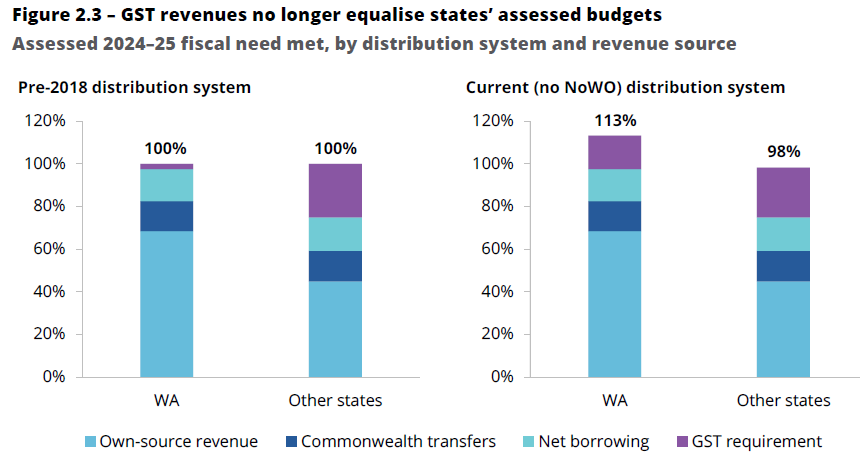
Source: GST distribution reforms interim report.
The commission makes no comment on the poor financial management of debt-ridden states like Victoria, nor does it consider gambling revenues, which are excluded from GST distribution assessments.
It did take into consideration the Cook government’s concerns about WA’s previous GST returns sinking to 30 cents in the dollar but argued that could be rectified without the hard 75 cent floor or the no worse off guarantee.
But the commission said the 2018 solution had failed and the government needed to consider the three options available at this point of its review.
“The second-best option, which is less desirable, is to return to the pre-2018 system, but with a commitment from the Australian government to make direct and transparent payments to states it considers to be materially impacted by dominant-state effects, instead of the treasurer directing the CGC to account for these impacts,” the report said.
The third option put forward by the commission was for the government to make minimal changes and reactivate the 75 cents in the dollar relativity floor.
“This option would have an enduring detrimental impact on the fiscal position of states other than Western Australia relative to the pre-2018 system,” the commission concluded.
“Therefore, if this option is adopted – and only if this option is adopted – the no worse off guarantee should be made permanent.
“The GST pool boost, which has failed to make all states better off, should also be removed. This would ensure that the Australian government – rather than the states other than Western Australia – continues to bear the ongoing cost of its policy choice to change the system in 2018.”
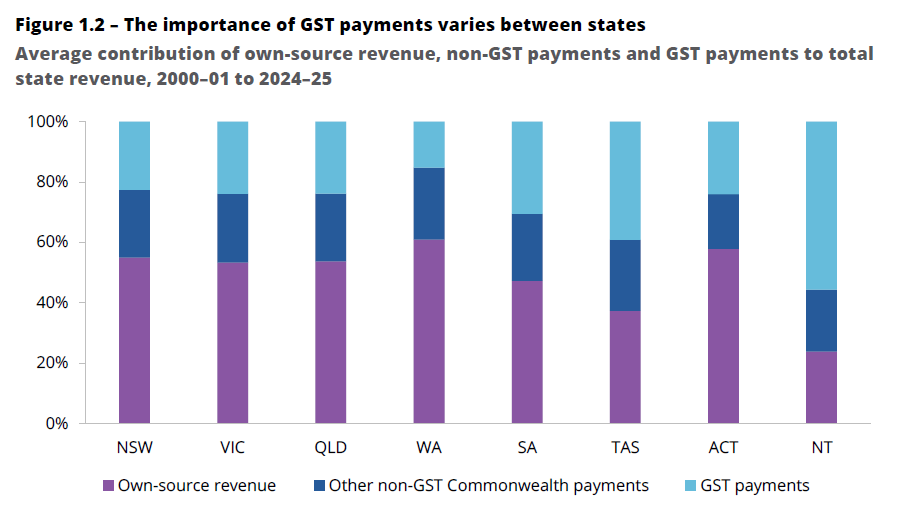
Source: GST distribution reforms interim report.
Pre-empting the commission’s interim report, Premier Roger Cook warned in parliament on Thursday, that WA was at risk of losing $6 billion a year if the current GST deal was dumped.
“We need to keep the pressure on,” he told parliament.
“When WA does well, the national economy does well.”
The report’s authors disclose the use of AI tools during the preparation of the document, which at times seems to contradict the argument about the risks posed by the current formula.
Prime Minister Anthony Albanese has maintained his position ahead of Friday’s Productivity Commission report, which is a promise that no state would be worse off by any changes to the 2018 deal.
But the commission’s interim report leaves little wriggle room for the government, which will be under mounting pressure from other states ahead of the next election.
“The 2018 reforms were expected to cost the Australian Government about $5 billion by 2024–25, but have ended up costing almost $23 billion, largely due to payments made under the no worse off guarantee,” the report said.
“While Western Australia was expected to benefit by a cumulative amount of about $3.9 billion by 2024–25, it has received the majority of the benefit from the $23 billion spent by the Australian Government.”
The commission concluded after reviewing more than 60 submissions and consulting with state governments that the “2018 reforms have largely not met their intent and have introduced a range of undesirable features”.
Interested parties have until the end of September to respond to the interim report before a final report is released during the Christmas and New Year holiday period.