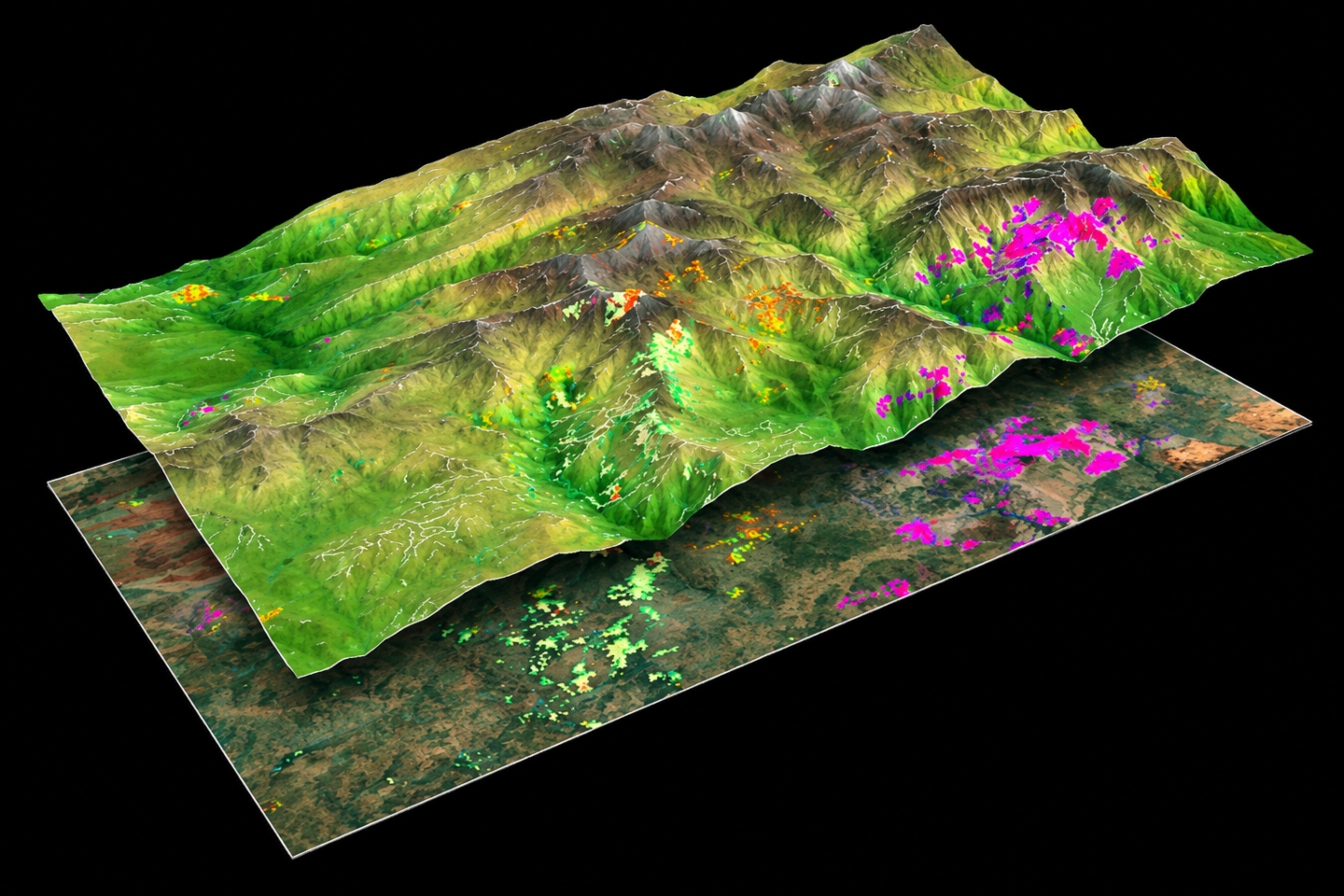
West Australian-based critical minerals explorer Octava Minerals has launched a high-tech satellite targeting program over its recently acquired West Sierra Grande fluorspar project in Argentina, aiming to generate a pipeline of new drill targets across the 400-square-kilometre tenure.
The company has joined forces with exploration technology firm TerraEye to deploy multispectral and hyperspectral satellite imagery, capable of detecting minerals and rock alteration through reflected light, integrated with terrain mapping and AI-assisted interpretation. The program is designed to rapidly identify structural corridors and alteration features associated with the project’s hydrothermal fluorspar vein systems.
TerraEye will use high-resolution digital elevation models and optical imagery to trace faults, fractures and intersections that may have channelled mineral-rich fluids into fluorspar veins. TerraEye will draw on satellite data from three sophisticated Earth observation systems – Sentinel-2, ASTER and EMIT – to map geological structures and identify the telltale mineral signatures that could point towards hidden fluorspar deposits.
The findings will then undergo spectral similarity analysis, allowing geologists to rank the most promising targets. Octava says the high-tech approach should help cut through 400 square kilometres of geological guesswork and steer its exploration dollars towards ground with the best discovery potential.
West Sierra Grande sits in Argentina’s Río Negro Province, historically the country’s biggest fluorspar district. Its four old mines lie 17km west of Sierra Grande, 47km west of Punta Colorada port and 1100km south of Buenos Aires, giving Octava access to established regional infrastructure and potential export routes.
The project’s Jurassic-era Marifil Volcanic Complex hosts steeply dipping fluorspar veins and fracture fillings, historically reported up to 12m thick and extending for hundreds of metres. Mining peaked in the 1970's and barely scratched the surface, leaving plenty of running room along strike and beneath the old workings.
Octava Minerals managing director Bevan Wakelam said: “Our key focus is progressing towards drill testing in and around the historic fluorspar mines. This satellite data analysis will fast-track additional areas for us to target and follow up with field investigations and guide additional work programs.”
TerraEye will crunch the satellite data to produce detailed mineral maps, geological comparisons and a hit list of priority targets, backed by a technical report. Octava’s geologists will then put the findings to the test on the ground, combining promising leads with existing exploration data to zero in on potential drill sites.
The results will guide geochemical sampling and geophysical surveys, including drone magnetics and ground-based electrical techniques, before the drill bit gets its chance. Management expects to keep the market posted as the exploration program gathers momentum.
Meanwhile, work continues at the historic fluorspar mines, where exploration is underway. Geological mapping, rock-chip and soil sampling will look for signs of extensions to known mineralisation to build the case for drilling.
A few regulatory hurdles remain, with exploration tenure applications pending and environmental baseline studies required before drilling permits can be secured. Any trenching or drilling will also need the necessary approvals before the company can get its hands dirty.
Octava is pursuing West Sierra Grande through a conditional agreement to buy up to 100 per cent of Argentine tenure holder Aybull S.A., subject to due diligence, regulatory and shareholder approvals. The staged deal, worth up to US$1.5 million (about A$2.1 million), offers an initial 70 per cent interest through option payments, worth US$650,000 (A$960,000). The remaining 30 per cent, costing US$850,000 (A$1.25M), requires a JORC-compliant indicated resource of at least 500,000 tonnes grading 30 per cent calcium fluoride (CaF₂), plus further payments.
If completed, the fluorspar project could add a valuable string to Octava’s critical minerals bow, taking the company beyond its Australian portfolio, including the Byro lithium, rare earths and vanadium project 220km southeast of Carnarvon in WA, and into the strategic global fluorspar market.
Western nations are scrambling to secure fluorspar supplies as demand grows for hydrofluoric acid, used in semiconductor etching for AI chips, lithium-ion battery electrolytes, defence electronics and refrigerants.
China still dominates, accounting for roughly 60 per cent of global production. However, US Geological Survey data shows it has become a net importer, adding pressure to the concentrated supply chain and highlighting opportunities for alternative producers.
By applying modern exploration technology to a forgotten mining district, the company is aiming to quickly build a resource in a critical mineral with a compelling supply-demand story. If the eyes in the sky can point the way for the drill bit on the ground, Octava could be well-placed to carve out a niche in the fluorspar supply chain.
Is your ASX-listed company doing something interesting? Contact: matt.birney@businessnews.com.au