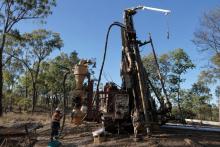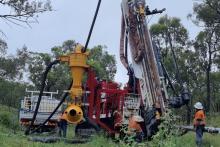


Phase two reverse circulation drilling at Moonlight Resources’ Leo Grande prospect within its Clermont project in Queensland has extended the gold footprint by a whopping 450m along the Leo Grande shear zone. Step-out drilling to the southeast and northwest returned broad near-surface gold intersections with several holes ending in mineralisation, highlighting further upside potential as more assays land.

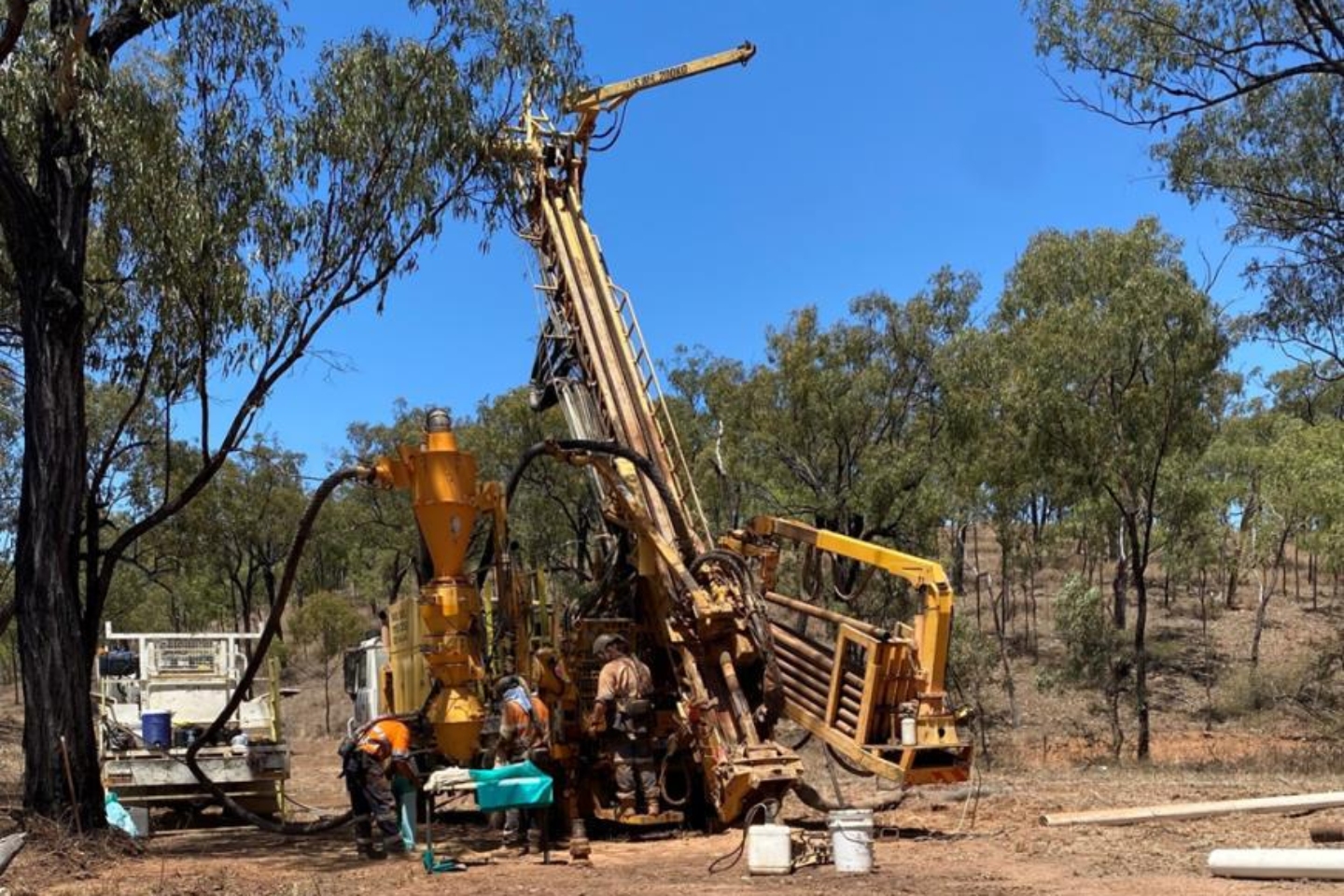
Phase two reverse circulation (RC) drilling at Moonlight Resources’ Leo Grande prospect has extended the gold footprint by a massive 450m along the Leo Grande shear zone within its Clermont project, 15 kilometres west of Clermont in Queensland.
Analytical results from an initial 22 reverse circulation (RC) drill holes have returned broad near-surface gold intersections, particularly from step-out drilling to the southeast and northwest.
Better intercepts to hand from the southeastern extension included an impressive 42-metre run at an average grade of 1.01 grams per tonne (g/t) gold from surface.
A second hole bored through 40m at 1.31g/t gold from 76m depth, including a 5-metre interval going 3.40g/t gold from 108m, while a third hole gave up 37m at 1.04 g/t gold from surface, including 7m at 2g/t gold from 22m.
Those results have extended the company’s prospective Leo Grande Central zone a healthy 200m further to the southeast, towards its Leo Grande South zone, revealing strong gold continuity within the mylonitic, intensely deformed rock fabric of the Leo Grande shear.
Intriguingly, the Leo Grande Central shear zone has been interpreted to continue a further 600m in this direction, which would hook up with previously intersected gold in the company’s Leo Grande South prospect area. This suggests that future exploration to the southeast could prove rewarding.
Moonlight Resources managing director Greg Starr said: “While the initial drilling results at Leo Grande have already demonstrated the presence of a broad, near-surface gold system, our focus is now firmly on defining the scale, continuity and additional growth potential. These initial Phase 2 results are an important step in that process.”
Drilling along the northwestern extension of the Leo Grande shear has also turned up definitive runs of relatively shallow gold. The best result to hand gave up an 18-metre chunk of mineralisation at 1.55g/t gold from 60m, including 3m at a handy 7.80g/t gold.
That hole is notable as it sits at the extreme northwestern end of the current phase two drilling pattern.
A second hole delivered 37m going 0.81g/t gold, including 22m at 1.01g/t gold from 79m, an estimated 230m southeast of the preceding 18m hit, which places it in the more central part of the Leo Grande system currently being explored.
The company has concluded that, overall, its northwestern drilling has intersected broad zones of mineralisation, with grades varying according to the host rock.
It was noted that slightly lower grades were returned from intercepts in chlorite-schist host rocks, although grades improve further to the northwest, within quartz-mica-schist rocks. The two holes referred to here with respect to the northwestern extension drilling exemplify that distinction.
However, regardless of gold tenor, the latest drilling has extended gold mineralisation a further 250m along the shear zone to the northwest.
More encouragement arises from the fact that several holes have ended in mineralisation, highlighting further upside potential.
The latest results form part of Moonlight’s 5000m phase two drilling assault on Leo Grande, which began in late February. The campaign was designed to include step-out and shallow extensional infill drilling and to increase the drilling density required for a maiden mineral resource estimate.
The program builds on the company’s maiden 2025 campaign, reported in January, where all 14 holes hit thick gold from surface or very shallow depths, including 40m at 1.30g/t gold from surface and 34m at 1.37g/t gold from 6m, with multiple holes finishing in mineralisation.
Impressively, all phase one drill holes intersected mineralisation and several step-out holes have revealed continuity beyond previously drilled areas. Moonlight says those results highlight the potential scale of the system and have provided the technical foundation for the phase two campaign.
The phase two campaign is ongoing, with Moonlight looking to release further results when they come to hand and are validated. When the current work at Leo Grande wraps up, the company will move the RC rig to begin drilling at its Goldfinger prospect.
With plenty of results still to come, gold frequently reporting from surface, plenty of holes ending in mineralisation and strong indications of further strike potential along the Leo Grande shear in both directions, Moonlight looks well placed to keep adding scale at Leo Grande as it marches resolutely towards its maiden resource.
Is your ASX-listed company doing something interesting? Contact: matt.birney@businessnews.com.au