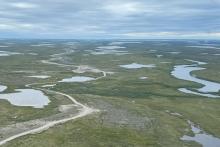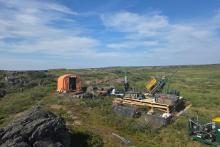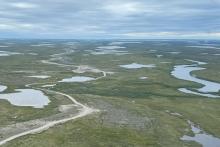


Manhattan Gold Corporation has launched a 4000m reverse circulation drilling campaign at its Hook Lake project in Nunavut, Canada, marking the first modern exploration there in over 30 years. The program will test a historical foreign estimate of 285,000 ounces of gold at the Jaws prospect. The drill bit will also follow up on high-grade surface samples and VMS targets across the underexplored greenstone belt.

Manhattan Gold Corporation has kicked off a comprehensive exploration program at its Hook Lake project in Nunavut, Canada, launching a 4000-metre reverse circulation (RC) drilling campaign, marking the first modern drilling on the ground in more than 30 years.
The campaign is being driven by a recently refreshed board, funded by a new $3 million war chest and led by newly appointed non-executive chairman Gavin Rezos, the founding chairman of the highly successful Vulcan Energy Resources.
The company’s headline act is the Jaws prospect, which hosts a non-JORC historical foreign estimate of 3.4 million tonnes grading 2.38 grams per tonne (g/t) gold for about 285,000 ounces.
The new drilling aims to confirm impressive historical drill results, from way back in 1988, including a hefty 52.78-metre hit at 3.38g/t gold from 89.22m, featuring an eye-catching higher-grade core of 46.22m at 3.80g/t gold. Other outstanding legacy intercepts include 16m at 5.04g/t gold and 15.2m at 4.50g/t gold.
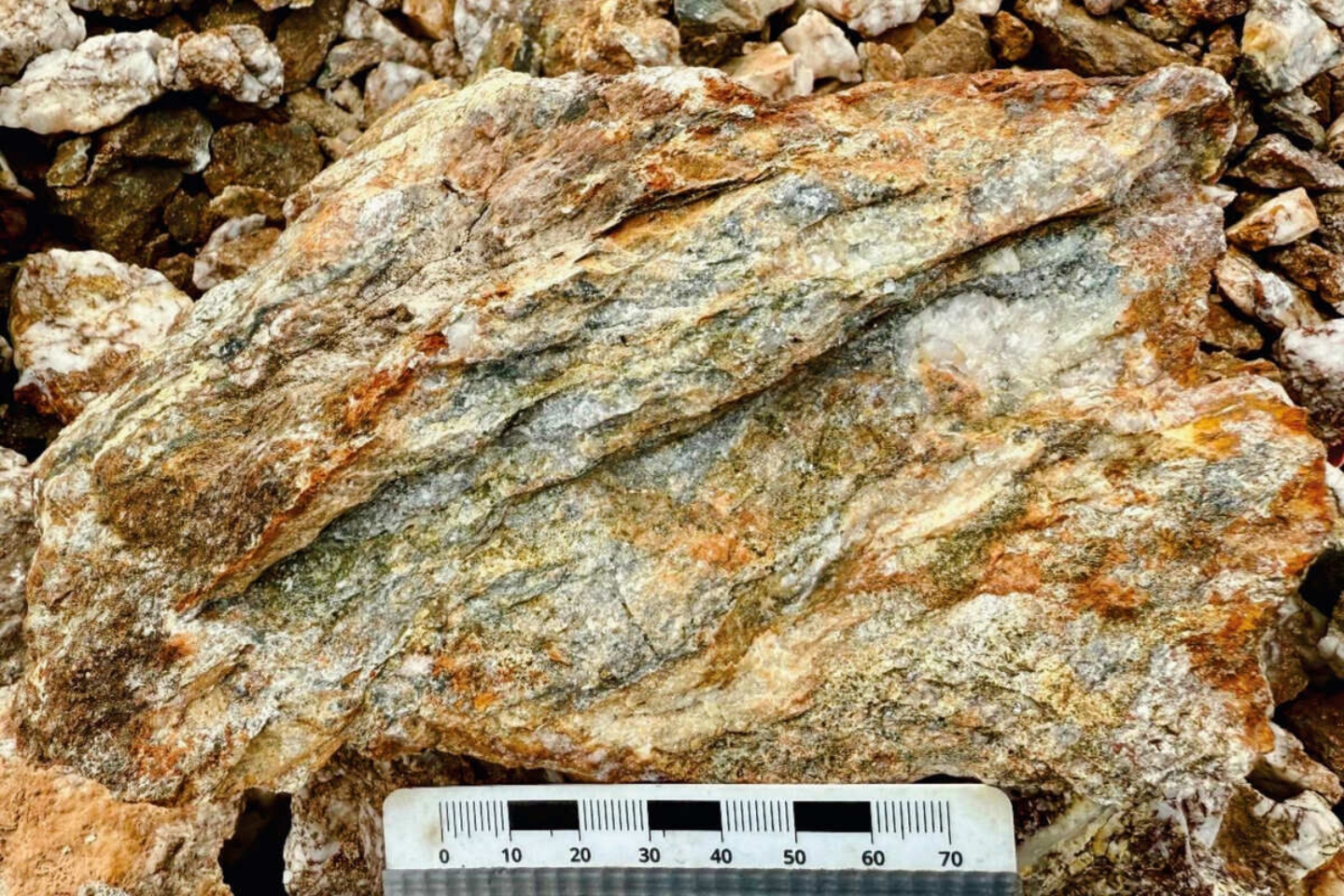
The gold mineralisation at Jaws is a common deposit style known as an orogenic system, typically found in ancient volcanic 'greenstone' belts.
The yellow metal is hosted in quartz veins within volcanic rocks of the Kaminak Group and was subsequently altered by mineral-rich fluids. It is also associated with a mix of sulphide minerals, including arsenopyrite and pyrite.
Manhattan says historical drilling was largely directed to the northwest, a direction it believes may have resulted in exaggerated intercept widths. The company’s new program will drill scissor holes towards the southeast to intersect the mineralisation at a better angle and test its true thickness whilst also checking for gold mineralisation that may have been missed.
Notably, the Jaws mineralisation remains open in all directions with a strike length potential of 3.3 kilometres and has only been tested to a shallow vertical depth of about 190m.
Manhattan Gold Corporation technical advisor Eric Sondergaard said: “The Hook Lake project will see more exploration work this year than at any time in the past 30 years, a level of attention we believe is warranted given its potential to become Nunavut’s next major gold district.”
The campaign is also set to conduct the first-ever drill tests of its other high-grade prospects. At Manhattan’s untouched Quantum and Lotus targets, rock chip sampling in 2025 delivered eye-catching results. Quantum returned up to 16.75g/t gold and a whopping 1485g/t silver, while Lotus yielded 8.01g/t gold alongside a spectacular 2660g/t silver.
Drilling will also test the nearby Spectre prospect, where work - last conducted in 1974 - will assess the continuity of shallow copper-zinc-gold-silver massive sulphide lenses. Historic drilling at Spectre returned a mouthwatering polymetallic hit of 10.51m at 2.91 per cent copper, 6.7 per cent zinc, 95.67g/t silver and 1.04g/t gold.
In addition to the upcoming drilling, Manhattan says it’s running a multi-pronged surface exploration campaign. A two-plane airborne magnetic survey has been restarted and expanded to cover 81 square kilometres of new claims staked in April, 30km to the west of Hook Lake, with the data set to feed into targets for future drilling.
A project-scale till sampling program will also be completed across the Vesper-Jaws-Omega region to search for mineralisation hidden beneath shallow glacial cover. Additionally, the company will run channel sampling on its newly acquired claims to investigate historic results on an 8m by 40m outcrop that included a peak of 17.14g/t gold over 0.3m.
The 665-square-kilometre Hook Lake project sits within the underexplored but highly prospective Rankin-Ennadai greenstone belt, the second largest of its kind in Canada. The belt hosts major operations such as Agnico Eagle's 6.7-million-ounce Meliadine mine 225 kilometres to the northeast, suggesting it has potential for further significant gold deposits.
Operating in Canada's northern territories requires a strong social licence, and Manhattan appears to have its ducks in a row on that front. The company has locked in a 20-year mineral exploration agreement with the Kivalliq Inuit Association and the local Hamlet of Arviat, granting it access to 338 square kilometres of Inuit-owned land.
In a further boost, the company has received drilling and water permits for an initial seven-year term. At the same time, the Nunavut government has chipped in with A$255,000 in direct financial support through its Discover, Invest, Grow exploration grant program.
With a new board, fresh cash, local agreements locked in and the drills finally turning on a project brimming with historical data and untested high-grade targets, Manhattan appears to have all the pieces in place for a compelling exploration story.
If the drill bit can confirm the promise seen on the surface and in the old drill logs, this new Canadian chapter for the company could get interesting very quickly.
Is your ASX-listed company doing something interesting? Contact: matt.birney@businessnews.com.au