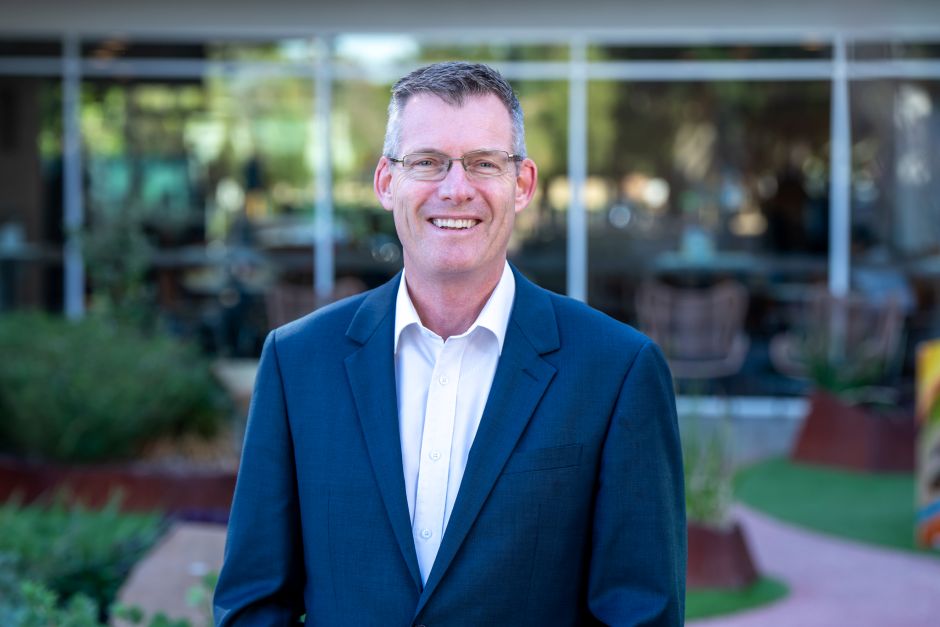
Peter King, ASM has spent much of his professional life working in organisations where leadership is measured by more than commercial performance.
Before joining Ronald McDonald House WA 12 years ago, Mr King spent 18 years with St John Ambulance, including 12 years on its executive team, where his responsibilities spanned portfolios including marketing, training and ambulance services. He has also served on the boards of community organisations including Interchange and Good Sammy, building a career that has consistently combined organisational leadership with a strong sense of social purpose.
That experience ultimately led him to Ronald McDonald House WA, where he saw both an opportunity to support families during some of the most difficult periods of their lives and to help lead an organisation with significant potential for growth.
“As much as it is about the purpose of the organisation, it is also an opportunity to lead,” Mr King said.
For Mr King, effective leadership begins with clarity: a strategy that is actively used, a strong culture and a capable team supported to perform at its best.
“My philosophy is to have a clear strategy that is lived, not one that sits in the bottom drawer,” he said.
“Our values are our north star, and what gets measured gets done.”
That philosophy has guided Ronald McDonald House WA through a period of considerable transformation.
When Mr King joined the organisation, the original House in Subiaco adjacent to Princess Margaret Hospital accommodated 18 families a night. It also operated a relatively small Ronald McDonald House Learning Program for children missing school during treatment and 2 Ronald McDonald House Family Retreats.
One of Mr King's earliest challenges was preparing Ronald McDonald House WA for the transition to Perth Children's Hospital (PCH). The development of a purpose-built Ronald McDonald House accommodating 47 families a night, as well as running the Parent Accommodation 14 room facility within PCH supporting both metro and regional families with critical ill children in ICU, tripled service delivery.
Today, Ronald McDonald House WA can accommodate 111 families in 3 Ronald McDonald Houses, operates two Ronald McDonald House Family Rooms supporting about 120,000 visits each year and provides approximately 4,000 hours of education support through our Ronald McDonald House Learning Program. To deliver these essential services, the charity employs 75 staff and is supported by about 450 volunteers.
To support these services, Mr King had to invest in strategies to significantly increase fundraising revenue from $800,000 when Mr King first joined the organisation to around $8 million today.
The scale of that growth reflects Mr King’s strong leadership enabling an organisation to evolve well beyond the traditional perception of Ronald McDonald House as simply a place where regional families stay while a child receives treatment.
Whilst accommodation remains central to its purpose, the support surrounding families has become increasingly sophisticated. Today, under Mr King’s leadership Ronald McDonald House WA a strategic partner of WA Health Service delivering essential services which enable family centred care within the healthcare system as well as maintaining families financial, emotional, psychological and environmental wellbeing.
For parents travelling from regional and remote Western Australia, having a child undergo serious medical treatment can mean weeks or months away from home, separation from extended family, disrupted employment, financial pressure and the challenge of trying to maintain some sense of normality for siblings.
At the same time, families are navigating an unfamiliar health system during what is often one of the most stressful periods of their lives.
“What families need is a coordinated network, not isolated services,” Mr King said.
“When a child is ill, families are navigating medical care, financial pressure and practical challenges. Our close relationships enable families to experience a more seamless service of support.”
That support comes at a significant cost.
Mr King estimates it costs around $360 a night to provide a family with accommodation, meals, education and broader services.
As an organisation supporting more than 100 families at one time, the financial requirements are substantial, reinforcing why Ronald McDonald House WA must be run with many of the same disciplines expected of a successful business.
Strong governance, financial sustainability, workforce planning, operational excellence, risk management and long-term strategic planning all sit behind the organisation’s frontline services.
Mr King considers a strong board particularly important, with directors bringing the same expectations around accountability and governance that they would apply in commercial organisations.
That discipline is essential when an organisation is responsible for millions of dollars in community, philanthropic, corporate and government support.
Ronald McDonald House WA has therefore focused on diversifying its funding base.
The Stan Perron Charitable Foundation is among its significant philanthropic supporters, contributing around $1 million a year, while other families and philanthropic partners support areas such as education. Major fundraising initiatives, including its Ronald McDonald House WA Gala Ball, Ride For Sick Kids WA and Up All Night, also remain important.
Mr King said diversification was essential to ensuring the organisation could continue to grow without becoming overly dependent on any one funding stream.
Government partnership will also play an increasingly important role in its next phase.
“The State Government is currently assessing a business case for the organisation’s future expansion, State Government support will allow the organisation to plan with greater confidence”, said Mr King.
That growth is now being mapped out through Ronald McDonald House WA’s 2026–2031 strategic plan, which is centred on improving equitable access to the health system regardless of where families live or their circumstances.
One of its most significant priorities is increasing accommodation capacity from 111 families to 136 by the end of 2031.
However, Mr King is clear that the next phase cannot simply be measured by the number of additional rooms created.
“A family needs more than a room,” he said.
The organisation’s strategy places greater emphasis on strengthening family support, improving wellbeing and resilience, and ensuring families feel connected throughout the treatment journey.
It is also developing a stronger framework for measuring impact.
Rather than focusing only on the number of nights of accommodation provided or programs delivered, the organisation is increasingly looking at whether families genuinely feel supported and whether its services contribute to better outcomes for the family unit as a whole.
That approach reflects Mr King’s belief that purpose must be backed by evidence.
“What gets measured gets done,” he said.
Technology is another major part of the organisation’s future direction.
Ronald McDonald House WA is investing around $1.8 million in a digital transformation program, with the first phase completed and the second phase in progress.
The investment is designed to improve the experience for families while reducing administrative workloads, strengthening donor stewardship, improving volunteer management and delivering better governance, compliance, data and reporting.
Perhaps most importantly, it is intended to allow staff to spend more time supporting families and less time navigating inefficient systems.
“In the not-for-profit sector there is real pressure to put every dollar raised into frontline service,” Mr King said.
“But if you neglect the technology that supports the business, it becomes a false economy.”
It is a point that speaks to a broader challenge across the not-for-profit sector.
"People often separate purpose and performance, but in my experience, they are inseparable,” says Mr King, “The stronger the governance, strategy and financial sustainability, the greater the impact you can deliver."
For Ronald McDonald House WA, the next chapter will require continued support from government, philanthropy, business and the wider community, alongside the leadership, systems and workforce required to manage a much larger organisation.
After growing from 18 families to 111, and from around $800,000 in annual fundraising to approximately $8 million, the organisation is now preparing for another significant phase of expansion.
The challenge is to ensure that growth does not dilute its purpose, but strengthens it.
For Mr King, the objective remains clear: to build an organisation capable of supporting more families while retaining the compassion, discipline and sense of purpose that have driven its growth to date.
At its heart, the principle is simple. When a child becomes seriously ill, where a family lives should not determine whether they can stay close, remain connected and access the support they need.
After more than three decades leading mission-driven organisations, Mr King remains motivated by the same principle that first attracted him to Ronald McDonald House WA: ensuring families can stay together during a child's illness. The scale of the organisation may have changed dramatically, but its purpose remains unchanged, and Mr King believes its greatest chapter is still ahead.