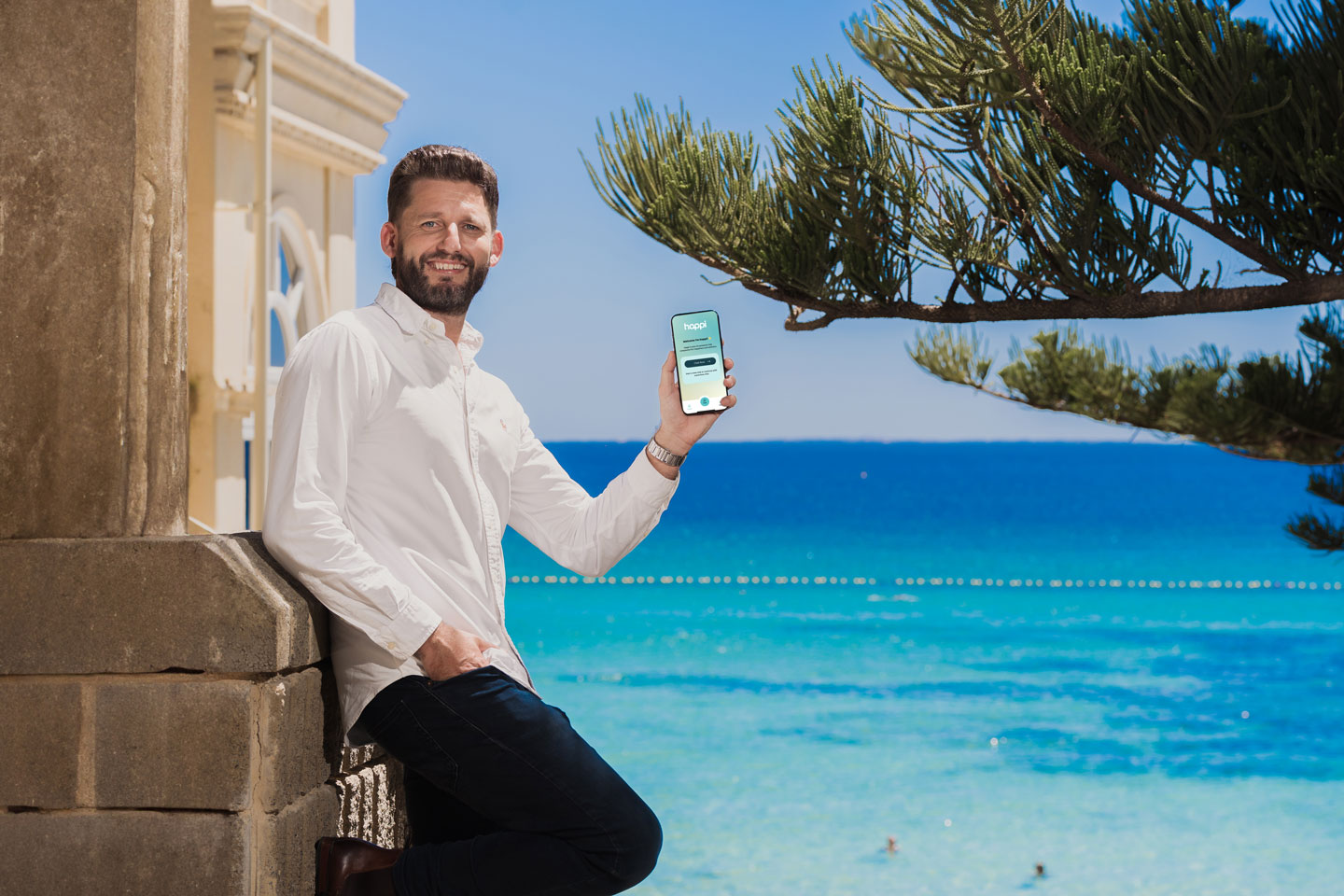
As demand for mental health support continues to outpace supply, we have a responsibility to explore new ways of supporting people through their mental health challenges.
Research shows around 60 per cent of Australians never seek mental health support, with cost, availability and stigma remaining major barriers.
With artificial intelligence rapidly transforming the way we live and work. those two realities collided. If people aren’t accessing traditional support, and AI is becoming more accessible, we thought we could we use technology to help shift the needle.
That realisation led to the creation of Happi – an AI-powered mental wellbeing companion built and owned here in Western Australia.
We designed Happi with local technology company Mechanical Rock to provide accessible, on-demand support across corporate and community settings, with organisations increasingly looking for proactive, scalable ways to support people.
The app has just launched but there is already wide uptake in the community and corporate space. Co-living provider Living Rooms has integrated Happi into its residential model with 24-hour wellbeing support.
Organisations including Alchemy Saunas, Monson Agency, West Coast Civil, Mazzei and Mechanical Rock have also adopted the technology.
Bridging the access gap
Australia’s mental health system is under strain, with long wait times and growing demand. While many organisations offer Employee Assistance Programs (EAP), uptake remains low, due to stigma.
Happi is designed to bridge the gap between clinical care and informal advice. It is not designed to replace therapy or clinical care, but to complement it. Happi provides support in the moments between appointments, or before someone decides to seek formal help. You don’t need to be in crisis to need support.
The platform uses clinical and evidence-based psychological and wellbeing frameworks, combined with clear ethical guardrails – to support daily reflection, emotional regulation, habit-building and early help-seeking.
With the mental health system under pressure and workplaces looking for practical tools that genuinely support people, I believe technology can play a critical role in making wellbeing more proactive, consistent and accessible.
The app also takes away the barrier of cost. Australians aged 18–24 can access the core version free of charge, while adults over 25 can subscribe for $2 per week, creating a low-cost entry point to support.
Enterprise-grade security
From day one, privacy and safety have been central to our design decisions. Happi was developed in partnership with WA technology firm Mechanical Rock, with security embedded from inception.
All data is hosted in Australia and protected by encryption, with additional field-level encryption applied to user conversations. No employer or administrator can see the details of any chat. Conversations are private, and user data is not used to train broader AI models.
Unlike open AI systems that draw from the internet, Happi uses retrieval-augmented generation, meaning responses are pulled from a curated knowledge base rather than open web sources. The system operates within defined psychological frameworks to help ensure guidance remains supportive and appropriate.
A WA AI story
As workplaces and communities search for scalable, preventative mental health solutions, Happi sits at the intersection of responsible AI and human-centred wellbeing.
With local ownership, Australian-hosted data and early market traction, our goal is simple – to reduce barriers to support, at scale.
Technology is evolving rapidly, and we have to evolve with it. If we can use AI responsibly to make support more accessible – not to replace human care, but to complement it – that represents a meaningful shift in how we think about mental wellbeing.






 05 Oct 2026
 24 Aug 2026
 20 Apr 2026
 19 Jan 2026
 28 Nov 2025