




Bulls N’ Bears Big Hits looks at notable drill intercepts recently reported to the ASX this week, led by White Cliff Minerals, which has continued to build the case for a district-scale copper system at its Rae project in Canada. Australian Gold & Copper extended high-grade mineralisation beneath its existing Achilles resource in NSW, while Kingfisher Mining delivered wide high-grade copper-gold hits as it edges its Copper Blow IOCG project towards a maiden resource estimate.


Bulls N’ Bears Big Hits looks at notable drill hits recently reported to the ASX, led by
White Cliff Minerals, Australian Gold & Copper and Kingfisher Mining after delivering standout drilling results that have expanded discovery scale, extended known resources and strengthened future development potential. So, let’s dive in.
WHITE CLIFF MINERALS (ASX: WCN)
Project: Rae Project, Nunavut, Canada.
Hit: 41.5m at 0.87 per cent copper, 176.78m.
White Cliff Minerals has continued to strengthen the case for a potentially district-scale copper discovery at its Rae project in Canada's Nunavut province, significantly extending the mineralised footprint.
The standout discovery assay came from a step-out drill intercept more than 600 metres from the company's flagship Danvers 1 discovery area, returning 41.5m grading 0.87 per cent copper from 176.78m, including a higher-grade interval of 9.14m at 3.06 per cent copper.
Management said the result was significant because it represented the first hole drilled into the 4km-long Danvers 4 northeastern target area and demonstrated that the mineralised system extends well beyond the original discovery zone.
Another hole, drilled 685m northeast of Danvers 1, delivered multiple copper-bearing intercepts, including 12.19m at 0.54 per cent copper from 128.02m and 15.24m at 0.86 per cent copper from 149.35m, including 1.52m grading 4.16 per cent copper.
The latest assays continue to build White Cliff's growing story of scale at Rae, where the company says drilling has confirmed copper mineralisation stretching to more than 5.4km of strike.
Recent drilling has also identified copper sulphides over a further 1.6km of prospective ground, increasing the potential strike of the mineralised corridor to about 7km. The company plans to test more than 10km of strike as drilling progresses, meaning that its “district-scale” handle is beginning to look compelling.
Supporting the assay results, White Cliff also completed its first diamond drillhole at Danvers 1. The hole intersected 91.35m of bornite and chalcocite-bearing copper sulphide mineralisation and supplied important structural information, which will help refine the geological model for future resource definition drilling.
The geological picture was further strengthened by another diamond hole, which logged a combined 144.45m of visible copper sulphides dominated by bornite and chalcocite. Assays from that hole are still pending, providing market watchers with another potential near-term news catalyst.
White Cliff managing director Troy Whittaker said the results continued to build confidence that Danvers could develop into a copper discovery of significant scale, with high-grade mineralisation now confirmed hundreds of metres from the original discovery area.
The company also strengthened its balance sheet during the week after receiving A$6.5 million from the conversion of listed options, funding the next phase of drilling as it works to define the full size of what is emerging as one of the ASX junior sector's most closely watched copper discoveries.
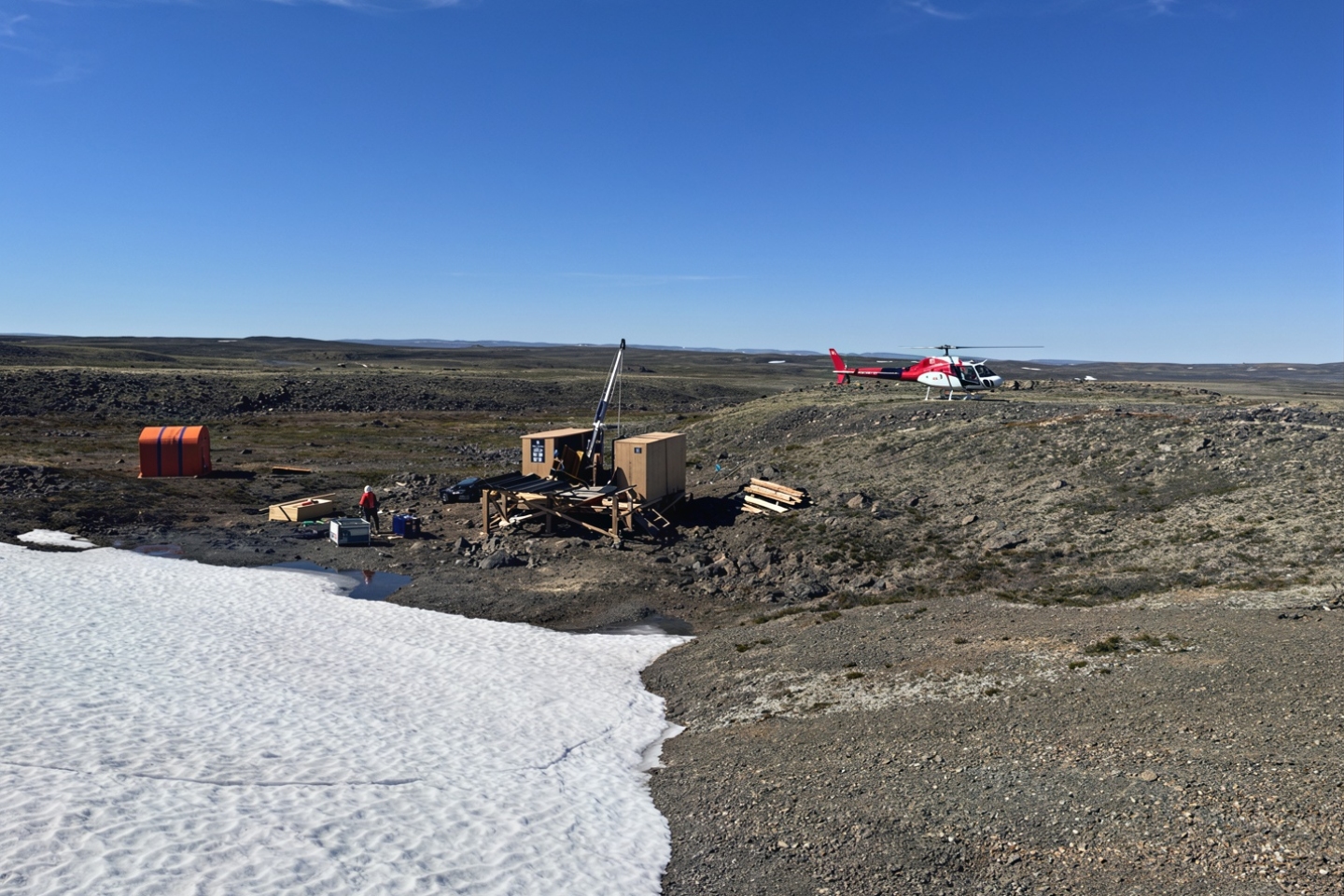
White Cliff Minerals drilling at its Rae project in Canada’s Nunavut province. Credit: File
AUSTRALIAN GOLD & COPPER (ASX: AGC)
Project: Achilles deposit, central NSW, near Lake Cargelligo town.
Hit: 26m at 102g/t silver equivalent from 433m.
Australian Gold & Copper has continued to demonstrate the growth potential of its Achilles deposit within the mineral-rich South Cobar Basin in NSW, after the deepest hole ever drilled at the project intersected high-grade mineralisation hundreds of metres below the company’s current mineral resource estimate.
The latest diamond drilling program was designed to test extensions beneath the existing Achilles mineral resource, with one hole delivering a standout intercept of 26m at 102g/t silver equivalent from 433m, including 15m at 153g/t silver equivalent and a bonanza-grade interval of 2m at 770g/t silver equivalent.
The hole intersected mineralisation an estimated 540m down-dip from surface and 250m below the base of the current Achilles resource estimate, providing compelling evidence that the mineral system remains open and fertile at depth.
That hole tested below a previously drilled hole, which at the time was the deepest hole put into Achilles’ northern high-grade zone and returned 11m at 424g/t silver equivalent from 305m, including 3m at 1,453g/t silver equivalent from 306m.
Management described the latest result as the strongest outcome from its recent depth-extension drilling campaign, which was specifically designed to test whether the northern high-grade zone continued well below the existing resource envelope. The answer appears to be a resounding yes.
A second hole from the program also intersected mineralisation, returning 3m at 97g/t silver equivalent from 332m, including 1m at 130g/t silver equivalent.
The results build on what is already shaping up as one of the more significant precious and base metals discoveries in the South Cobar Basin. Achilles currently hosts a mineral resource of 10.3 million tonnes grading 116g/t silver equivalent for 38.5 million ounces silver equivalent, with much of the recent drilling yet to be incorporated into the model.
Importantly for investors, the latest success is not simply about adding ounces. By confirming mineralisation well below the existing resource, the drilling materially strengthens the case for future underground mining options and extends the potential life and scale of the deposit.
Managing director Glen Diemar said the result confirmed the Achilles mineral system remained open hundreds of metres below the current resource and provided added confidence as the company assesses future underground mining potential, resource growth and longer-term development options.
While the recent deep drilling has highlighted the long-term upside, Australian Gold & Copper’s next phase of work will shift back towards lower-cost, shallower reverse circulation drilling targeting near-surface oxide gold-silver mineralisation and additional resource growth opportunities.
The company is also continuing diamond drilling at its emerging Evergreen discovery, where further assay results are expected in the coming weeks.
For now, however, the market's attention is likely to remain on Achilles, where drilling continues to show the deposit extends far beyond the boundaries of the current resource estimate and may still have considerable room to grow.
KINGFISHER MINING (ASX: KFM)
Project: Copper Blow IOCG project near Broken Hill, NSW.
Hit: 26m at 2.57% copper and 0.75g/t gold from 73m.
Kingfisher Mining has delivered some of its strongest copper-gold drill results yet from its Copper Blow project near Broken Hill, extending mineralisation and moving the project another step closer to a maiden resource estimate.
Mineralisation at Copper Blow is believed to be associated with a northeast-southwest-trending iron-oxide copper-gold (IOCG) system hosted within the Copper Blow shear zone. Historical drilling has defined two main mineralised zones, the North and South Zones, along an estimated strike distance of 600m. The two zones are separated by a northwest-southeast-trending fault structure.
The latest reverse circulation drilling campaign returned several wide, high-grade intercepts from the North Zone, highlighted by one hole which intercepted 26m at 2.57 per cent copper and 0.75g/t gold from 73m, including 13m at 4.07 per cent copper and 1.20g/t gold from 75m. Within that interval, the company also reported a particularly rich 4-metre section grading 7.06 per cent copper and 2.38g/t gold.
Another standout hole returned 43m at 1.32 per cent copper and 0.32g/t gold from surface, including 17m at 2.46 per cent copper and 0.60g/t gold.
Deeper drilling also intersected 58m at 0.67 per cent copper and 0.15g/t gold from 165m, including 11m assaying 1.01 per cent copper and 0.27g/t gold from 167m.
The company has highlighted the importance of that deeper 58-metre intercept, which management says demonstrated continuity of the mineralised shear zone at depth. According to Kingfisher, that continuity could be critical in establishing the vertical extent needed to support a sizeable resource beneath the roughly 600m strike length already identified.
The results are significant not only for the grades but also for the continued demonstration of the scale of the mineralised system. Kingfisher said drilling had extended high-grade sulphide mineralisation by a further 50m towards a major cross-fault and has confirmed the system remains open both at depth and along strike.
Management believes the latest work has strengthened confidence in the North Zone, where several of the best intercepts were returned from areas previously considered to have limited mineralisation potential. That suggests additional mineralised material may exist outside the currently recognised domains, potentially adding to the project's future resource inventory.
While most of the attention centred on the North Zone, drilling in the South Zone has also returned encouraging results, including 3m at 1.99 per cent copper and 0.45g/t gold from 146m, reinforcing the potential for additional high-grade lodes elsewhere in the system.
Managing director Chris Bittar said the latest campaign has further demonstrated both the scale and quality of the Copper Blow mineralised system and represented another important step towards delivering a maiden mineral resource estimate.
The project's location lends further appeal to its story. Copper Blow sits 20km from Broken Hill Mines' concentrator and the two companies already have a processing agreement in place, potentially providing a lower-capital pathway towards future development should sufficient resources be defined.
With geological modelling now underway and additional drilling planned, Kingfisher appears to be steadily transforming its Copper Blow project from a historical prospect into an emerging copper-gold resource story with genuine development credentials.
Is your ASX-listed company doing something interesting? Contact: matt.birney@businessnews.com.au

