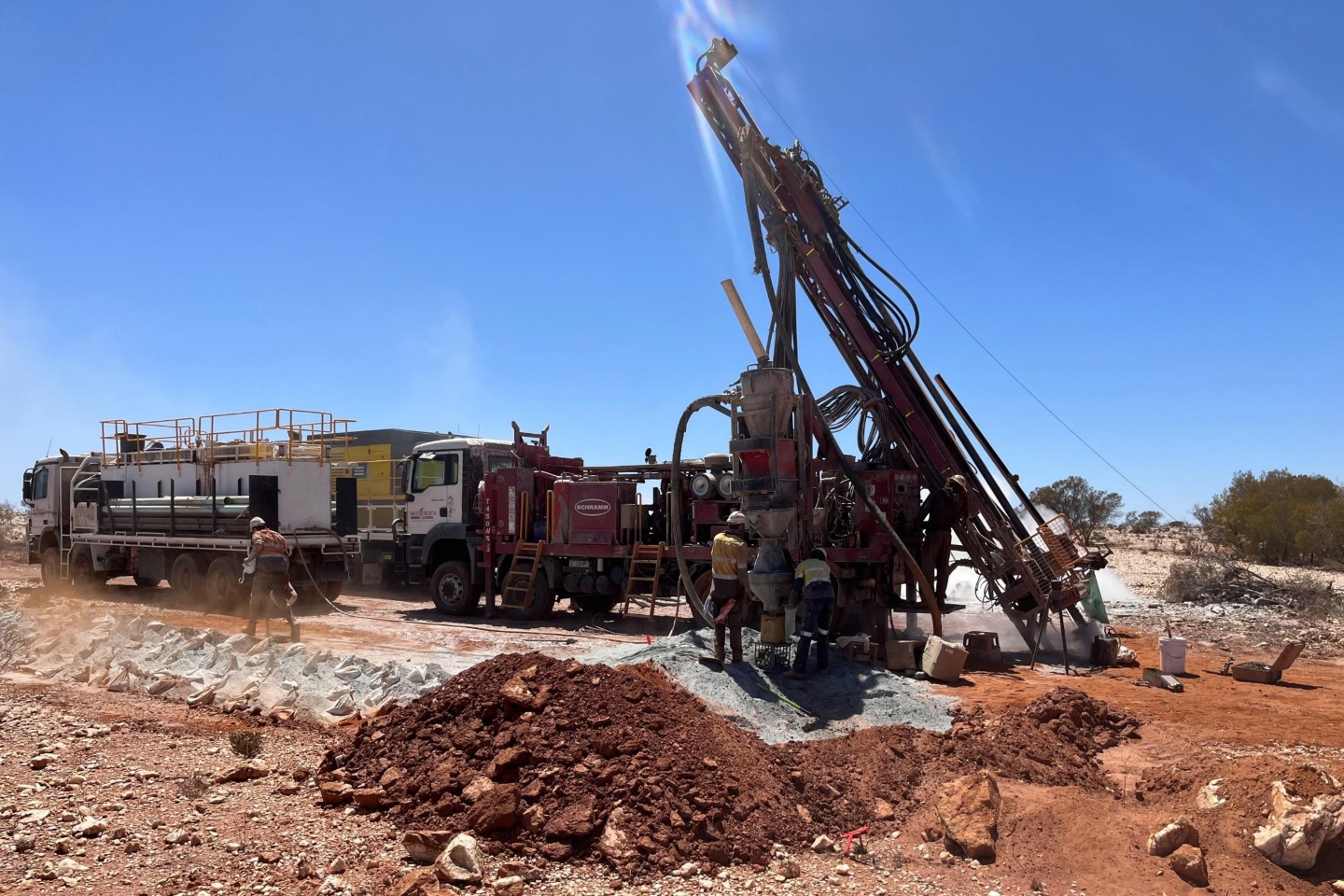
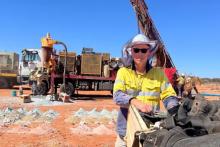
Augustus Minerals is set to fire up a reverse circulation (RC) drilling program at its Music Well gold project in Western Australia’s fabled Leonora gold district. The campaign is designed to test a new geological interpretation at its Clifton East prospect, which will include breaking ground for the first time at its high-grade St Patrick’s Well target.
The company says the rig is mobilising to the site, 35 kilometres north of Leonora, to begin a campaign it hopes could significantly advance its understanding of the project’s mineralisation. The timing couldn't be better, with the price of gold continuing to trade near record territory and corporate interest in WA gold assets remaining strong.
The company's latest round of drilling at the Clifton East prospect is based on a refined geological model, following recent diamond drilling results. The new findings have led management to believe higher-grade gold may be hosted in southeast-dipping pyritic quartz veins. This is a crucial detail, as previous RC drilling might have been oriented parallel to those key structures, potentially missing the best of the mineralisation.
The upcoming RC drilling will be oriented towards the northwest, which effectively “scissor” its previous drill holes to intersect the newly-interpreted southeast-dipping veins at a better angle. The company hopes this new approach will uncover multiple higher-grade zones similar to a previous intersection of 1 metre at 19.5 grams per tonne gold.
"Scissoring" drill holes refers to the common practice of drilling intersecting or angled fans of holes from different and often opposing site setups or directions when targeting a sub-surface geological body. The objectives include determining true structural orientation, accurately probing for or defining irregular boundaries and resolution of spatial data bias. The method can help clarify complex geometry, structural controls and true thickness when vertical or parallel drilling from a single orientation proves inadequate.
Augustus' earlier RC drilling at Clifton East has already delivered broad zones of shallow gold mineralisation, including 11m at 2.41 grams per tonne (g/t) gold from 32m, 34m at 0.83g/t gold from 38m and 8m at 3.27g/t gold from 72m in separate holes.
While the drill bit is engaged at Clifton East, Augustus will also sink the first-ever drill holes into its St Patrick’s Well prospect, 11.3km west of Clifton East. The target sits adjacent to the same major shear corridor that hosts the Clifton East mineralisation and Northern Star Resources' Celtic gold mine, northwest of St Patrick's Well.
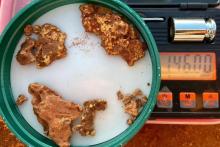
St Patrick’s Well has already delivered a string of impressive high-grade gold assays from surface rock chip sampling over a 600-metre strike length. Notable results include 30.4 g/t, 21.7 g/t and 20.4 g/t gold, making it a compelling walk-up drill target.
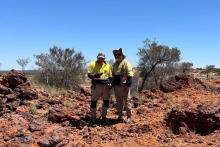
Augustus Minerals general manager of exploration Andrew Ford said: “The RC rig is mobilising this week to Music Well, with continued drilling at Clifton East as well as drilling the first RC holes at the promising St Patrick’s Well prospect. The Clifton East drilling will test the frequency of quartz-pyrite veins that dip to the SE, an orientation not effectively tested by the previous drilling orientation.”
Augustus' Music Well project covers a commanding 1242-square-kilometre tenement package in the heart of the Leonora-Laverton greenstone belt, a region endowed with more than 28 million ounces of gold. The project abuts active mining operations, including Northern Star’s Darlot and Thunderbox gold mines and Genesis Minerals’ King of the Hills mine.
The company's geos previously noted geological and geochemical similarities between its Clifton East prospect and the 1.4-million-ounce Golden Cities group of deposits - historically known as the Woodcutters goldfield and often referred to as one of the largest granite-hosted Archaean gold systems in Australia. The deposits are hosted within a sanukitoid-type mafic granitoid, a prospective rock type that the Geological Survey of WA (GSWA) has also identified at Music Well.
Golden Cities is owned and operated by Norton Gold Fields, a fully owned subsidiary of the Chinese mining conglomerate Zijin Mining Group. The gold camp operates as part of Norton's broader Paddington operations, which feeds ore into the nearby Paddington processing plant.
In other work, assays from Augustus' recently completed first diamond hole at Clifton East are expected within the next four weeks. The results from the planned two-hole program are expected to provide critical structural information to guide ongoing work.
With the drill rig mobilising this week, Augustus is poised for a busy period of exploration. The upcoming RC campaign will test the company's new theory at Clifton East and provide the first look at what lies beneath the high-grade surface samples at St Patrick’s Well.
Given the extensive gold mineralisation in the immediate locality and the company's encouraging high grade gold results to date, the next round of results from the RC and diamond drilling will likely be keenly awaited by market watchers.
Is your ASX-listed company doing something interesting? Contact: matt.birney@businessnews.com.au


 By Doug Bright