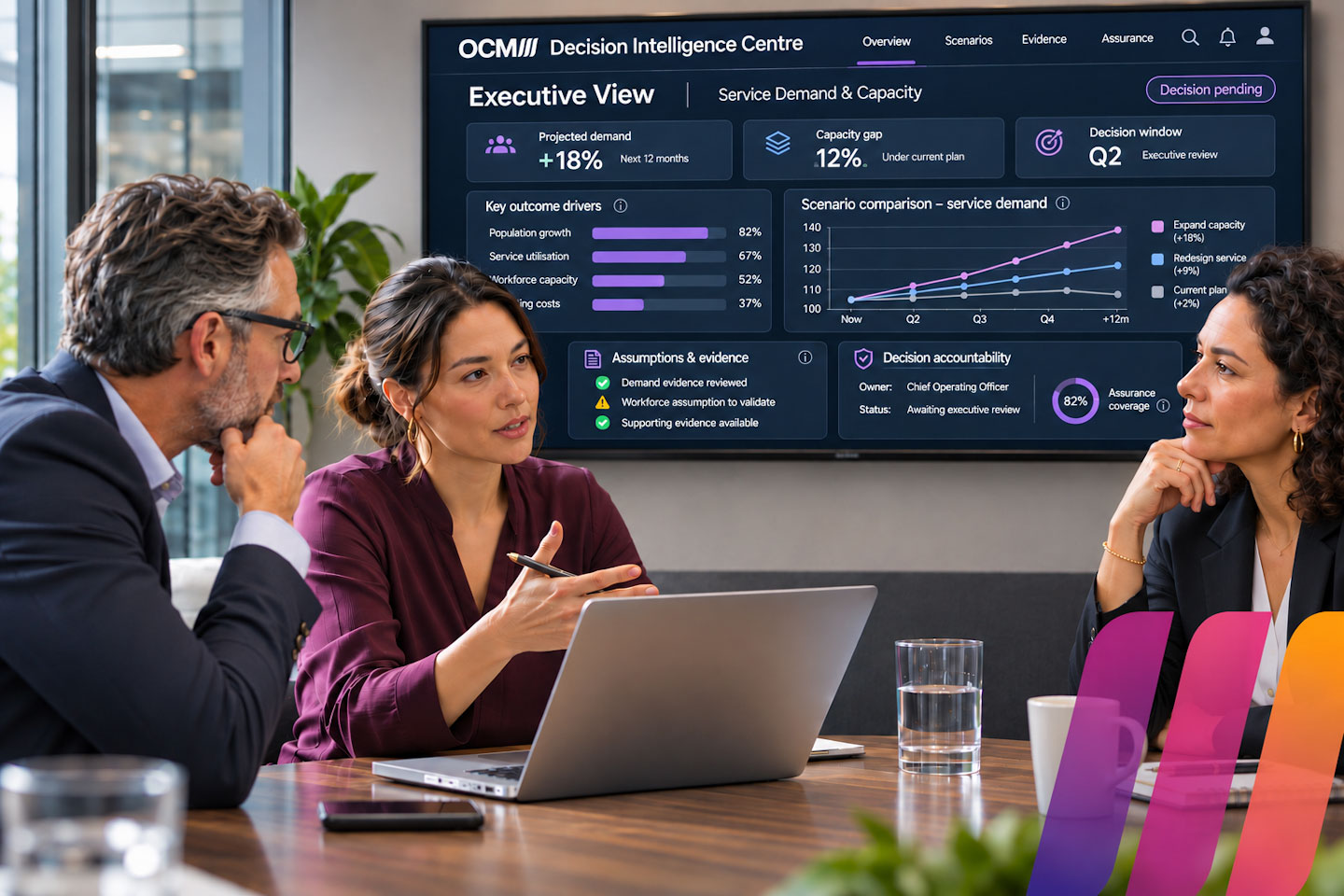
Why organisations need to move beyond AI governance to ensure the decisions AI influences are reliable, explainable and accountable.
Artificial intelligence is no longer just helping organisations produce content or find information. It is influencing how they allocate resources, interpret policy, deliver services and make consequential decisions.
Imagine a policy assistant that provides a confident answer, complete with references, but draws on superseded guidance. Or a forecasting model that predicts rising demand for a public service without showing which assumptions underpin the prediction.
Both technologies may be useful. Neither necessarily provides enough evidence to justify acting on its output.
The challenge is knowing when to rely on AI, how much authority to give it and how to recognise when trust is misplaced.
Trust needs evidence, not confidence
Trustworthiness and our willingness to rely on AI are not the same thing.
We can trust confident but unreliable AI too much, or underuse reliable AI. Both carry costs.
The question is: reliable for which purpose, under what conditions and with what consequences if wrong?
Governance establishes the rules.
Assurance demonstrates they work.
Governance defines how AI may be used and who is responsible. But policies and controls cannot prove an application operates as intended.
Assurance tests whether outputs are evidence-based, data or models introduce bias, safeguards work and performance remains acceptable over time. Accountability means organisations and decision-makers remain answerable for outcomes.
Assurance should be proportionate to the decision. An assistant drafting routine correspondence does not warrant the same scrutiny as a system informing funding allocations or access to essential services.
Increasingly, assurance must be designed into the system, not added after deployment.
Can we trust what AI knows?
Consider the policy assistant. The problem may have little to do with its ability to search or summarise. The organisation may be unable to reliably distinguish current, approved knowledge from outdated or contradictory information.
A citation shows where an answer came from. It does not prove the source is authoritative.
At OCM, we have developed GRAIL (Governance Retrieval Augmented Intelligence Layer) as part of our work in AI Governance. It uses AI to identify knowledge and relationships within organisational information, preserves links to supporting evidence and enables subject matter experts to review and approve what becomes part of a governed knowledge base.
The aim is not to ask AI to decide what should be trusted. It is to give AI a more reliable, traceable foundation.
Can we explain the decisions AI influences?
GRAIL addresses whether AI relies on authoritative knowledge. Decision Intelligence focuses on the assumptions and relationships behind its predictions and recommendations.
A forecast of rising service demand is valuable. But leaders also need to understand what drives demand, which factors can be influenced and the trade-offs between choices.
OCM's Decision Intelligence approach begins with the desired outcome. We then make the decisions, assumptions, causal relationships and evidence influencing that outcome visible and open to challenge.
This does not remove uncertainty or guarantee a correct prediction. It helps decision-makers distinguish what is known from what is assumed, and identify what needs testing before acting.
Accountability cannot be outsourced to AI
Consider an AI tool that flags possible cancers on medical scans. Its developer must validate performance and disclose limitations. The hospital must decide when it is suitable, establish safeguards and monitor its use. Clinicians remain responsible for interpreting findings and making care decisions.
The same applies across business: providers validate capabilities, organisations govern deployment and decision-makers remain accountable. AI agents raise the stakes: an incorrect recommendation can be challenged before action, but an agent may already have changed a record, sent a notice or committed funds. Clear authority, traceable actions and ways to intervene become essential.
Assurance enables responsible innovation
Assurance should not slow innovation. It should help organisations understand where AI can be relied upon, what safeguards are necessary and when human judgement must remain decisive.
For leaders, four questions offer a starting point:
- Which decisions is AI influencing, and what are the consequences if it gets them wrong?
- Have we tested accuracy, reliability and bias, including unfair outcomes for particular groups?
- Who can challenge recommendations, identify failures and intervene when necessary?
- How will we detect changes in information, assumptions or performance, and respond?
OCM helps organisations address these challenges through AI governance, governed knowledge and Decision Intelligence. For organisations looking to understand where to begin, our AI Organisational Impact Scan provides a practical starting point to identify opportunities, understand potential exposure and prioritise areas requiring closer examination.
The question is not whether AI can influence your decisions. It is whether you can demonstrate why that influence deserves your trust.