Marking 15 years, Variety WA’s Motor Mouth Camp is reshaping how children with complex communication needs connect with the world. The program goes beyond traditional therapy, supporting not only children who use augmentative and alternative communication (AAC), but also the families and carers around them.

In Western Australia, where conversations around inclusion, disability support and equitable access are increasingly shaping policy and community priorities, a quiet but powerful program has been building something far more fundamental: the ability for children to be heard.
For 15 years, Motor Mouth Camp, delivered by Variety ,the Children’s Charity WA, has been doing precisely that, creating a space where children with complex communication needs are not only supported, but understood.
At its core, the program addresses a challenge that is often overlooked in mainstream discourse. For children who rely on augmentative and alternative communication (AAC) whether through devices, eye-gaze technology or other supports, communication is not simply about speech. It is about autonomy, identity and connection.
Over the past decade and a half, nearly 200 Western Australian children and their families have participated in the three-day camp, supported by more than 350 volunteers who have collectively contributed over 8,500 hours. These numbers speak to scale, but they only partially capture the impact.
Because what Motor Mouth Camp delivers is not therapy in the traditional sense. It is immersion.
Chief Executive Officer of Variety WA, Chris Chatterton, frames it simply: communication is fundamental to a child’s independence and their ability to engage with the world. Yet for many families, the journey to that independence is complex, often isolating, and rarely linear.
This is where the model distinguishes itself. Rather than focusing solely on the child, the camp is designed around the ecosystem that surrounds them, parents, siblings and carers, recognising that communication is never a one-way process. It requires skilled partners, shared understanding and, critically confidence.
That confidence is built not in clinical rooms, but in moments that mirror everyday life: sharing meals, making friends, participating in outdoor activities. The environment is deliberately relaxed, allowing children to practice communication in contexts that matter and not prescribed exercises, but lived experiences.
For Kelly Savage, who co-founded and continues to coordinate the program, the vision was always about connection. Children who use AAC, she notes, have just as much to say as any other child. The challenge is ensuring the world is equipped to listen.
And increasingly, that world extends beyond the camp itself.
As demand grows, the program is expanding, with an additional camp introduced in April 2026 alongside the longstanding October event. This growth, supported by philanthropic backing including the Morning Sunshine Foundation, reflects both the program’s success and the scale of unmet need across the state.
But the most compelling measure of impact lies with the families. For Keeley, a young girl with a sharp sense of humour and determination, the shift was not just technical it was transformational. Her mother, Lee-Ann, describes a change in perspective that reframed everything: understanding AAC not as a substitute for speech, but as her daughter’s primary language.
That distinction matters. It moves communication from being seen as a limitation to being recognised as a different, equally valid mode of expression.
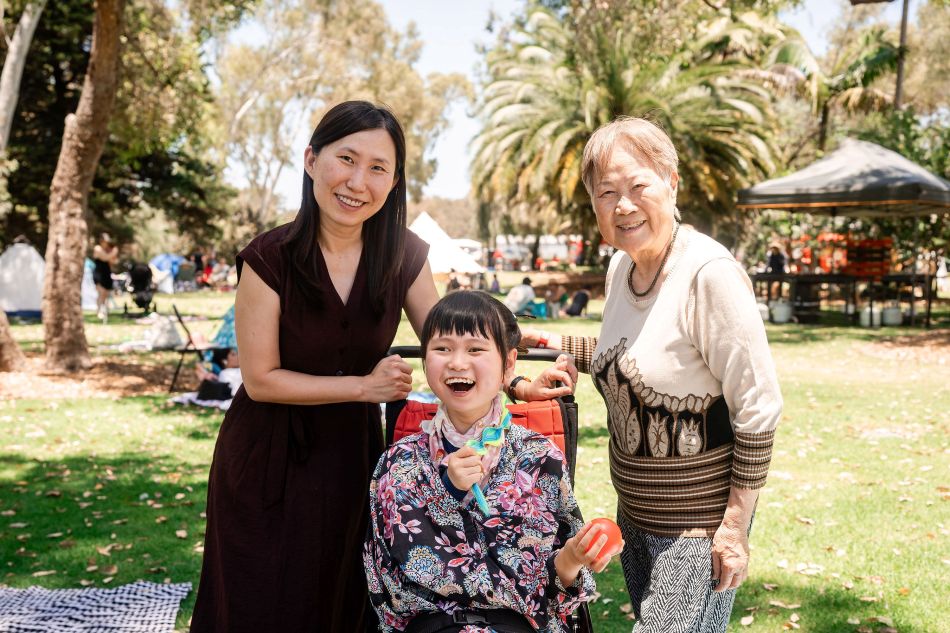
For Zhiqing’s family, the breakthrough came in the form of confidence, not just for the child, but for her mother, Lizzy, who began to see how consistent use of AAC in everyday settings could unlock new levels of engagement. The most telling moment was not a technical milestone, but an emotional one: hearing her daughter laugh freely again.
And for Isaac, a young boy navigating a rare neurodevelopmental disorder, the value of the camp was found in community. Surrounded by others who understood the patience required to build communication skills, both he and his family gained something often absent from the broader experience, a sense that they were not alone.
These stories underscore a broader truth that policymakers and service providers are increasingly grappling with: access is not just about infrastructure or funding, but about capability and the ability for individuals to participate meaningfully in society.
Programs like Motor Mouth Camp sit at the intersection of health, education and social inclusion. They do not replace formal services, but they complement them in ways that are often more immediate and tangible for families.
In a policy environment where outcomes are frequently measured in metrics and milestones, the program offers a different lens, one that prioritises human connection, lived experience and the incremental but profound gains that come from being understood.
For Western Australia, the challenge now is not whether such programs are valuable, but how they can be sustained and scaled.
Because communication, as this program has demonstrated over 15 years, is more than a skill. It is a gateway to independence, to relationships, and to the simple but powerful act of being heard.